
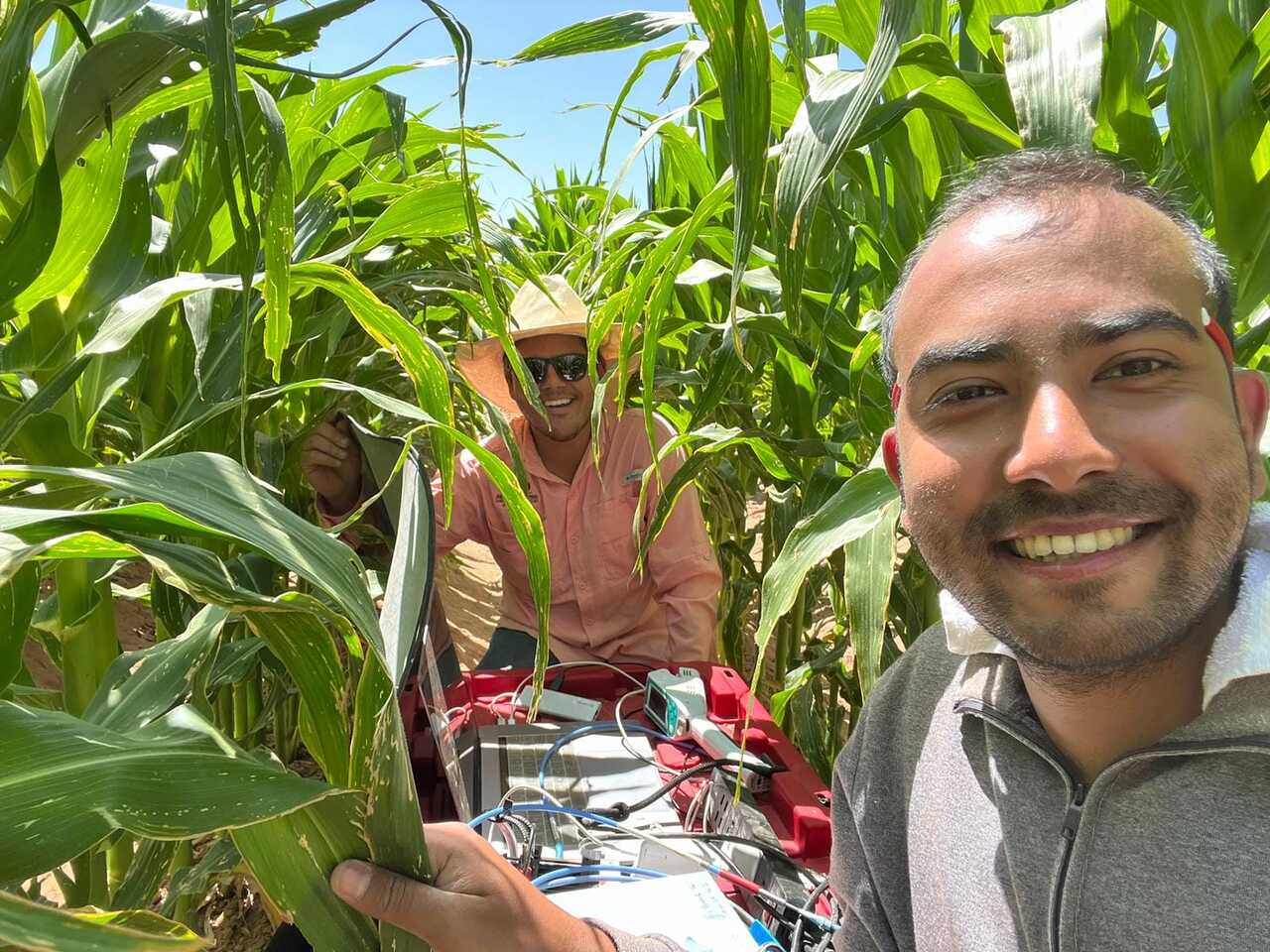

A pathbreaking research, which was published in November in a frontline global journal, has discovered, with a key contribution from a Kolkata-born young scientist, a hitherto unknown mechanism that plants utilise to carry out water and gaseous exchanges.
Sabyasachi Sen, 28,, is a senior doctoral researcher scholar at Cornell University, US. The scientist, who studied in La Martiniere for Boys, Kolkata, and earned his B-Tech degree in mechanical engineering from IIT Kharagpur, is part of the research that is being expected to radically transform the long-held understanding of how plants exchange water and gases. The research, in which other scientists from his university and other major global institutions, such as Harvard University, US, Cambridge University, UK , and University of Illinois Urbana-Champaign, US, participated, is being considered critical in the era of climate change.
The discovery, published on November 19 in ‘PNAS’, ‘Proceedings of the National Academy of Sciences’, one of the most-cited and comprehensive multidisciplinary scientific journals in the world, has been based on studies on several plant species, but the most robust evidence came from maize.
“Cornell researchers have discovered a previously unknown way plants regulate water that is so fundamental it may change plant biology textbooks – and open the door to breeding more drought-tolerant crops,” reads a communication from Cornell University on November 20.
“What we’ve discovered occurs within the last 100 microns of the long path that water follows during transpiration from the root to the site where it evaporates inside the leaves,” said Abraham D. Stroock, a professor in the Smith School of Chemical and Biomolecular Engineering in Cornell Engineering and Sen’s guide.
Surprised by what we found
“Leaves exchange water and carbon dioxide with the atmosphere, shaping both the water and carbon cycles that sustain life, and for decades, scientists believed that this delicate exchange was controlled solely by stomata,” explained Sen, who has been pursuing the research from 2020. Stomata are the microscopic pores on the surface of leaves that open and close to balance the plant’s need to take in carbon dioxide for photosynthesis.
“…New study describes for the first time how water regulation also occurs under the leaf’s surface, at the membranes of photosynthesising cells. The result was made possible thanks to AquaDust, a Cornell-developed nanoscale sensor that measures water status inside leaves,” reads the Cornell University communique.
Sen elaborated further. “Our research challenged the long-held view. Using a new fluorescent technique developed at Cornell University, we peered inside living leaves to observe in real time how water moves through leaf tissues. What we found surprised us; the living cells within the leaf can dramatically reduce their internal conductance to water, effectively tightening the plant’s internal plumbing, without reducing the conductance to the carbon dioxide,” explained Sen during a long chat from the United States.
Previously unknown mechanism
“The conventional assumption is that stomatal conductance…dominates the regulation of water and carbon dioxide fluxes between leaves and the atmosphere….This work opens paths of inquiry into the molecular basis and functional consequences of nonstomatal regulation of transpiration,” reads the published paper, a copy of which is with the correspondent.
The researcher pointed out that “this means plants can conserve more water while maintaining their ability to take in carbon dioxide to make food”. “ …In other words, we uncovered a previously unknown mechanism that improves how efficiently plants use water, a vital trait as the world faces growing drought and water scarcity,” Sen clarified.
Critical in this climate epoch
The discovery, apart from adding a landmark chapter to global plant research, stands crucial in the context of its impact on global environment and climate change.
“The twenty-first century confronts agriculture with an important constraint; producing more food with less water in an era of intensifying drought catered by rising global warming. Crop production consumes nearly 70 per cent of global freshwater withdrawals, meaning that even modest gains in water conservation, as possible through this secondary method, can yield significant benefits for food security, ecosystem resilience, and long-term sustainability,” Sen said.
“Through photosynthesis, vegetation acts as planetary regulators, but this regulation comes at a cost,” he added. “To assimilate carbon dioxide, plants must open stomata through which water is unavoidably lost. This fundamental trade-off between carbon gain and water loss forces plants to balance productivity against dehydration. Open stomata enable growth but accelerate water loss. Closed stomata conserve water but suppress carbon assimilation,” said the researcher.
The scientist further explained how plants counter this uneasy trade-off as highlighted by the discovery. “Our discovery of non-stomatal control of water loss fundamentally alters this paradigm. By decoupling water conservation from carbon assimilation this mechanism enables plants to retain more water in soils and landscapes without sacrificing photosynthetic performance.”
A game changer for India?
According to Sen and his team members, the finding can be seen as a game-changer, especially in watershed sustainability, climate regulation, and enhancing resilience of terrestrial ecosystems, particularly the agricultural sector within dry areas. “We have found that this phenomenon is more pronounced in water-deficient areas; hence it is clearly a climate adaptation,” said the scientist.
A rapidly warming India, where nearly two-thirds of the 1.4 billion population depends on agriculture and allied activities, can be a major beneficiary of the research findings.
“The study is pathbreaking as it reveals a new layer of internal control over water loss in leaves, beyond the traditional understanding of stomata are the sole responsible. This improved understanding could help scientists in identifying and developing crops which are better suited in water-scares and hotter regions like India … which will be a common phenomenon with Global Warming,” said Anshuman Das , an agroecologist with Welthungerhilfe, one of Germany’s largest non-denominational, non-profit, and independent NGO that fights global hunger and poverty. Anupam Pal, an agriculture expert and retired state government scientist, agreed that the discovery has brought a new insight and may be useful for promoting crops in India’s dry weather, but also pointed out that the country also has several plants which are adapted to dry region and its important to focus on them.