
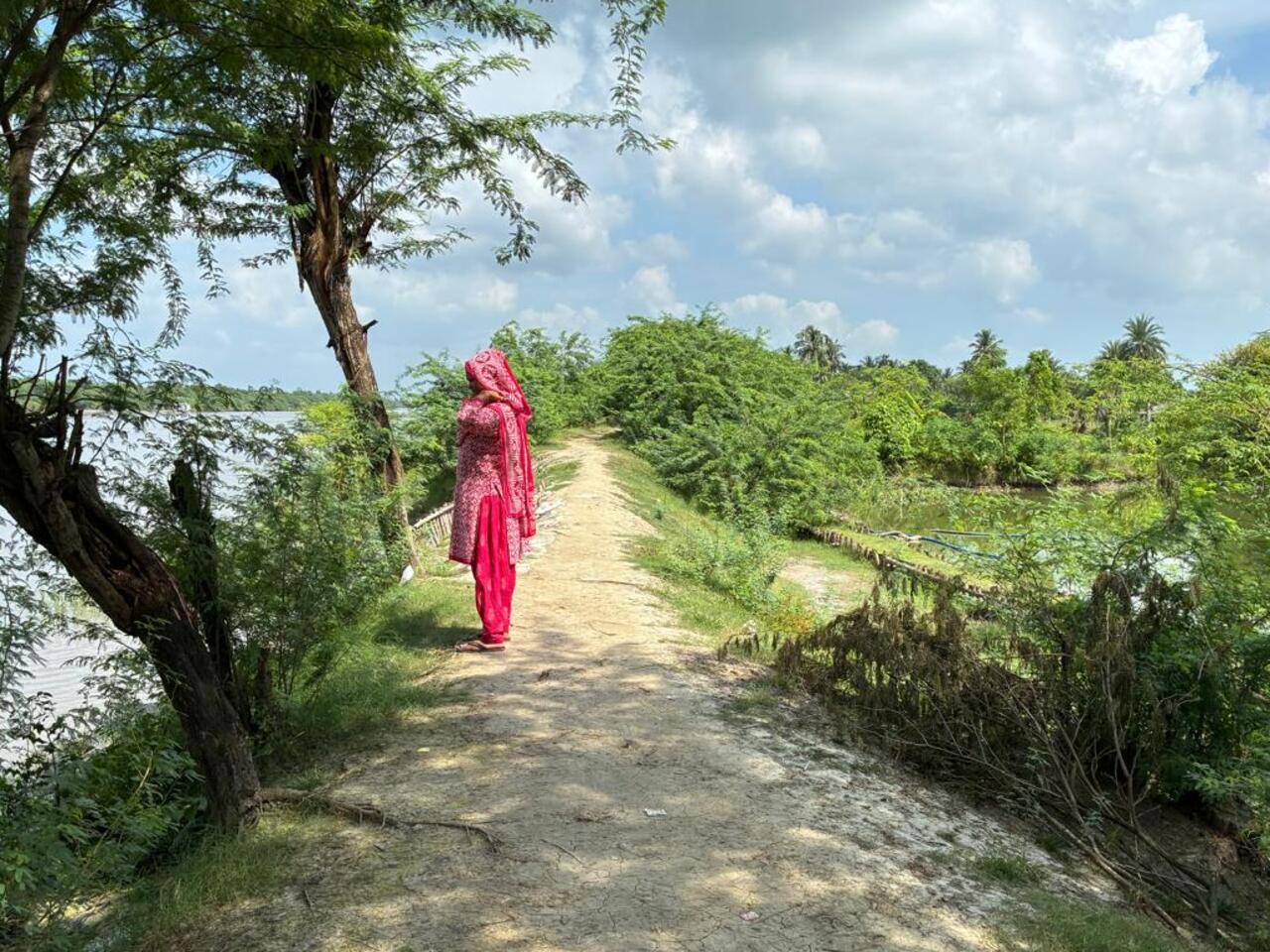

A trafficking survivor, who is now an anti-trafficking activist, has played a key role in rescuing a school student who had gone missing from her home in Basanti block in Sundarban, located on the southern fringe of the state of West Bengal in India. For Rubina Khan (name changed), 26, the activist, the episode brought a strange sense of déjà vu, the circumstances 12 years ago in which she herself was trafficked having been strikingly similar.
On the late evening of September 10, Rubina accompanied a police team to rescue the missing girl, Rubina’s neighbour’s daughter, from Chandanehwar in Bhangar, about 50km from the Basanti village. “She is just 12 years and 9 months old,” says Rubina of the girl, a student of Class VI.
High trafficking rate
On September 9, the girl had left for school in the morning. When she did not return home after 4pm, Rubina, who works with a non-profit for anti-trafficking work, scanned the area with the girl’s family and neighbours but could not find any trace of the girl.
Rubina helped the family to lodge an FIR at Basanti police station. Her neighbourhood and adjoining areas in Basanti are among the most trafficking-prone areas in Bengal, if not the country. Rubina’s house and her neighbour’s are a few feet away from the embankment on a stream that connects Matla and Bidhyadhari, two major rivers of Sundarban.
A huge number of trafficking cases has always been reported from the area. Last year, Garambose Gram Bikash Kendra (GGBK), the NGO Rubina works with, received reports of about 10 trafficking cases from Basanti and an adjoining block in Sundarban, Canning.
Flooding causes trafficking
The village gets flooded not only during cyclones, but from high tides as well. Cyclones, which have become almost annual events in Sundarban — Bulbul in 2019, Amphan in 2020, Yaas in 2021 and Remal 2024 — all have impacted the area, with Amphan and Yaas having caused massive devastation. But the excessive rainfall in the last two months has also proved quite damaging; and flooded the neighbourhood for about a month.
The fragile environment combines with severe poverty to make the traditional livelihood choices difficult, and often children are lured with hopes of a better future in a big city, or are just picked up by traffickers, who take advantage of the vulnerability of the families. The poorer and larger a family is, the greater the chance that a child will be targeted.
Search for the minor girl
Rubina and the others came to know that the missing girl did not go to school in September 9. “Next morning, a van driver told us that he had seen the girl in school uniform going away from the village with a male relative from her mother’s side, who used to visit the family,” says Rubina.
The relative was picked up by the police and he told the police that had met the girl when she was going to school and had taken her to a relative’s place in Chandaneshwar in Bhangor. “He had asked her to go with him to Mumbai where he would get her a well-paying job, the school student said,” Rubina stated. After taking the girl to Bhangor, the man, Salim Shaikh, in his late 20s, had come back to Basanti to the girl’s home and had even joined the search for her, to allay suspicion.
The girl comes from a very poor family. Her father works sporadically. Her mother stays at home. The girl has three siblings. Shaikh, who had been married more than once before, had been coming to the girl’s house and giving her gifts.
The girl stood dazed, alone at midnight
On the late evening of September 10, with officials from Basanti police station and with the support of GGBK, Rubina left for Bhangor. Shaikh had directed them to the Bhangor address. “We reached the house at midnight. The residents of the house had left, possibly on being informed that the police were coming, locking it from outside. The girl was left standing in front of the house, still in school uniform, in a daze,” says Rubina. After being rescued, the girl was sent to a shelter for girls for the time being. Shaikh has been arrested and will be produced in court.
Shamiul Hosain, investigating officer at Basanti Police Station, claimed that prima facie the case looks like that of kidnapping; claiming a “love affair” between Shaikh and the girl who had gone missing. Some of the provisions of the laws in Bharatiya Nyay Sanhita on kidnapping include trafficking as well.
The girl’s parents refuse to believe the police claim of an “love affair”. Rubina believes that the girl could have been trafficked to Mumbai.
A déjà vu moment
For Rubina, the incident was like revisiting her past. She was also 12 when she had been trafficked, a student of Class V, and she was going to school. A bright girl, she had wanted to study.
Unlike this girl, however, she had been picked up by her traffickers and taken to a brothel in a city in western India. She came back on her own, successfully planning her escape with a friend. “When I went to the police after my return, at first they told me, too, that I had run away with someone with whom I had a ‘love affair’,” Rubina laughs.
Not much has changed in decades here in Sundarban, neither in the social and economic conditions, nor in the perception of women.
Over the years, Rubina has become a confident activist. “I am not afraid, traffickers are afraid of me now,” she announces.