
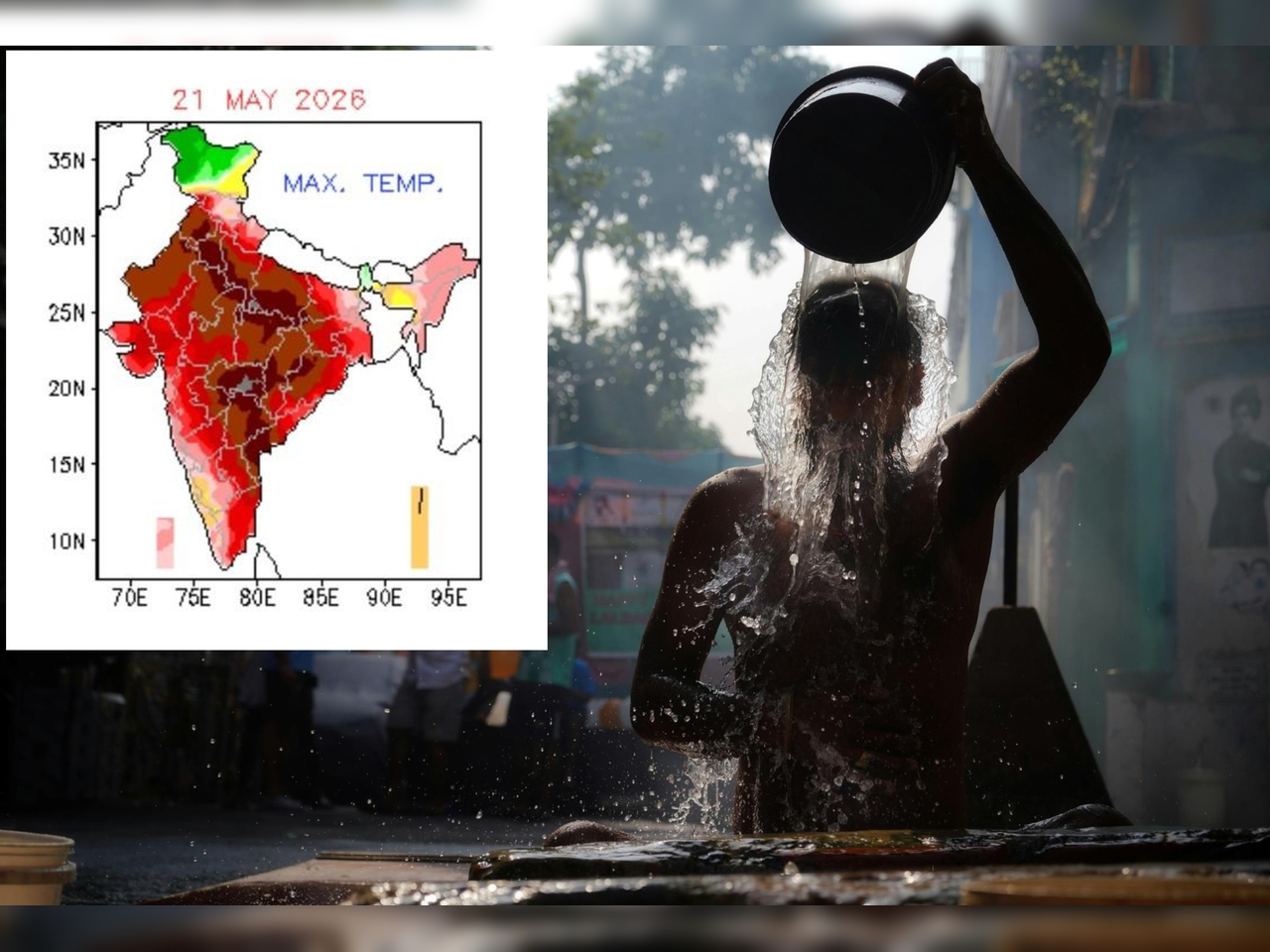
Summer in India has hardly felt so hot. Several parts of the country are experiencing temperatures well beyond 45°C, with severe heatwave conditions prevailing in the last few days. Experts point out that the developing El Niño is severely exacerbating the heat quotient in the country.
No surprise, the heat map shared by the Indian Meteorological Department (IMD) for May 21 varied between very dark and dark shades of red; the more the heat, the darker the shade.
IMD points out that the “maximum temperatures (as of 21.05.2026) … were in the range of 40-47°C over northwest, west, central & adjoining east, and north Peninsular and adjoining southeast coastal India. The highest maximum temperature of 47.6°C was reported at Banda (Uttar Pradesh). ”.
“Heat is India’s burning issue. Searing temperatures are scorching cities, forcing workers to lay down tools and putting many people, particularly the old, the young, and the sick, in deadly peril,” said Simon Stiell, executive secretary to UNFCCC.
An analysis by a New Delhi-based environment research organization, Climate Trends, looks at the several factors leading to the current extreme heat. The analysis considers observations and reports from several organizations and experts.
IMD flashes a heat alert
“Yesterday, maximum temperatures were markedly above normal (> 5.1°C) at isolated places over Coastal Andhra Pradesh & Yanam and appreciably above normal (3.1°C to 5.0°C) at a few places over Odisha and Vidarbha, and at isolated places over Uttarakhand, Punjab, Delhi, East Uttar Pradesh, Jharkhand, Assam, Tamil Nadu, Puducherry & Karaikal,” shared IMD on May 22.
“Night Temperatures/Minimum temperatures (as of 22-05-2026) were markedly above normal (> 5.1°C) at isolated places over Vidarbha; appreciably above normal (3.1°C to 5.0°C) at isolated places over Himachal Pradesh, Uttarakhand, Punjab, Bihar, Odisha, Gangetic West Bengal, Coastal Andhra Pradesh & Yanam; above normal (1.6°C to 3.0°C) at isolated places over Jammu-Kashmir, Haryana, Chandigarh & Delhi, Uttar Pradesh, north Rajasthan, Jharkhand, Sub-Himalayan West Bengal & Sikkim, Saurashtra & Kutch, and Madhya Maharashtra.
Northwesterly wind factor
The ongoing weather conditions are due to the flow of hot northwesterly winds from the desert region across Rajasthan, Punjab, and Haryana to the central India, points out Climate Trends.
“In the absence of any weather system over the Indian mainland, hot north-westerly winds from the desert of the adjoining Sindh region of Pakistan and Rajasthan are penetrating deep into the country. The uninterrupted flow of these winds for the last three to four days has been pushing the mercury, resulting in heatwave to severe heatwave conditions,” says Mahesh Palawat, Vice President-Meteorology and Climate Change, Skymet Weather, in the Climate Trends report.
“When the days are hot and there are no pre-monsoon activities in the evening, these high temperatures are also reflected in higher nighttime temperatures. The ongoing weather conditions are considered to be the normal seasonal pattern during May, which is also the peak of the summer season. We would only see some respite with the arrival of the western disturbance, which would then alter the wind pattern, bringing in much-needed relief,” Palawat adds.
Night temperatures in certain places have reached 30°C or more. World Health Organization (WHO) Housing and Health Guidelines say that indoor air temperatures should not consistently exceed 24°C to prevent heat-related health risks, cardiovascular strain, and sleep disturbance, Climate Trends points out.
Increasing frequency and duration of heatwaves
The core heatwave zone (CHZ) is experiencing the most heat. The CHZ covers the states of Punjab, Himachal Pradesh, Uttarakhand, Delhi, Haryana, Rajasthan, Uttar Pradesh, Gujarat, Madhya Pradesh, Chhattisgarh, Bihar, Jharkhand, West Bengal, Odisha, and Telangana, and the meteorological subdivisions of Maharashtra-Marathwada, Vidarbha, Madhya Maharashtra, and coastal Andhra Pradesh.
“According to a study by the Indian Meteorological Department (IMD), there is an increasing trend of 0.1 days/decade in the frequency of heatwaves averaged over the core heatwave zone (CHZ) during 1961-2020. Also, the total duration of heatwaves averaged over the CHZ has increased by 0.44 days per decade, with the maximum duration showing an increasing trend of 0.55 days per decade,” says Climate Trends.
Multiple factors acting in tandem
Heatwaves are not new to India. What is making them more intense is the changing background climate, says Climate Trends. “From heat-trapping cities and rising humidity to dry soils and climate change-driven warming, multiple factors are now converging to make extreme heat deadlier and more widespread than ever before,” it adds.
It has enumerated the different factors:
1. Rising background temperatures:. For India, the annual mean land surface air temperature till November 2025 was +0.29°C above the 1991-2020 average and was the 7th warmest since 1901. The annual maximum and minimum temperatures for the country were +0.10°C and +0.49°C, respectively, above the 1991-2020 average till November 2025.
2. Hotter nights: When nighttime temperatures stay high, people, crops, and infrastructure get less recovery time. This often makes heat stress much more dangerous than daytime heat alone. The all-India average nighttime temperature shows an estimated rise of about 0.21°C per decade over 2010–2024. Of the 36 states and union territories, 35 show warming, according to data by CEEW, a think tank and research body.
3. Humidity and heat stress In many parts of India, high humidity makes the body less able to cool through sweating. The most intense combined heat-stress patterns are concentrated in coastal, tropical, and some densely populated inland states.
4. Urban heat island effects: Indian cities are increasingly functioning like heat traps, absorbing heat during the day and releasing it slowly at night, leaving millions exposed to prolonged thermal stress. Over the last 3–4 decades, urbanization in several parts of India has led to notable changes in the local atmosphere, accompanied by an increase in surface temperature relative to the adjoining rural regions.
5. Large-scale climate variability: Seasonal circulation patterns, delayed pre-monsoon relief, and sometimes El Niño-related conditions can raise the likelihood or persistence of hot spells, though these operate on top of the longer-term warming trend.
6. Dry soils and rainfall deficits: When soil is dry, less solar energy goes into evaporation, and more goes into heating the air, which can amplify extreme heatwaves and prolonged hot conditions by creating positive feedback loops that make extreme heat more persistent.