
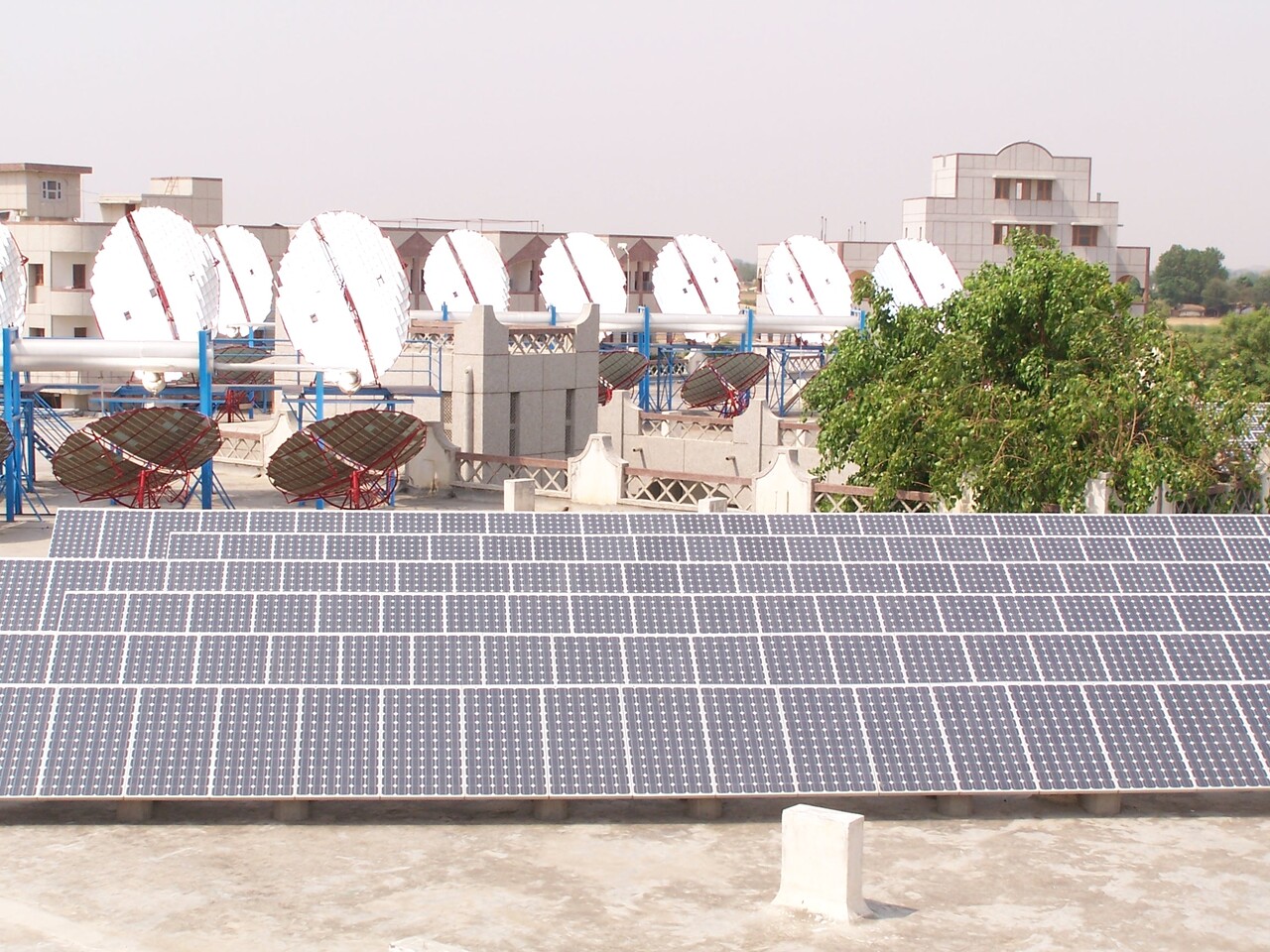
Solar power generation in India has increased 37% year-on-year in the first quarter of 2026-27, which makes it the fastest-growing major source of electricity generation in the country, according to a report by a global research organisation. At the same time, solar energy storage has begun to contribute to nighttime peak demand, now playing operational role in India’s power system.
The report by CREA (Centre for Research on Energy and Clean Air), based in Helsinki, has studied India’s solar energy map for the months April to June of 2026.
The private sector has played a significant role in boosting solar power in India.
Solar contributes one-fifth power during peak hours
The report, titled ‘Quarterly Energy Snapshot for India, Q1 2026-27’, points out that the peak electricity demand in India reached a record 271 GW on May 21, 2026, around 12% higher than the peak recorded during the first quarter in the previous year, which was 243 GW.
“During 61 of the 91 days in Q1 FY2026-27, the daily peak occurred during solar generation hours. Solar’s contribution of more than one-fifth of total generation during the system peak demonstrates its growing role in supporting India’s daytime electricity demand,” says th CREA report.
“Maharashtra recorded the highest state-level peak demand at 30 GW, followed by Uttar Pradesh (27 GW) and Gujarat (25 GW),” it adds.
Solar fastest growing in India
Even as the country registered a 12% higher demand compared to the 2025-2026 first quarter, its electricity generation increased by 9% year-on-year during the 2026-27 first quarter, reaching a record 524 BU.
“Solar remained the fastest-growing major source of electricity generation, increasing by 37% year-on-year, compared with 13% for nuclear, 10% for wind, and 9% for coal and lignite,” says the report. “Hydropower generation declined by 9% over the same period.”
Solar has been the driver behind India’s robust renewable energy growth. “Over the past three years, solar generation has more than doubled, increasing from 28 BU in Q1 FY2023-24 to 57 BU in Q1 FY2026-27,” says the report. The solar output in India reached a new daily record on May 11 with 696 MU generated.
“Solar accounted for 10.9% of India’s electricity generation, crossing the 10% share for the first time during the April-June quarter,” observes CREA.
Coal and lignite still dominate
Coal and lignite, however, remain in the topmost rung, by far, in India’s energy ladder, which has invited criticism on the global platform. Coal and lignite contributed 369 BU (around 70% of total generation). “However, coal generation grew by 9%, substantially slower than solar generation, reflecting the increasing contribution of renewable energy to India’s electricity mix,” says the report.
Combined non-fossil generation (renewables, hydropower and nuclear) reached a record 149 BU.
India’s energy storage pipeline continues to grow at a high rate. Energy storage is now playing a critical role in India’s power system. Storage contributed up to 4.1 GW during nighttime peak demand,, supplying around 1.1–1.8% of national electricity demand.
“As of May 2026, tenders for approximately 272 GWh of storage capacity have been issued, including 142 GWh of pumped storage projects (PSP) and 133 GWh of battery energy storage systems (BESS),” says the report. It mentions that about 7.5 GWh of India’s BESS is currently operational and around 3 GWh is expected to be commissioned by December 2026.
Private sector push
India’s solar march has been possible to a great extent due to the contribution of the private sector bolstered by government policy.
The private sector is estimated to account for approximately 90% or more utility-scale solar power generation capacity and new installations in India. Public sector undertakings, such as National Thermal Power Corporation (NTPC), still play a significant role, but private producers and developers are mainly driving the solar power growth.
Adani Green Energy, Tata Power and ReNew Power are in the forefront of the private sector’s engagement with solar power. Rooftop solar installations, both commercial and industrial, which represent roughly 70% to 80% of all rooftop deployments, are almost entirely driven by private companies.
Private entrepreneurs also own nearly all of India’s increasing domestic solar photovoltaic module manufacturing capacity, which went up to about roughly 172 GW.