
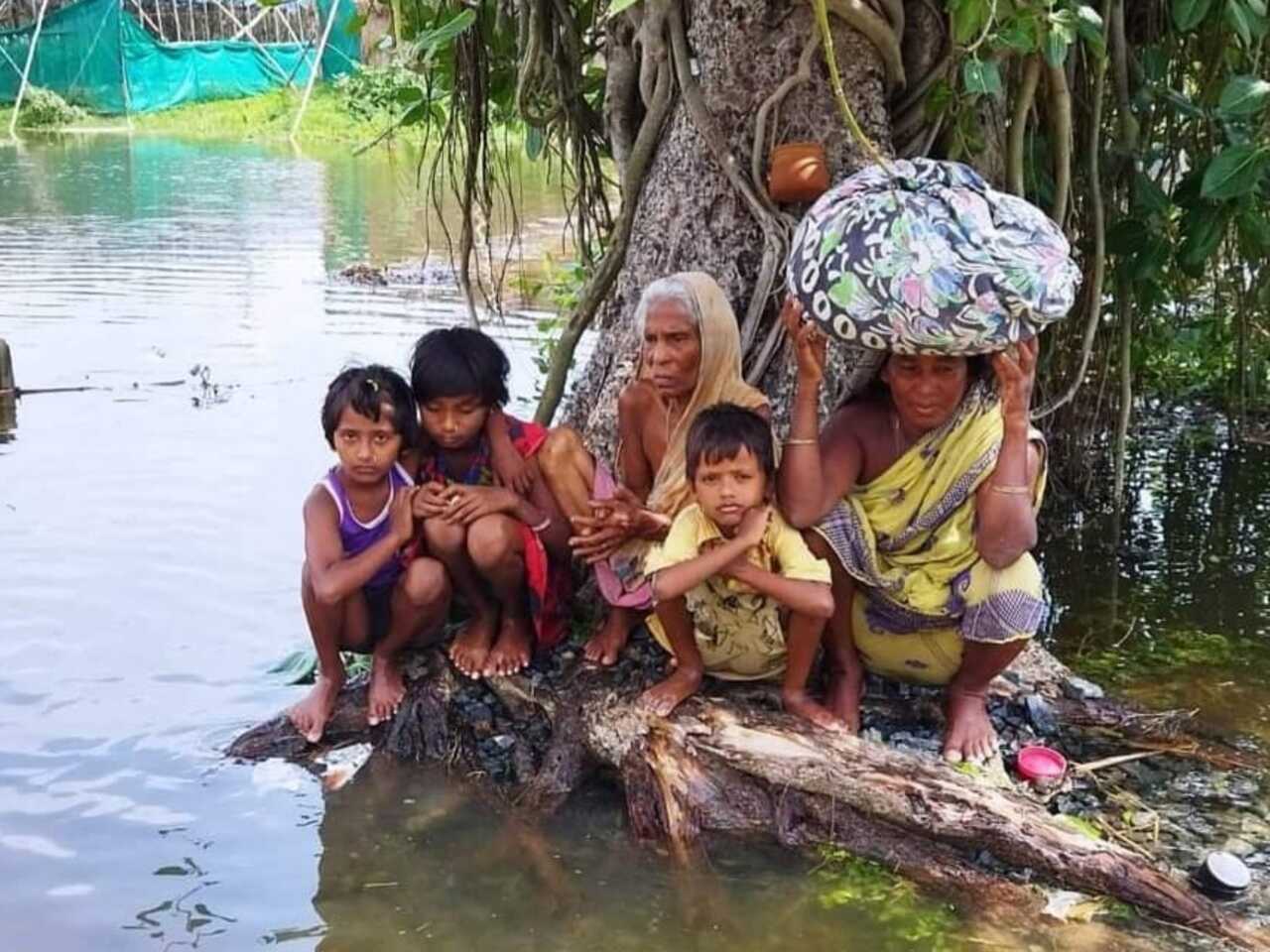
More than 200 organisations from across the world, representing millions, have written an open letter to the board of the Fund for Responding to Loss and Damage (FRLD), warning that without more contributions soon, the fund can dry up.
FRLD is an operating entity under the financial mechanism of the United Nations Framework Convention on Climate Change (UNFCCC) and addresses the growing needs of vulnerable communities in developing countries facing the irreversible impacts of climate change. The FRLD board recognises that fund support is critical to combat both economic and non-economic loss and damage.
Drying up the fund can hit least developed climate-vulnerable countries hardest, followed by developing countries that aspire to address climate change-inflicted loss and damage through fund support. India is one of the most globally vulnerable countries to climate change, given its Himalayan region in the north and more than 11,000 km of coastline. Sundarban, lying along the Bay of Bengal, is one of the most vulnerable regions globally with about 5 million people and a unique biodiversity that includes Royal Bengal Tigers.
The letter, co-ordinated by the Fill The Fund campaign and including platforms and organisations such as Climate Vulnerable Forum (CVF), WWF International (World Wildlife Fund) and other civil society organisations, asks the board to implement a human rights-based Resource Mobilization Strategy (RMS), which will be capable of delivering at least US $400 billion annually by 2035.
The FRLD was established in 2022 during the UN climate summit at Sharm El-Sheikh, Egypt, after more than 30 years of advocacy by activists and developing nations, and was hailed as a landmark victory for climate justice.
The SOS letter
The letter arrives days before the FRLD board’s eighth meeting in Livingstone, Zambia, in end-April, where critical decisions will be made about the FRLD’s start-up phase. The situation is threatening: if the developed countries do not deliver soon, the FRLD can run out of money completely by 2027.
The figures are bleak. Pledges to the FRLD add up to just US $822 million with merely US $448 million having been actually paid. That is less than 0.1 per cent of the $400 billion per year that is the requirement.
The letter asks the board to adopt an incremental, science-based approach: at least $50 billion every year from 2027, rising to $100 billion every year by 2031, and a minimum of $400 billion every year by 2035. It rules out debt-creating finance for developing countries.
According to FRLD board sources, as of March 15, 2026, a total of USD 822.06 million has been pledged to the FRLD, though the board has actually received USD 448.92 million till mid April. Since the Fund’s establishment at COP27 and the decision to operationalise it at COP28, the FRLD received pledges from 27 partners. Of these, 24 partners have signed contribution agreements and begun transferring their funding.
Rights-based plan urged
“We write to urge your support for the adoption of an ambitious, equitable, and human rights-based Resource Mobilisation Strategy for the Fund for Responding to Loss and Damage,” begins the letter, signatories to which include global, regional, national and sub-national organisations.
At COP30 in Brazil in 2025, the FLRD issued the first funding calls. The letter acknowledges the first calls for funding, saying these “requests under the start-up phase, under the Barbados Implementation Modalities (BIM), represent an essential first step towards delivering long-awaited support to countries and communities most affected by loss and damage.” But one first step is just not enough. A huge gap is opening up between the support available and the requirement.
“…the financial envelope initially allocated to this phase (US $250 million in grant support), as well as the total amount of funding pledged to date, remains far below the vast and rapidly increasing needs of developing countries and affected communities,” the letter says.
Legal obligation claimed
An analysis from the Loss and Damage Collaboration in 2024 estimated that developing countries needed US $724.43 billion per year until 2030 as loss and damage funds, the letter mentions, adding that these are only “estimates that do not fully take into account non-economic loss and damage while real figures are only going to increase with time due to effects of inflation and other variables and as the climate crisis worsens”.
To provide primary multilateral contribution to cover these requirements, FRLD must grow to at least US $400 billion in disbursements each year, say the organisations writing to FRLD. The rest of the requirements should be covered by other actors under larger loss and damage funding structures.
The FRLD has to provide finance that is “new and additional, timely, adequate, public, grant-based and non-debt creating, predictable, precautionary, effective, human-rights based, child-responsive, gender-transformative, disability-inclusive and poverty-reducing” to developing and climate-vulnerable countries that have waited for so long for funds. “This is not just our demand; these are legal obligations under international law, as confirmed by the International Court of Justice (ICJ) in its Climate Advisory Opinion …,” the letter says.
Step by step
The organisations want an incremental approach from FRLD ensuring the following; mentions the letter,
*A mobilisation target of at least US $50 billion per year at the first resource mobilization process due to take place in 2027.
* A commitment and a strategy to reach at least US $100 billion per year by 2031 at the second replenishment round.
* A commitment and a strategy to reach at least US $400 billion per year by 2035 at the third replenishment round, as we consider the evolving needs of developing countries.
Highlighting the role developed countries can play in raising money, the letter mentions instituting financial mechanisms such as a Climate Damage Tax on fossil fuel extraction and production, windfall taxes or a permanent rich polluter profit tax on large fossil fuel corporations, financial transaction taxes, levies on luxury aviation, wealth taxes, redirecting fossil fuel subsidies and part of public military spending and tackling tax evasion and avoidance. It recommends internationally administered levies or solidarity levies administered nationally but earmarked for the FRLD, such as a maritime shipping levy with a portion allocated to the FRLD or a premium flyer solidarity levy.
Betrayal of humanity
“There is an insulting chasm between the few million dollars currently trickling into the FRLD and the hundreds of billions urgently required on the ground. Vulnerable communities across the Global South are already bearing the catastrophic and disproportionate costs of climate inaction,” says Harjeet Singh, global convenor, Fill The Fund Campaign, and founding director, Satat Sampada Climate Foundation, based in India.
“We did not spend three decades fighting for a hollow mechanism that merely shuffles around loose change. This fund was established to deliver hundreds of billions of dollars annually to meet real, escalating needs, and we will not accept anything less,” he adds.
Tasneem Essop, executive director, Climate Action Network (CAN) International, says: “It is an absolute disgrace that rich nations can instantly mobilise billions to fund endless wars and systematically protect the wealth of billionaires, yet suddenly claim their coffers are empty when faced with the climate crisis.” Essop adds: “Rich countries must be held strictly accountable for the devastation they have caused. Their failure to fulfil their responsibility to the Loss and Damage Fund is not just an oversight; it is a shameful betrayal of humanity.”