
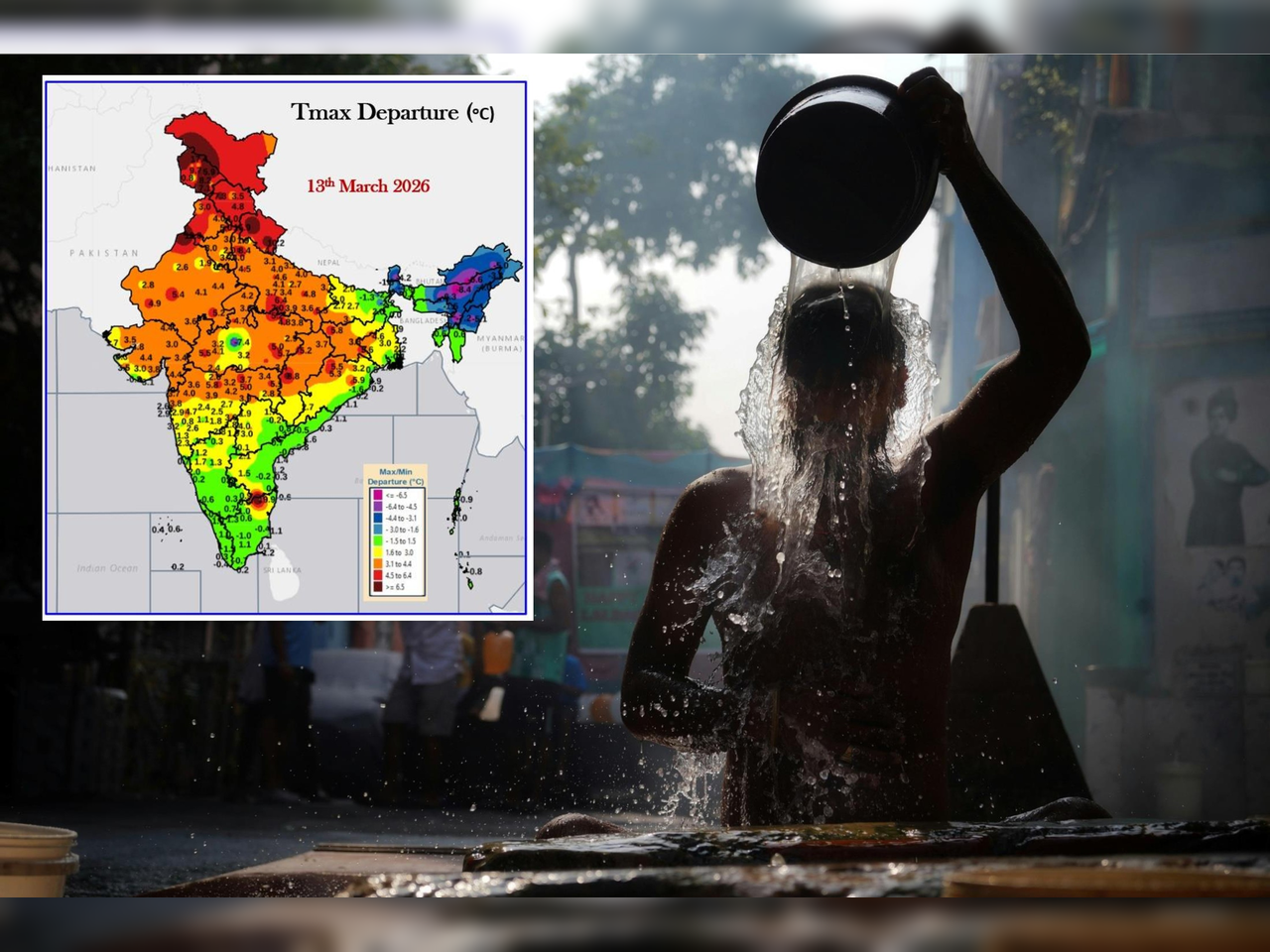
Heatwaves have come early in India this year with Mumbai already experiencing 40 degrees Celsius temperature in early March and the daily maximum heat across Delhi-NCR has been recorded 6-7 degrees Celsius above normal.
Experts point out that this is the outcome of global warming overwhelming the cooling effects of La Niña, which is presently undergoing atmospheric circulation. La Niña is a climate pattern characterised by cooler-than-average sea surface temperatures in the central and eastern Pacific Ocean, resulting in increased monsoon rains in India. Normally La Niña causes cold weather in the north-west.
The 2026 early summer is no exception. A report prepared by Climate Trends, a New Delhi-based environment research and advocacy group, released a report on Friday that has pointed out: “The annual mean land surface air temperature in India in 2025 was 0.28 degrees Celsius higher than the average of the years 1991 to 2020 … As a consequence 2025, despite being a La Niña year, was measured as the eight warmest year since 1901”.
Heat waves are already here
“Parts of northwest India and Vidarbha have already reported heat wave-like conditions well above seasonal norms,” says the Climate Trends report. “At the same time, winter rainfall remained severely deficient, with February recording an 81 per cent rainfall deficit, pointing to a shrinking winter season,”it reminds. “This has resulted in heat wave to severe heat wave conditions in Himachal Pradesh in early March,” the report further adds.
A report by Indian Meteorological Department (IMD), released on Friday, reaffirms the trend. On March 13, the “Maximum temperature departure (was) …markedly above normal (> 5.1 degrees Celsius) at a few places over Madhya Pradesh, and at isolated places over Jharkhand, Jammu-Kashmir-Ladakh-Gilgit-Baltistan-Muzaffarabad, Himachal Pradesh, Uttarakhand: Appreciably above normal (3.1 to 5.0 degrees Celsius) at most places over Gujarat state; at a few places over Rajasthan, Uttar Pradesh, Punjab; at isolated places over Bihar, Chhattisgarh, Gangetic West Bengal, Madhya Maharashtra; above normal (1.6° to 3 degrees Celsius) at a few places over Marathwada, north interior Karnataka; at isolated places over Telangana, Rayalaseema, Konkan & Goa, Tamil Nadu, Puducherry & Karaikal,” reads the report, a copy of which is with The Plurals.
A heatwave is considered to form if the maximum temperature of a station reaches at least 40 degrees Celsius or more for plains, and at least 30 degrees Celsius or more for hilly regions. A deviation of 5 degrees Celsius or more generally triggers a heat wave alert, with over 6.4 degree Celsius classified as a severe heat wave.
Climate change is responsible, period
“La Niña is a climate pattern marked by colder-than-normal sea surface temperatures in the equatorial Pacific Ocean that tend to suppress global temperatures. Global warming and changing climatic conditions tend to play a major role, which can be temporarily governed by these conditions but cannot completely outplay the effects of climate change,” said GP Sharma, president of Meteorology and Climate Change, Skymet Weather, a private Indian company.
“Apparently, all the naturally occurring climate events like El Nino, La Niña and the Indian Ocean Dipole are now severely affected by human induced climate change,” he added.
Three-years burst
This is not the first time global warming has outmuscled La Niña, observes the report. Four years since 2020 have been impacted by La Niña, including “an exceptional triple-dip event” from the summer of 2020 through early 2023.
Under normal circumstances, global temperatures would have been pulled down by La Niña during this period. But with surging greenhouse gas (GHG) emissions kept temperatures shooting up, making each of these years count among the hottest in history, remarked experts.