
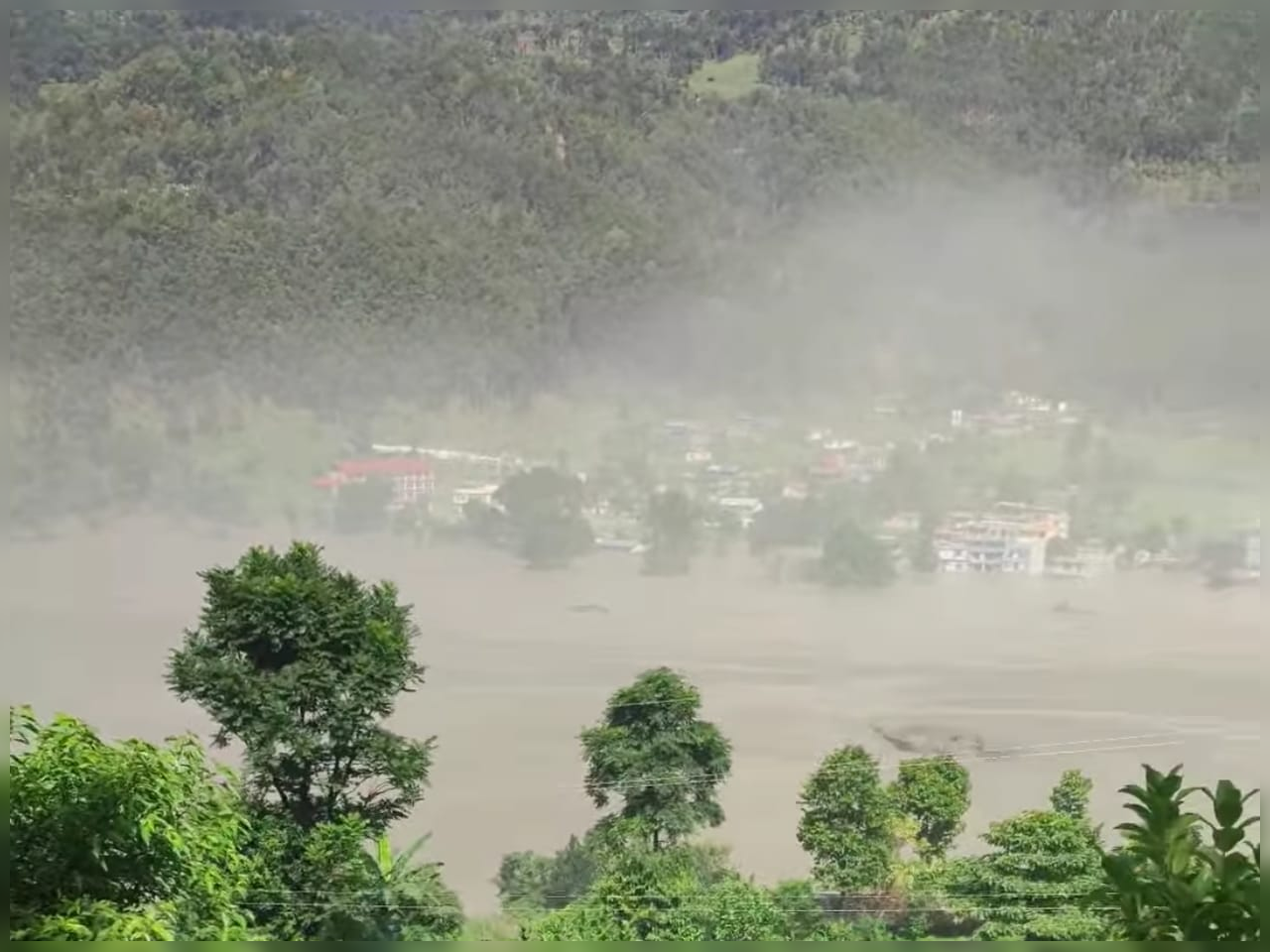

Seismic activity might have played a critical role in the unfolding of the major flash flood that struck Nepal’s Rasuwa district on Wednesday morning killing at least 270 so far, said a UN glacier expert in an exclusive interview with The Plurals on Thursday. The expert also pointed out the possible climate linkage to the development.
The UN expert told this correspondentthat impact on India cannot be ruled out as such flash floods are known to affect 100 km downstream, warning that there may be “cascading effects” to follow.
Seismic activity: either a trigger or response
Dipesh Chapagain, a senior scientist in the Global Mountain Safeguard Research (GLOMOS) programme at United Nations University Institute for Environment and Human Security (UNU-EHS), pointed out that the relationship between seismic activity and avalanche is not yet clear. “Seismic activity might have triggered the avalanche, but according to United States Geological Survey reports it may be the other way around, with the avalanche triggering seismic activity. We cannot rule out both working in tandem; the findings are evolving,” said the UN expert to The Plurals on Thursday evening from Bonn.
According to the expert, a major part of an unnamed evolving glacier on the Nepal side of the Himalayas had collapsed, causing ice melting; which in turn blocked the river for some time and triggered the avalanche and flood.
The observation tallies with the International Centre for Integrated Mountain Development (ICIMOD) report late Wednesday night. “Preliminary analysis of seismic records has identified unusual signals recorded during the period of the disaster. Data from a seismometer in Jilong, approximately 12 kilometres from the affected area showed anomalous signals, while a second station in Zhangmu also recorded unusual activity … Scientists are examining whether these signals are connected to the suspected ice-rock avalanche,” says the report.
Another disaster is building up
“Climate change, particularly rising temperature, has long been contributing to Glacial Lake Outburst Flood (GLOF). An on-going study of ours, which analysed nearly 500 GLOFs, shows that the rate of such incidents has risen fivefold since 1950,” pointed out the expert who warned of “cascading effects,” as another GLOF is apparently happening close to the Nepal and China border leading to the formation of another lake that may burst and trigger another spell of avalanche. .
“Preliminary assessment based on video footage and information from affected areas suggests that a large volume of ice and rock debris may have entered the Lende Khola, a tributary of the Bhote Koshi River. Researchers say the event could have generated a sudden surge that carried water, sediment and large boulders downstream,” reads the ICIMOD report, a copy of which is with this correspondent.
“The same site was devastated by last year’s Rasuwa flood is once again under threat,” said Qianggong Zhang, head of climate and environmental Risks at ICIMOD. “An ice avalanche in the Lhende Khola is the suspected trigger, but the cause remains unconfirmed. With a blockage still lodged upstream on the Nepal-China border, authorities warn a second flood is imminent and evacuation orders are now in place for Jilong port,” added the expert.
India monitoring closely, on alert
According to a PIB release late Wednesday, the union ministry has been closely monitoring the situation arising from the flash flood in Nepal, and Home Minister Amit Shah had spoken with the chief ministers of Bihar and Uttar Pradesh regarding the disaster in Nepal.
“The Government of India stands with Nepal in this hour of crisis. I spoke with the Chief Ministers of Bihar and Uttar Pradesh regarding the disaster in Nepal. In border areas likely to be affected, the local administration and rescue teams, along with the National Disaster Response Force (NDRF), have been placed on high alert,” wrote Shah in his X handle.
“As per the Advisory of the Central Water Commission (CWC) and media reports, a sudden rise in river water level in the Trishuli river at Furke Khola in Nepal, around 160 km from the Indian border, due to suspected Flash flood/GLOF activity near the Nepal–China border, has been reported. The impact of flood is likely to travel downstream in the Gandak River, in India,” states the release.
It further says that “…State governments of Bihar and Uttar Pradesh have taken measures such as required evacuation and other support to local Indian communities near the India–Nepal border,” adding that as per CWC, the water level on Nepal side reservoirs is reducing and the situation is under control and no panic-like situation has arisen.
Chapagain also did not rule out any impact in India. “Though the point of incidence is away from India, but such incidents can affect 100 km downstream and hence impact of India cannot be ruled out,” added Chapagain.