
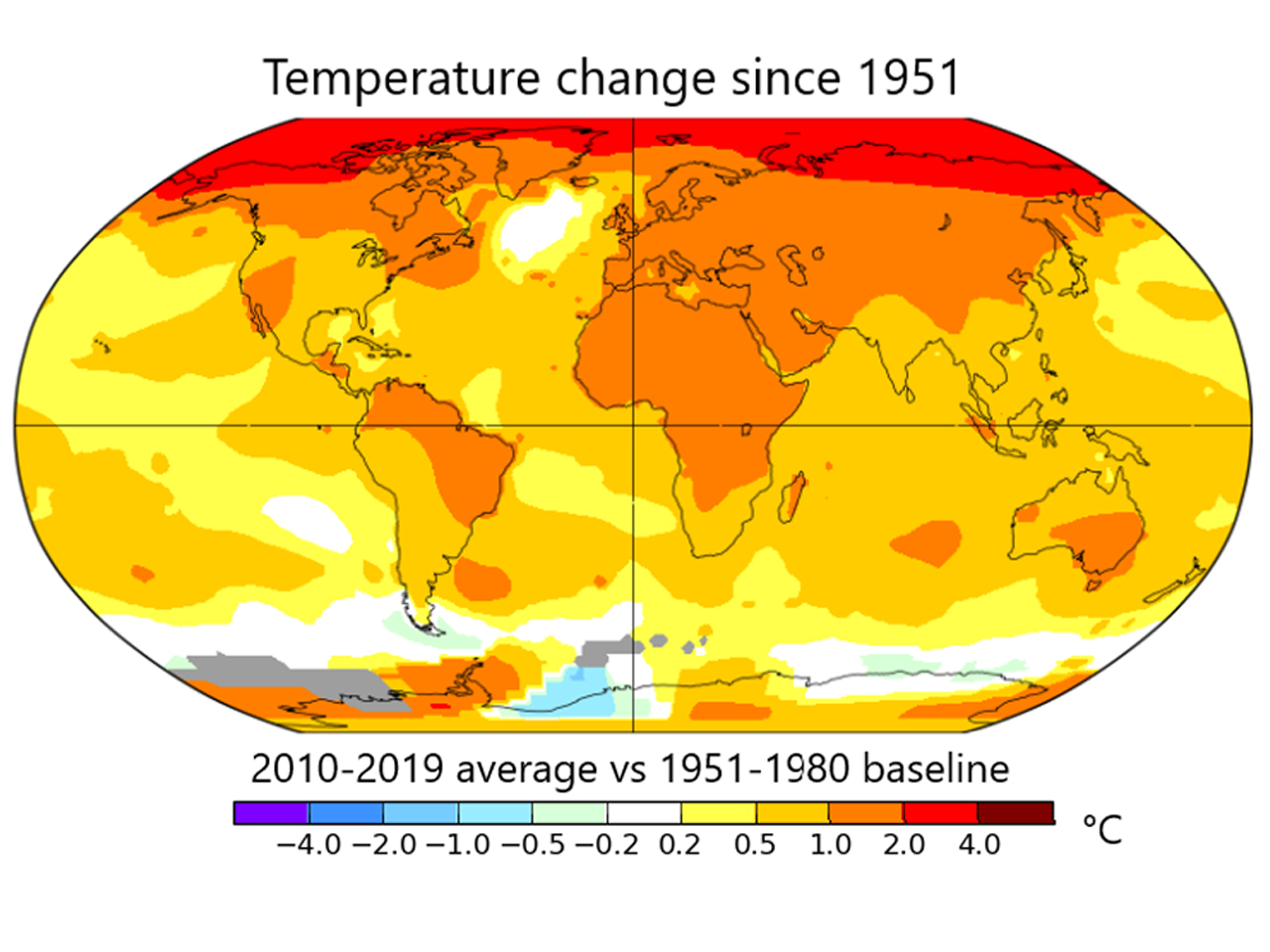

A United Nations (UN) report published on Tuesday warns that the world has already entered a threatening, “uncharted territory” of climate crisis, even as the rate of future global warming is being projected to be higher than previous UN estimates.
The report, prepared by United Nations Environment Programme (UNEP) with technical support from nearly 20 global organisations, added that one million of the estimated eight million species in the world are threatened with extinction, some of them within decades. “The populations of many more species are in decline, and their genetic diversity is being significantly eroded,” reads the report, a copy of which is with The Plurals.
“ ‘The Global Environment Outlook, Seventh Edition: A Future We Choose’, the product of 287 multi-disciplinary scientists from 82 countries, tells us what we stand to gain by choosing the path that tackles the interconnected crises of climate change, biodiversity loss and land degradation, and pollution and waste as one,” said Inger Andersen, executive director of UNEP.
The report predicts that depending on the implementation of current policies and Nationally Determined Contributions (NDCs) of emission cuts — or their lack – the global mean temperature is projected to increase by 2.4 – 3.9° Celsius in this century above the pre-industrial, falling well short of the targets set by the Paris Agreement. The agreement had decided to keep the global average temperature rise to less than 2° Celsius above pre-industrial levels, preferably to limit the increase to 1.5° Celsius.
“By investing in a global transformation of systems from energy to food, we can avoid nine million premature deaths by 2050 – many of them from decreased air pollution. We can lift 200 million people out of undernourishment and 150 million people out of extreme poverty by 2050. We can give 300 million more people access to safely managed water sources by 2050,” Andersen added. She said that while this would involve upfront costs, it would also generate a long-term return on investment of about “USD 20 trillion per year by 2070 and a boom thereafter.”
The official warned about the dangers of the current path. “If we choose to stay on the current path – powering our economies with fossil fuels, extracting virgin resources, destroying nature, polluting the environment – the damages would stack up. Climate change would cut four per cent off annual global GDP by 2050, claim many lives and increase forced migration,” she explained.
Address problems together
“Despite global efforts and calls for action, our planet has already entered into uncharted territory, facing global environmental crises of climate change, biodiversity loss, land degradation and desertification, and pollution and waste,” points out the report.
These interconnected crises, which are undermining human well-being and are primarily caused by unsustainable systems of production and consumption, reinforce and exacerbate each other and need to be addressed together, the report stresses.
The report has identified the possible crisis points the planet is currently facing.
§ The rate of global warming is likely to be higher than the global estimates of previous Intergovernmental Panel for Climate Change (IPCC) projections, increasing the risk of irreversibly passing several climate tipping points within the next few decades. A tipping point is a critical threshold beyond which a system re-organizes abruptly.
§ Due to crossing of tipping points, there may be major shifts in ocean circulation, accelerated ice sheet loss, widespread permafrost thaw, forest decline and collapse of coral reef ecosystems.
§ One million of an estimated eight million species are threatened with extinction, some within decades. The populations of many more species are in decline, and their genetic diversity is being significantly eroded.
§ Between 20 and 40 per cent of land area was estimated to be degraded in 2022. Between 2015 and 2019, at least 100 million hectares — the size of Ethiopia or Colombia — of fertile and productive land were degraded annually worldwide.
§ Annual solid waste currently exceeds 2 billion tonnes and, given current trends, is projected to increase to 3.8 billion tonnes by 2050.
§ Most of the internationally agreed (or adopted) environmental goals and targets are unlikely to be met with existing policies and practices, including those from the United Nations Framework Convention on Climate Change (UNFCCC), the Paris Agreement and others, as well as World Health Organization (WHO) pollution standards.
“These environmental crises are causing substantial economic and social damage…They can no longer be viewed as simply environmental issues; they are also economic, development, governance, security, social, moral, and ethical issues,” states the report. This explains why they should be addressed together.
Asia under threat
“The Asia and the Pacific (AP) region is bio-culturally and geographically diverse in its state of environment and development, facing numerous challenges (and) the key priorities of the
region are climate change adaptation and resilience building against extreme events, land-use change and land degradation, and increasing waste and pollution,” states the report.
It states that “significant gaps persist in reducing Green House Gas (GHG) emissions to limit warming, as presented by the Paris Agreement.” It adds: “Asia and the Pacific countries have achieved only
17 per cent progress in the 17 SDGs – slightly above the global level.”
The report warns that “at the current rate, the AP region will fail to achieve 90 per cent of the 118 SDG
targets by 2030.”
India has special cause for concern, experts feel. “For India, which is highly vulnerable to climate impacts and struggling with pollution and land degradation, these risks are acute,” said Harjeet Singh, climate activist and founding director, Satat Sampada Climate Foundation. “However, hope remains,” he added: “achieving global goals requires unprecedented, whole-of-society transformations in our economic, energy, food and materials systems. India can lead this change by embracing innovative green policies, sustainable infrastructure, and by rapidly shunning fossil fuels to leapfrog old technologies.”
Singh emphasised that “success depends on a just and equitable transformation that confronts vested interests and ensures strong governance that holds polluters to account”.