
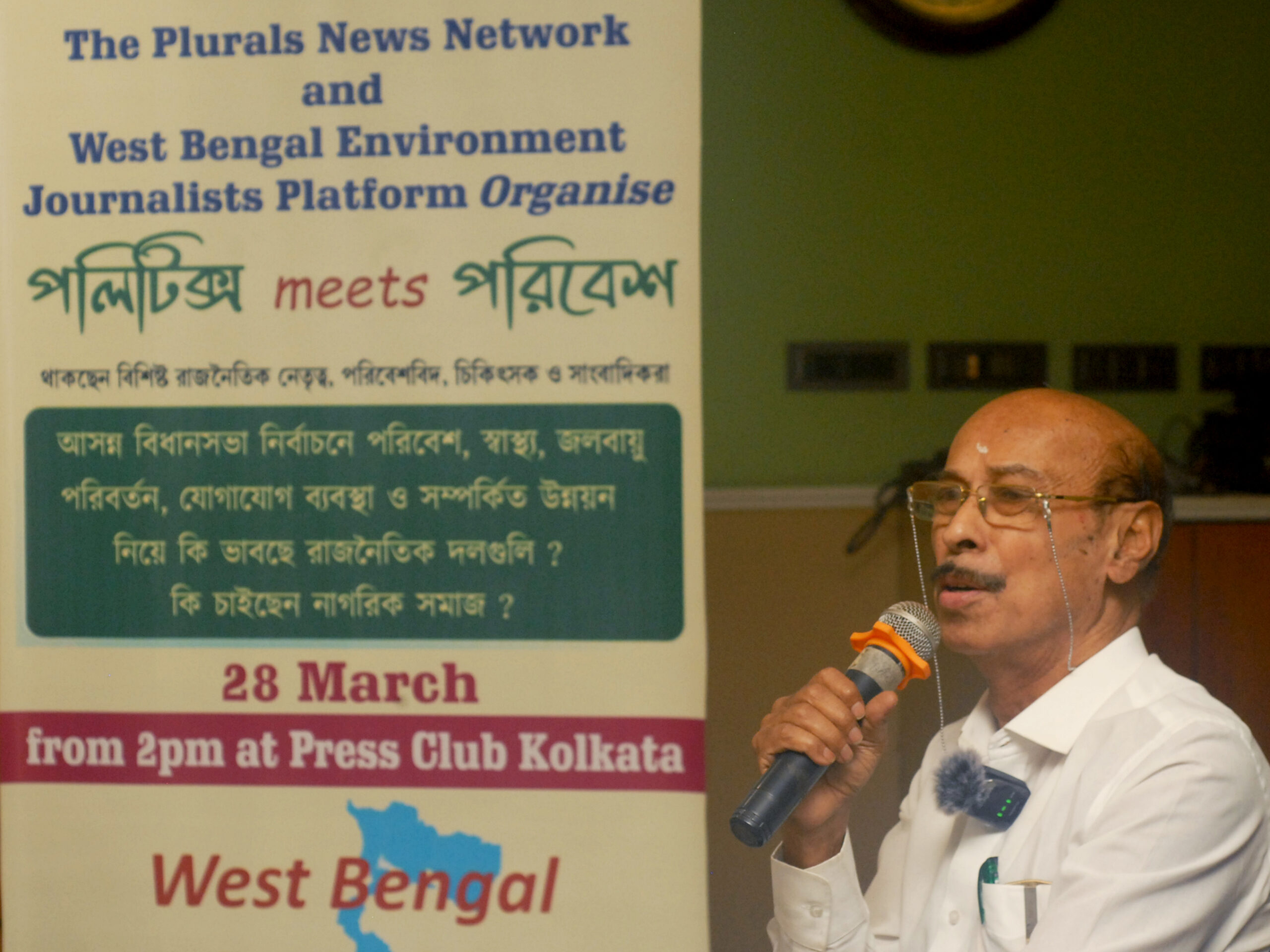
Since 1977, I have observed four different political parties in power in two central and two state governments. In all these years, I have never seen a single political party truly think about the environment, work on it, or seriously engage with it.
Our democracy is supposed to be of the people, by the people, and for the people — but in reality, it is all about the votes and nothing else. Vote or no vote — that’s all political parties care about. The “environment” has now become something tertiary —something external, almost decorative.
Let me share something. I once filed a case involving the Election Commission of India — not against it, but making it a party — about seven or eight years ago in the Calcutta High Court. My demand was simple: just like there is a Model Code of Conduct during elections, why shouldn’t there be an environmental code of conduct for elections? Like, restrictions on loudspeakers, sloganeering and various forms of violations — social, political, financial — those having environmental implications.
I had made about 18 political parties in West Bengal (recognised by the Election Commission) parties to that case. I sent those notices and copies of my representation. Not a single political party responded, not anyone of them came to court. Only the general
Secretary of one party (now deceased) contacted me and tried to understand my point.
This clearly shows how political parties treat environmental issues.
Even today, environment does not feature among the top four or five positions on their priority lists. And honestly, part of the onus should be also on us, through major responsibility falls on the political parties. Political parties behave differently when in power and differently in opposition. When they are out of power, they support movements — but once in power, they often change completely. I remember the Brigade movement regarding air pollution affecting Victoria Memorial and shifting of Kolkata Book fair — those who supported us then did nothing after coming to power.
Take another example: the dumping ground issue with the Howrah Municipal Corporation. I filed a case around 2002–03. In 2009, Calcutta High Court ordered that the dumping ground had become exhausted and should be shifted. It was not done. Years later, in August 2024, the dumping ground collapsed, and it became media headlines. The court took suo motu action and I had to get involved again. The court ordered immediate shifting and time-bound bio-mining of long-dumped solid waste, the scientific process of treating municipal solid waste in landfills using microorganisms.
But what did the Howrah Municipal Corporation do? They filed a writ petition in the high court seeking more time — even though the Supreme Court had already issued directions in February 2026, stating that such matters should be handled by the National Green Tribunal and not by high courts. Despite that, the municipal corporation got a long respite. To me, this feels like exploitation and misuse of the judicial system, along with misrepresentation.
Ironically, the same people had supported me back in 2009.
If I were to name the top three environmental issues those should be prioritised by the political parties leading to ensuing election in West Bengal, they would be air pollution, water pollution and noise pollution.
This first-person account is based on the speaker’s recorded speech on March 28, 2026, at Kolkata Press Club, delivered during the event Politics meets Paribesh organised by The Plurals, Bengal Environment Journalists Platform and nonprofit EnGIO.)