
A background story tells how environmental issues got historically linked with political parties, and election process, in West Bengal. In 1997, a Calcutta High Court order was issued stating that no one can be forced to become a captive listener. Late Justice Bhagwati Prasad Banerjee passed that order. He also directed the then Election Commission’s senior officials and the state’s director general of police, along with the chairman of the the state pollution control board Professor Deb Kumar Bose, to hold a meeting and ensure that environmental agendas were included in election campaigning. Excessive use of loudspeakers was to be restricted. That was in 1997, and the order has remained in force ever since. Through this verdict, the environmental concerns became formally, and legally, linked with elections and political parties.
But what do we see today? Many argue that political parties have no responsibility in relation to environment during the electioneering process, but I oppose the argument. Recently, we have seen Ram Navami processions in many places of the state where DJ music and music boxes played very loud music in public without permission with scant regard for the high court order. Who are leading these processions? Members of political parties! So, how can they claim that they have no responsibility in this matter? I would say that they are actively involved in this utter violation of judicial orders.
Secondly, there have been repeated appeals to reduce the use of flex banners, yet they are still being widely used during elections. What happens to them afterwards, I don’t know.
Now let me come to the election manifestos. Even before manifestos were released, several organisations, such as Paribesh Academy, Nari Khamataayan Shishu Raksha Manch, Tarakeshwar Green Mates and platforms opposing firecrackers and DJs, wrote to political parties, requesting them to include key environmental issues in their respective manifestos; but hardly any response came. I have no hesitation to state that political parties, in general, are still not sufficiently conscious about the impact of development projects on people’s livelihoods.
Many speak about “priority,” but if, I feel, a developmental activity harms people’s livelihoods, then that development should not happen.
Take mining, for example. In many places, people have been displaced as a consequence of mining. Can you name a single place in India where those displaced people — you may call them environmental refugees — have been properly rehabilitated by the governments? There is probably no such example. The likely reason: they are tribal, they are poor, they have no voice. Sometimes there are high court or Supreme Court orders on such matters, but broadly they remain ineffective.
Take the case of silicosis. Many people have been affected in the state by it, after having been forced to work in a completely polluted environment without almost any protection. Young people are dying in places such Minakhan in Sundarban and elsewhere. But medical reports are often being produced in such a way that silicosis does not get officially identified, because then the government would have to pay compensation as It is an occupational disease. Though some respite could be gained due to exertion of sustained social and legal pressure, how many political parties have spoken about this?
Take parliamentary or assembly proceedings over the last 15 years: how much time was spent on debates involving environmental issues? People are displaced by mining; have they been compensated? Again, no clear answer.
In village after village, under current industrial siting policies, even “red category” industries are being set up. What is happening to the people there? What is happening to their livelihoods? Are we tracking this? We are told technology will solve everything. But technology already exists — yet it does not get implemented. Sponge iron plants have technology, but it is not properly used. It is not that our scientists don’t know anything, but their suggestions need to be implemented on ground.
Are we monitoring what is happening in Sundarbans? Or in north Bengal, where landslides are increasing due to development? We have clearly documented all of this and sent it to political parties. Only one political party responded, saying they would include these issues in their manifesto.
We have repeatedly approached the political parties and their leaders before every level of election— panchayat, m
unicipal, parliamentary — and asked them to implement the rules prepared by them! But the response has been lukewarm to say the least.
There is no end to the indifference shown to key environmental issues. Take Ganga Action Plan. It started in 1986 during Rajiv Gandhi’s time. So many years have passed. IITs and many renowned scientists have produced series of reports. Nothing wrong with that, but tell me — have the experiences of the river-dependent communities been reflected in those reports? The reports are beautifully written, but I am afraid that they have failed to address the full extent of the impact on people whose livelihoods depend on the river. “Sustainable development” has become a buzzword, but where has it truly been implemented?
Going back to Ganga, it is said that no construction should take place within 47 metres of the high-tide zone of the river. Yet violations are routine. Regulatory authorities like the Kolkata Port Trust, West Bengal Pollution Control Board, land reforms department and fisheries department exist — are they acting? No. Anyone, with sufficient connection with the powers that be and deep pockets can even encroach upon the river itself! We have filed multiple complaints and cases in the high court, yet nothing has changed.
In Bengal the finance minister has been given the responsibility to run the environment ministry as well, which is acceptable. But tell me, under the “polluter pays” principle, how many industries have actually been penalised? And how much of that compensation has been used to benefit affected communities? This is a Supreme Court guideline — has it been followed?
Let me end with one final thought. So many people have said so many things on so many platforms —none has kept the promises. No one. So the time has come when we all need to ask every candidate when he or she will campaign at your doorstep: what are you leaving behind for the next generation? What are you leaving for the future?
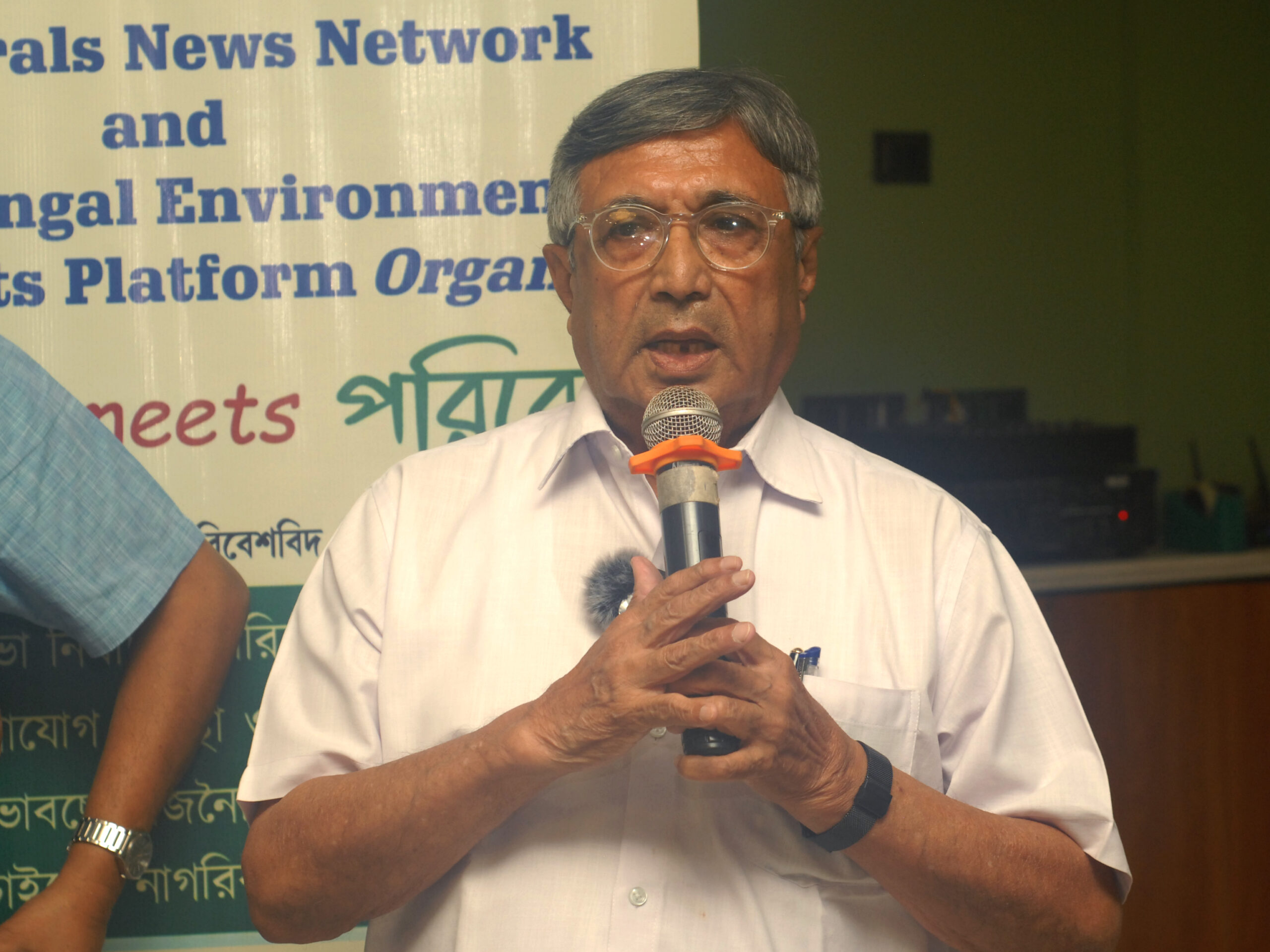
(This first-person account is based on the speaker’s recorded speech on March 28, 2026, at Kolkata Press Club, delivered during the event Politics meets Paribesh organised by The Plurals, Bengal Environment Journalists Platform and nonprofit EnGIO, as well post meeting inputs.)