
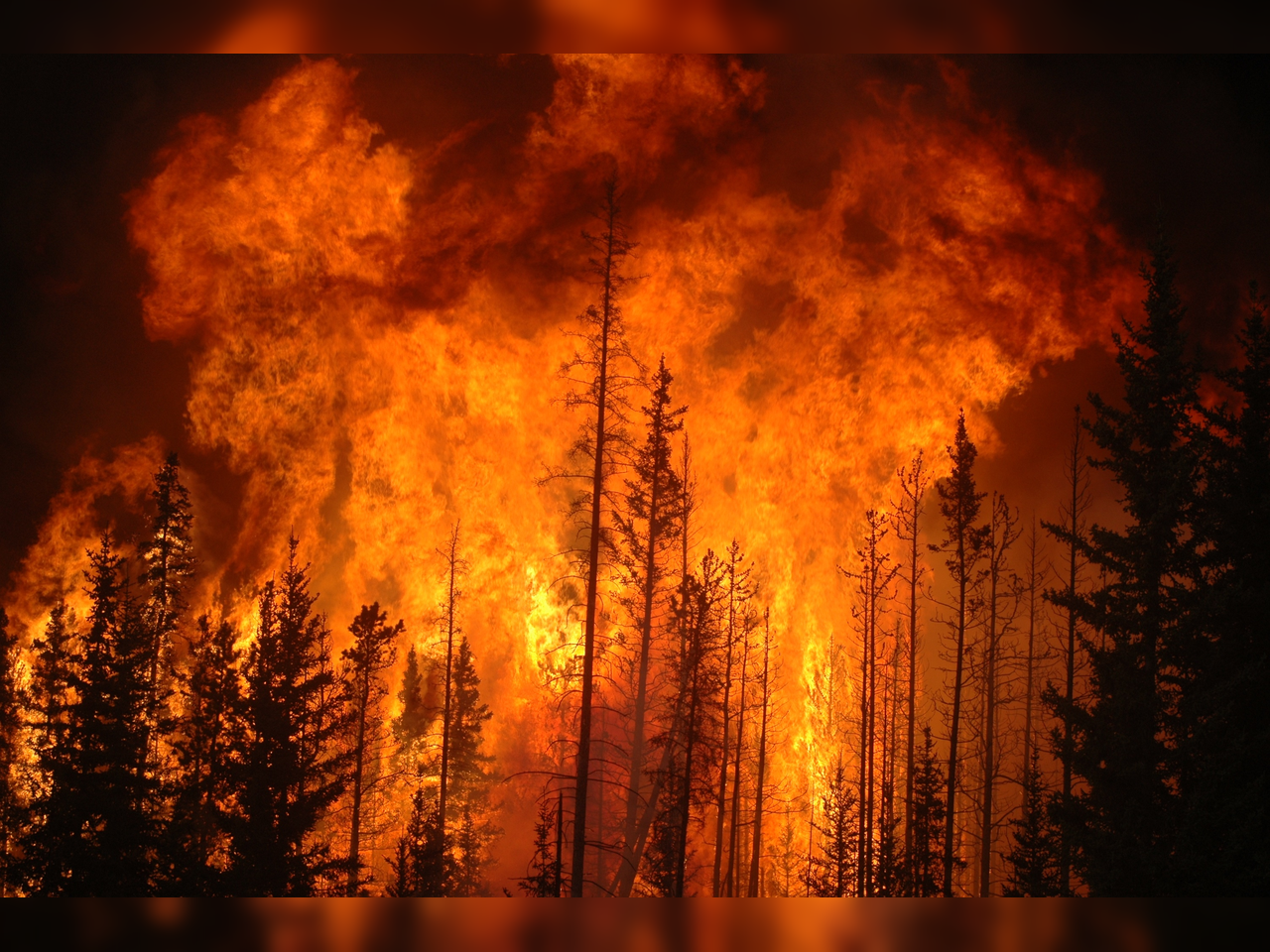
Two weeks back, Spain and France fought each other in the football World Cup; now, both are fighting to counter climate change-triggered wildfires raging across their countries. Records state that the ongoing fire is the largest single wildfire in Spain’s recorded history.
Wildfires across France and Spain have forced more than 300,000 people to leave their homes in last few days, with Spain declaring a national emergency as fires continue to spread near Madrid and along its eastern coast.
Data generated by the World Health Organization’s European Region shows that the trend is increasing rapidly, with land burnt by wildfire across Europe surging 57% in four years.
Soraya Fettih, a global campaigner at environment non-profit 350.org who lives near Bordeaux in France, shared his first-hand experience of facing the fire. “On Saturday morning, I was evacuated from my home. The fire is reaching the suburbs of Bordeaux. The sky is black, and the air is filled with ash. The city is filled with people forced to flee the suburbs and the coast. This isn’t something we’re watching on the news. We’re living it,” said the activist.
Unreal Madrid
In Spain, fires have burned nearly 10,000 hectares in the Madrid region alone and between 13,000 and 15,000 hectares in the neighbouring Ávila province, according to the country’s interior ministry. Spain has registered 35 large fires this year, compared to just 11 in 2025. The Ávila fire alone has burned 50,000 hectares—an area roughly the size of the city of Madrid—becoming the largest in Spain’s history. Copernicus data confirms Spain currently leads the EU in burned areas.
The figures accessed show that between 1 January and 27 July 2026, Spain lost over 172,000 hectares to extreme fires—an area equivalent to 17 times the size of Barcelona, and more than six times the area burned in the same period in 2025.
Wildfires in Spain and Portugal combined have more than doubled compared to last year, and the head of the Madrid regional government has called the current fires “the worst the area has ever seen”.
France is on fire
In France, around 63,000 people have evacuated southern regions as multiple fires burn simultaneously, destroying approximately 80 homes so far. France has appealed to the European Union’s Civil Protection Mechanism for international fire-fighting support.
This is not an isolated bad summer, as WHO Europe has documented that wildfires destroyed 2.2 million hectares of land across the region in 2025, up from 1.4 million hectares in 2022; a trajectory that gets linked to rising global temperatures.
Climate change blamed
Experts point to extreme climate conditions and land management as the clear drivers. Admitting the climate linkage, Prime Minister Pedro Sánchez has announced €300M for climate and fire fighting; while the government pushes for a historic State Pact on the climate emergency.
“There have always been wildfires, but these ones are being supercharged by climate change … We’ve had these heat waves that would have been impossible without climate change. That has led to a rapid drying of the land and creation of this tinderbox of a lot of vegetation that is very dry, that is ripe for wildfires to get going,” explained Peter Thorne, director of the Climate Research Centre, Maynooth University.
“These fires (in Spain and France) are some of the most extreme we have seen in Europe … the hot and dry summer weather we have seen is the singular reason for these dangerous extremes. Climate change is causing these conditions to become much more intense and more likely, which is why we are seeing much more extreme wildfires across Europe,” agreed Theodore Keeping, a researcher at Imperial College London: “
Cristina Santín, head of the department of biodiversity and global change, IMIB-CSIC stated that “ …Science has been warning us for a while that this was coming and, now, we are seeing the consequences of global change on our doorstep”.
Oil majors’ soar, people suffer
Fettih, of 350.org, blamed the oil majors for the emerging situation.
“My people are paying the price. We are losing our homes, our memories and our communities. Our lives and our future are turning to ash. At the same time, our region is being left to shoulder the enormous cost of fighting these fires and helping people rebuild, while governments continue to subsidise the fossil fuel companies driving this crisis,” alleged the expert. “Communities are paying twice: once through climate disasters, and again through public money that continues to support the companies profiting from them,” she further added.
Incidentally, the wildfires have come at a time when Europe’s oil and gas majors continue to report soaring profits. Total Energies reported adjusted net income of $6.03 billion for the second quarter of 2026, up 68% on the same period last year, while more profits are being announced.