
I must accept at the outset that whenever the elections approach, we tend to prioritise issues like roti, kapra, makan — food, clothing and shelter. People’s unemployment, housing and similar concerns become very important to us. However, we need to keep in mind that even though we may not always explicitly talk about the environmental issues, having roti, kapra, makan depends significantly on environment and climatic situations; moreover, there is a strong connection between environment and health.
The Trinamul Congress (TMC) government has significantly increased the healthcare expenditure over the years and introduced a unique insurance scheme such as Swasthya Sathi. There was a time when large private hospitals were accessible only to a particular class of people. But after Swasthya Sathi, today a person from a slum can also access treatment at a big private hospital if they have this card. This also helps the people to combat health problems linked to environmental pollution.
There is also a strong link between the environment and infrastructure. Rs 70,000 crore have been allocated for health infrastructure development by the state government. Of course, much more needs to be done. I am not claiming great credit for what has been done, but I am saying that we are moving in the right direction.
In our election manifesto, one of our priorities is to address the erosion of Ganga in Malda and Murshidabad. Plantation and growth of mangroves, which has helped to prevent erosion in Sundarbans, is another priority.
In the transport sector, we had targeted acquisition of 1,000 electric vehicles. While we have procured a significant number, we could not achieve the target since supply was inadequate. With a greater supply, we could deploy more electric buses, reduce fossil fuel consumption and improve air quality. We have also explored solar energy and installed solar systems in various places.
Kolkata Municipal Corporation (KMC) was among the first Indian cities to initiate solar projects, from solar parks to solar installations at several locations in the city. We are almost ready with Kolkata Climate Action Plan which is being prepared by a pan-India expert committee — perhaps Kolkata is one of the few cities in Asiathe country and the only one so far in eastern India to undertake such an exercise. We are gradually implementing its recommendations. As a matter of fact we have undertaken the task of conducting a tree census in city, of which about one-fourth has been completed so far, and also prepared the People Biodiversity Register. We are greening the city, especially the roadsides and the middle of the roads, to counter air pollution, apart from adding an aesthetic value to the city. But I know that we have to continue the exercise considering the low green quotient of the city despite the programmes we have taken.
Kolkata’s sewer system has been modernised over the years, yet why do we still experience water-logging in some areas? One reason is that with siltation in Ganga, over time, the river’s depth has reduced. Desilting Ganga is not the responsibility of the state government. If we cannot desilt Ganga, problems will persist.
For instance, in Kalighat, during high tide, water enters people’s homes. Earlier the branch of Ganga flowing near Kalighat had the capacity to carry more water, but now that capacity has decreased. Without desilting, this problem cannot be solved overnight. We have installed several lifting and pumping stations to remove stagnant water from low-lying areas as the city is shaped like a bowl, and the water tends to accumulate in certain places. We pump the water out into canals but canals also have the problem of siltation.
We have renovated many canals, but more work is needed. A major issue is encroachment along canal banks. When we remove silt from canals, where do we deposit it? If we keep it on the banks, we must relocate the people living there.
Our government has initiated projects like Jal Dharo, Jal Bharo to conserve water. There was a time when filling up wetlands and ponds was common practice in Kolkata. But if you compare data from 2011 to 2026, you will see that such activities have significantly reduced compared to earlier periods. We must also understand the socio-economic pressures behind this. With such a high population, the pressure on land in Kolkata has increased beyond the acceptable limit.
It is true that with the construction of dams in various places, those of us living in downstream Ganga have faced several problems. But this is not just about dams. There is an inherent conflict between environmental concerns and the materialistic, unplanned development. Urbanisation and environmental protection often come into conflict.
Let me conclude with one more point. Many mention about city’s waste disposal. In Kolkata, about 5,000 tons of waste are collected daily. There was a time when garbage trucks would pass through the city and people would have to cover their noses because of the stench. Over the past 10 years, that situation has changed significantly. Now, around 144 compactor stations have been set up, and you will no longer see waste being transported in open trucks. It is now carried in a compacted, sealed manner, almost like wagons. In Dhapa, waste is being recycled, gas is being generated and plastic is being used to make doors. I urge all to visit the space and see for yourself how the exercise is changing the landscape, on ground, literally.
I hope that through collective efforts, we can make this city and state more environment friendly. On behalf of my party, I can say that we are very conscious about environmental issues and we want to fight this election with a strong emphasis on protecting the environment.
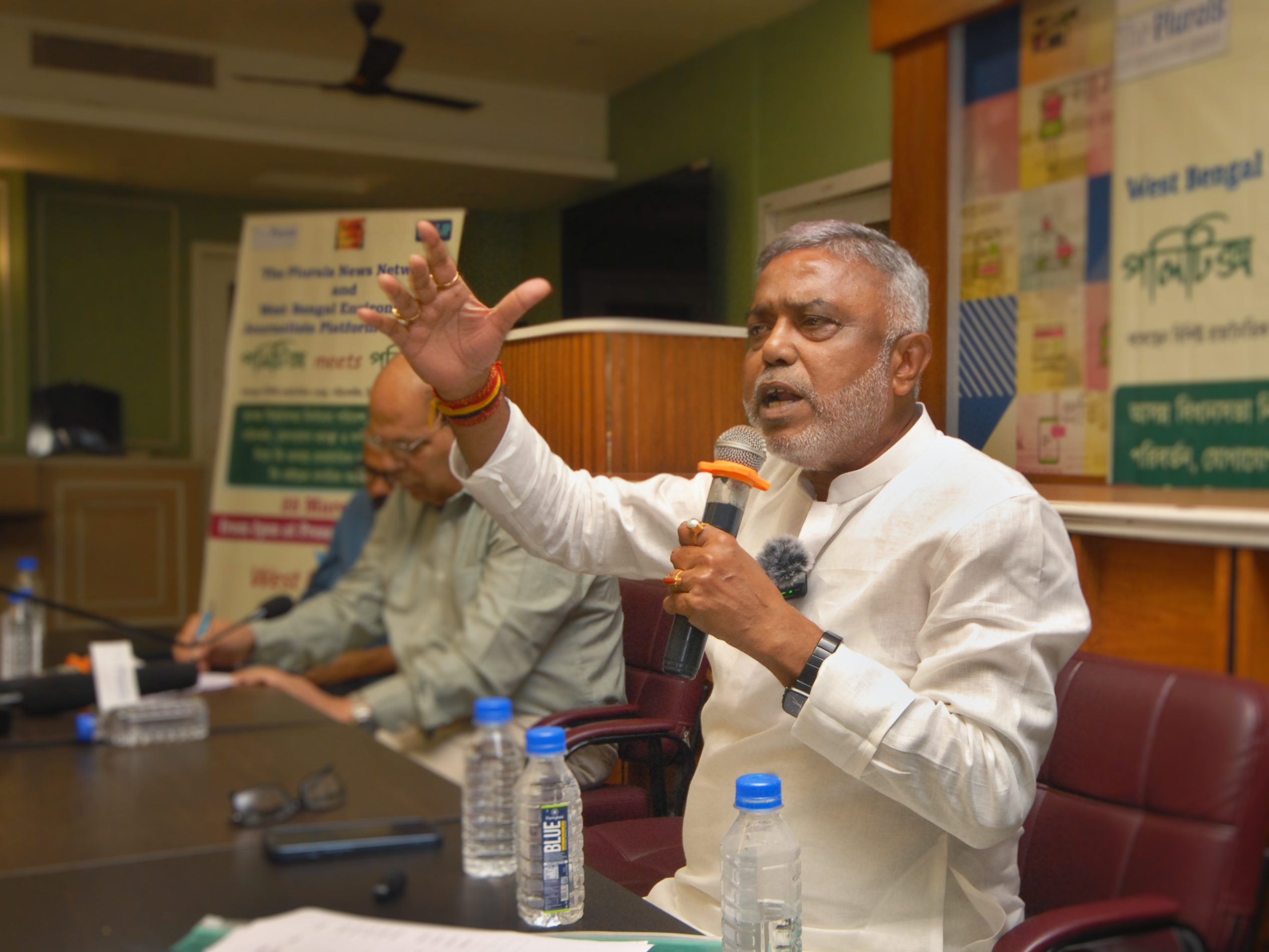
(This first-person account is based on the speaker’s recorded speech on March 28, 2026, at Kolkata Press Club, delivered during the event Politics meets Paribesh organised by The Plurals, Bengal Environment Journalists Platform and nonprofit EnGIO, as well post meeting inputs.)