
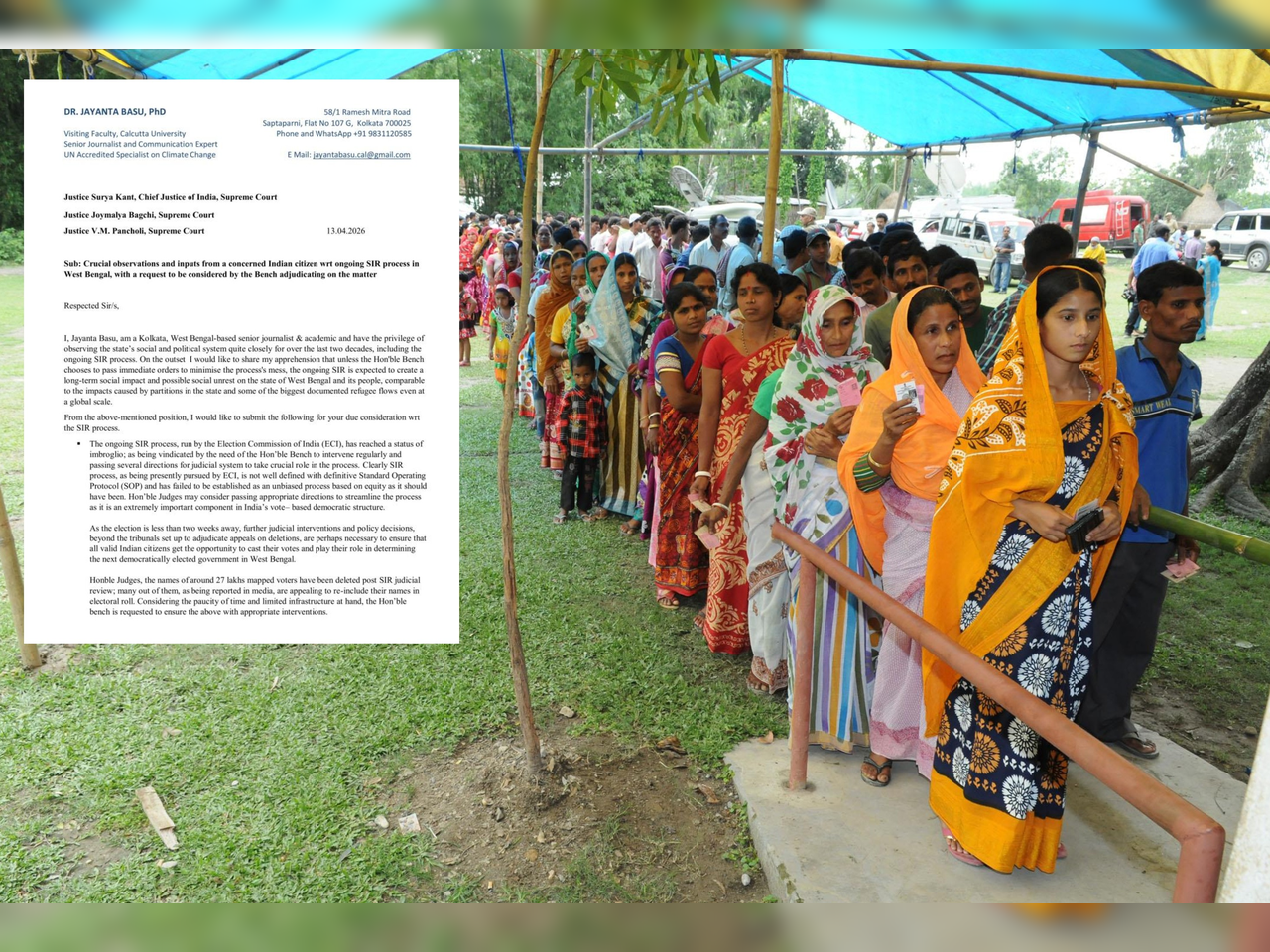

A few days back, I was having a conversation with an academic from Bengal on one of his recent write-ups on the ongoing Special Intensive Revision (SIR) in West Bengal, and we agreed that the Bengali intelligentsia needs to come out in the open to oppose the way it is being presently conducted by the Election Commission of India, stepping aside from the electoral politics linked with the exercise.
The next day, conversations with a few other thought leaders across sections of society strengthened this point of view. One of them said: “We must do something; the impact of SIR will be much more than the electoral outcomes; it is going to cause a great social impact and possibly unrest in West Bengal for a long time, almost akin to what we find in the case of the Partition, the Bangladesh war, and the refugee waves that followed.” A few others, with whom I had spoken on the subject, agreed.
As some of us were grappling with the idea of “we must do something” without really knowing what we can do to have some sort of meaningful impact, I chose to write this because of three reasons: the ongoing SIR is bereft of equity and is discriminatory on grounds of gender and religion; the poor and vulnerable are going to be further marginalised; and overall, the identity of Bengal and Bengalis is being threatened. It is felt by many, and I agree, that the findings of the toolkit called SIR may be used in the future by a few to create deep divisions in Bengali society, and as a journalist, it is my responsibility to reach out to the judiciary to share my concern, our collective concern, and also to share the possible way out from the imbroglio created by the Election Commission of India through the SIR process.
According to social activist Naba Dutta, nearly 2000 organisations and individuals from West Bengal have written to the Supreme Court demanding justice on the issue. The demands range from complete withdrawal of SIR in its present avatar to restore the voting rights of the “deleted” voters who have appealed to tribunals. It is feared that voting rights may be linked with their citizenship as well.
What I submitted to the Supreme Court bench
The letter dated April 13 and addressed to the judges of the bench led by Chief Justice Surya Kant adjudicating on the SIR agenda in West Bengal gives a brief background before flagging off key issues in a point-wise manner.
“On the outset, I would like to share my apprehension that unless the Hon’ble Bench chooses to pass immediate orders to minimise the process’s mess, the ongoing SIR is expected to create a long-term social impact and possible social unrest in the state of West Bengal and its people, comparable to the impacts caused by Partition in the state followed by some of the biggest documented refugee flows even at a global scale,” reads the letter. (Click on the link to see the full letter https://drive.google.com/file/d/15JNzfL2tFEDP43275B6htK9JSzOiSPwT/view?usp=drive_link)
“The ongoing SIR process, run by the Election Commission of India (ECI), has reached a state of imbroglio, as being vindicated by the need of the Hon’ble Bench to intervene regularly and pass several directions for the judicial system to take a crucial role in the process. Clearly, the SIR process, as being presently pursued by the ECI, is not well defined with a definitive Standard Operating Protocol (SOP) and has failed to be established as an unbiased process based on equity as it should have been,” it further reads.
“As the election is less than two weeks away, further judicial interventions and policy decisions, beyond the tribunals set up to adjudicate appeals on deletions, are perhaps necessary to ensure that all valid Indian citizens get the opportunity to cast their votes and play their role in determining the next democratically elected government in West Bengal,” the letter continues.
“While announcing the SIR process, ECI has set 2002 as the benchmark, as an SIR was conducted at that time. Considering the stated position, the Hon’ble Bench may consider allowing all those within the deleted list as applicable who were part of the electoral roll of 2002, as well as those who have at least one document to establish their biological linkage with anybody whose name was on that list, such as a passport, Aadhar card, voter ID card, ration card, bank documents etc.,” I have written.
“In the case of those being deleted but not having any established biological linkage with anybody in the 2002 electoral roll, established valid documents may be considered, which may include a passport, any document establishing that the person was/is part of any government job(s), establishing that the person was/is part of any well-established private job(s) within the formal sector for a significant period, establishing that the person was/is part of any recognised academic institution in the state, and similar instances,” I also proposed.
“The SIR process, in its present avatar, is being widely reported to be biased by experts as well as in media, against particular religion/s or class of people,” I have said, and urged the apex court “to undertake steps to dispel the notion, as we are all looking up to the judiciary to provide justice on the ground in this highly politicised atmosphere.”
The April 13 hearing touched on a few issues.
During the April 13 hearing on SIR, the bench, especially Justice Joymalyo Bagchi, referred to several contentious points raised by political observers and nonprofits at large, including the mail sent by me to the Supreme Court bench.
Bagchi mentioned that the Election Commission of India (ECI) introduced the new category of “logical discrepancy” in West Bengal, and it revised its position for the state, as in Bihar individuals who had been mapped in the 2002 electoral rolls had not been required to upload documents.
“If you see the original SIR notice, it talks of the benchmark as the 2002 electoral roll. So the SIR does not touch a person who is in the 2002 roll. The 2002 roll is not touched. What is touched is who are relating themselves to the 2002 roll. The 2002 roll was the benchmark. Why? Because the last intensive revisions were then…. When the Bihar SIR was argued, and we understand your SIR (in Bengal) is a facsimile of the Bihar, the submissions from ECI were unequivocal that the person in the 2002 electoral roll does not need to give any document,” said Bagchi.
The judge also referred to the alleged extreme hurry that marked the process by remarking that the judicial officials conducting SIR adjudication could not be expected to function with 100 per cent accuracy when dealing with more than a thousand documents a day with very little time; even an accuracy of 70 per cent should be considered “excellent.” Well, that “excellent” result means at least 18 lakh people — 30 percent of around 60 lakh under the “logical discrepancy” category — are being done away with as voters.
The question looms: who will take the responsibility of the physical, mental, and societal trauma that SIR is leading to? Fingers crossed.
Jayanta Basu is Editor, The Plurals