
Let me start with a statement. Left politics has never functioned without environmental thinking. Whether globally, nationally, at the state level, or even within a neighbourhood — this has always been the case.
Having said that we must accept that the environmental politics depends on the political environment. Whatever political environment you are a part of, if it is driven by profit and plunder, then the environment is bound to be destroyed indiscriminately. Some people cut down trees and clear forests for quick profit. But the goal of Left politics is to build a future with creativity, and we have always planted trees, carried out afforestation and fought for forest rights.
The difference between Left and Right is not just about what is written in electoral promises or manifestos. The work of environment must be done throughout the year, and the Left does it — whether in government or in opposition; it is not just about celebrating Environment Day on June 5 or distributing saplings ceremonially.
It is acknowledged that at present, both globally and in our country, including in West Bengal, environment stands severely impacted. This is driven by the hunger to devour everything for more and more profit. When a major part of the Aravalli hills were declared to be no longer hills, what role was being played by the judiciary, the Pollution Control Boards; whether at the state or central level? Clearly, their roles have been weakened over time.
Under the “Namami Gange” project, a budget of over Rs 22,000 crore has been allocated. But as we know, laws were passed in the late 1980s with the promise of maintaining a minimum flow in the Ganga; the stretch from Kolkata to Allahabad was declared as the first National Waterway. Governments have come and gone, making big claims, but today we see the Ganga silting up and widening before our eyes. Some blame the Farakka Barrage, others blame other things — but where is the dredging? Why not use the silt to generate employment or recycle it? Instead of allowing unplanned brick kilns, this could be organised better since there is already a market for bricks. But that requires vision and planning!
The Planning Commission has been dismantled. NITI Aayog exists, but there is no long-term planning. Secondly, the “hunger for profit”, that I mentioned earlier, has led to exploitation. Who fought against it? Whether in courts, or on the ground?
In West Bengal’s Deucha Pachami, a false narrative was created that a coal mining project had started, but there was no coal — only stone has been extracted so far. The networks of sand mafias, stone mafias and coal mafias operate like an organised crime nexus. If a state or country is run by such mafias, then environmental laws, plans and declared goals lose all meaning.
There are exceptions. Take the Khari River in East Burdwan. Over the past two years, Left-led movements with the CPI(M)’s participation have carried out positive work there, but it gets little media coverage. For Khari River, students, youth, teachers and members of science forums have come together. The river had become so polluted with industrial effluents that even cattle would not drink from it. Through collective action, this could be stopped, despite lack of support from the government or police. As a matter of fact, a few activists, who were a part of the movement, are facing legal actions.
Today, water bodies and wetlands are being destroyed. Fishermen who depend on them are losing their livelihoods. Environmental issues are not just academic concerns; they are directly tied to people’s lives and livelihoods. If we think from that perspective, as we have said before, land should belong to those who cultivate it – langol jar, jomi tar — and water to those who depend on it – jal jar, jol tar – not to land mafias. Many traditional fish species in West Bengal’s wetlands have disappeared.
Going back to manifestos, this time, we have not relied on a single manifesto, we have created constituency-wise manifestos. We have focused on five areas: education, health, land (including chars, embankments, forest land, tea gardens) and housing, public transport and environment. Land grabbing by mafias is increasing, also in our state.
Public transport is directly linked to the environment. Removing trams, that is attempted in Kolkata oresently, does not make transport eco-friendly. Moreover, public transport is being reduced, which is pushing people toward private bikes and scooters.If there is no dependable and affordable public transport system, you cannot blame the people for the trend. At the same time, cyclists in Kolkata face harassment and legal cases, while other cities are building dedicated cycling lanes in this era of climate change. Even during British times, there were provisions for different forms of transport. Now, under this “mafia raj”, such systems are being destroyed.
Those responsible for environmental destruction are the same people grabbing land, filling ponds and cutting trees. Trees planted during the British era have been sold for lakhs of rupees, but the money has not gone into municipal or government accounts. Local power brokers, who act as agents of the ruling system, have looted these resources. Similarly, excessive sand and stone extraction from rivers is weakening bridges. In Birbhum, many bridges are marked “weak” because the sand beneath their pillars has been removed, causing structural damage. These are all environmental issues —and they are real-world problems.
I conclude with what I started, we can go on with an umpteen number of discussions and debates, but if the political environment is not healthy, a healthy natural environment cannot be built. Period.
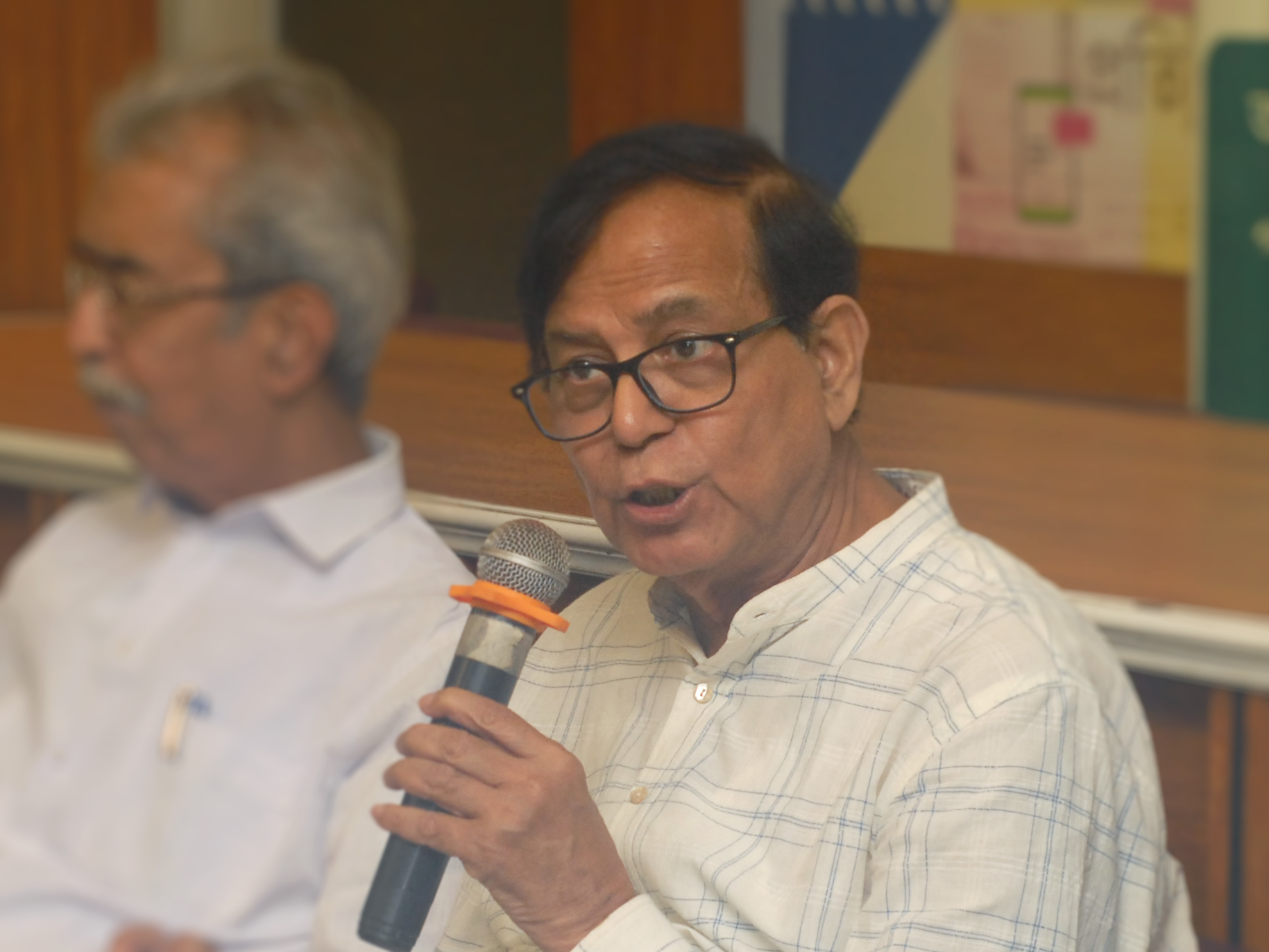
(This first-person account is based on the speaker’s recorded speech on March 28, 2026, at Kolkata Press Club, delivered during the event Politics meets Paribesh organised by The Plurals, Bengal environment Journalists Platform and nonprofit EnGIO.)