
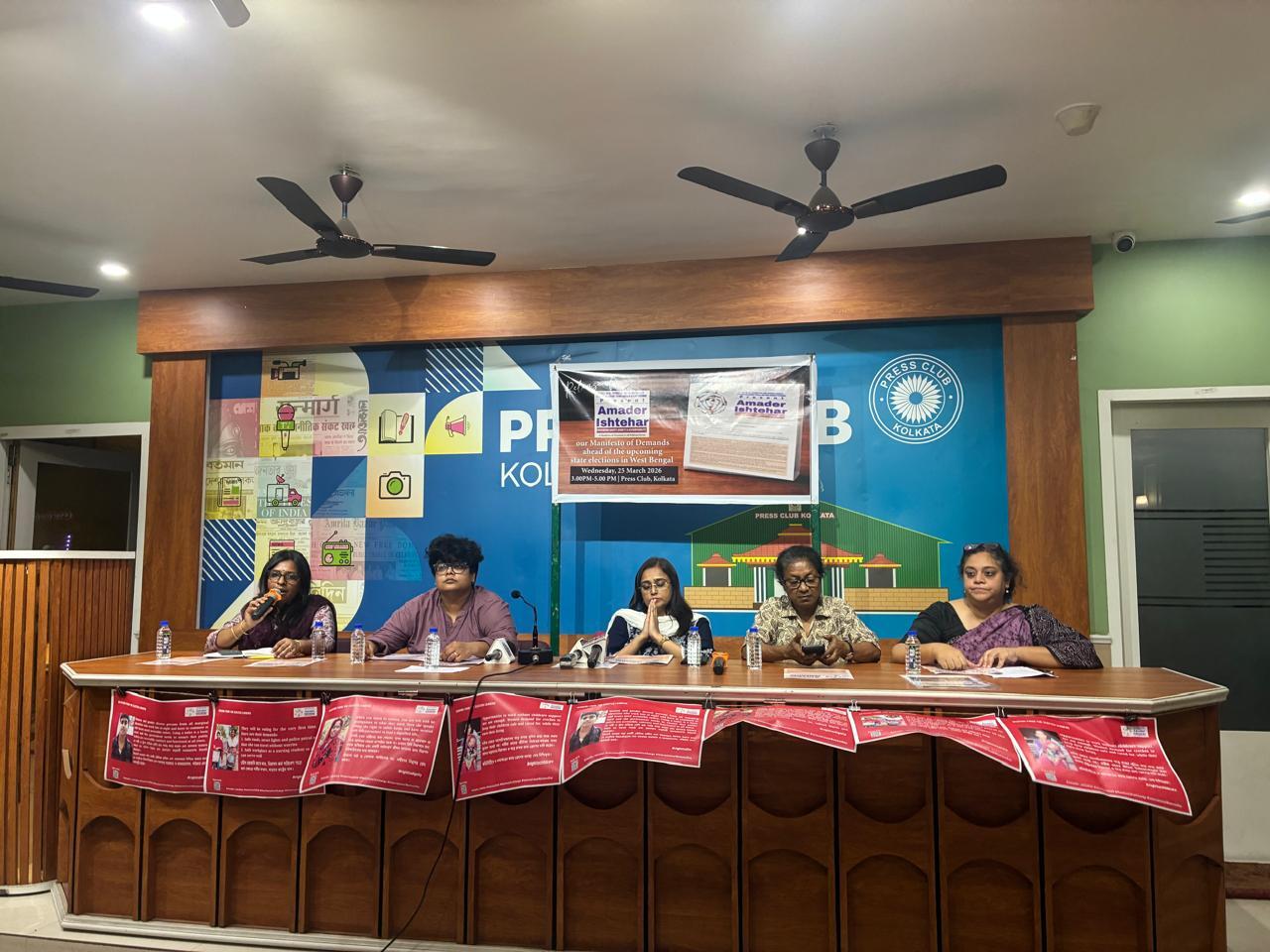
In the run-up to the West Bengal Assembly elections scheduled to be held in end-April, a platform of women activists on Wednesday demanded safety, dignity and accountability from political parties, citing statistics that reveal the dark side of state of women’s security in the state.
Amader Istahar, a platform that describes itself as a collective of women in all diversities, articulated its charter of demands related to these concerns at a news conference held at Kolkata Press Club. Anindita Majumdar, member of the women’s rights network Maitree, referred a safety audit conducted by Maitree in Kolkata and six districts of West Bengal, which found that only about 12 per cent of the sampled women felt safe in public spaces.
The panel referred to the 2023 National Crime Records Bureau data that mentions more than 34,000 crimes against women in the state, while the conviction rate remains barely 3.7 per cent. The activists pointed out that 22 sitting MLAs from West Bengal have declared that they are undergoing trial in courts for crimes against women.
Accountability of political parties a key demand
Accountability was the keyword, as the speakers highlighted the need for all political parties to respond to what often goes unnoticed about women — their daily struggle just to have a safe home, workspace, environment, access to law and to infrastructure, including toilets — and act to ensure safety and security.
In order to feel safe, a woman has to constantly negotiate the spaces she inhabits. “We asked what is missing at the policy level so that she has to go through this. We feel the missing point was accountability,” said Majumdar.
Safety for women became a critical concern for campaigns after an on-duty woman doctor was raped and killed at RG Kar hospital in Kolkata, her workspace, in the early hours of August 9, 2024 — an incident that shook the state and country and also made news globally. The mother of the murdered doctor is contesting the upcoming elections from the BJP, her campaign built on the demand of “justice” for her daughter.
Amader Ishtehar highlights “governance accountability” and “accountability within political parties” as key to the concerns about women.
A separate department for women demanded
Feminist disability rights activist Kuhu Das and all other speakers repeatedly spoke about the requirement to not look at women as an undifferentiated category.“The NCRB data does not mention how many of the crimes against women were against disabled women or gender-diverse persons,” said Das. “We have to understand that women are not a homogenous group”. — diverse groups should be kept in mind,” she said.
Das stressed the need for a separate department for women’s rights and empowerment. “Often the funds meant for women and children are diverted into programmes for children,” said Das. Presently the welfare of both women and children come under a common department.
Amader Ishtehar demanded 50 per cent representation of women and gender-diverse persons in all political parties. “The platform is against the Draconian Transgender Bill and demands its withdrawal,” Das said.
The charter also demands prevention of gender-based violence, safe and equitable economic opportunities and justice systems that work on ground.
Register complaints against violence by families
Queer-feminist activist Koyel spoke about the family as not being a safe space often. “Even as we speak, the Transgender Bill is being heard in the Rajya Sabha. It will allow a medical board to decide the gender of an individual. Even individuals and organisations who help in the rehabilitation of transgender people may be criminalised,” said Koyel.
The family, said the activist, is often the place where queer individuals face violence. “Police systems should be ready to register complaints about this violence.” It is the state’s responsibility. Protection officers must be educated.
The activist highlighted the need for access to basic public infrastructure such as toilets for women. “Many women cannot use toilets for 8 hours outside their home,” said Koyel.
Political parties should take actions against sexual harassment at their workplace
Social worker Ujjaini Halim pointed at the requirement of political parties defining themselves as organisations where women work. “The law on sexual harassment at the workplace does not apply to political parties,” said Halim, highlighting again that 22 MLAs are presently facing trial for crimes against women. She stressed the accountability of all political parties to start addressing the matter from within their own organisations.
“Political parties should constitute their own Internal Complains Committees (ICCs). The parties should be fully compliant with the Prevention of Sexual Harassment (POSH) Act. No candidate accused of crimes against women is to be nominated by any party,” said Halim. The panel also demanded the Right to Recall to be applied to elected political representatives.
The women are most vulnerable to climate change
The activists said that environmental degradation and climate change affect all women, especially the socio-economically challenged sections. “Unorganised section women workers in particular are severely affected by climate change,” said women’s rights activist Paramita Chowdhury.
Workspace safety cannot be considered without factoring in the effect of climate change on women, the panel felt. “In future, we hope to be thinking about mechanisms such as heat compensation,” said Chowdhury.