
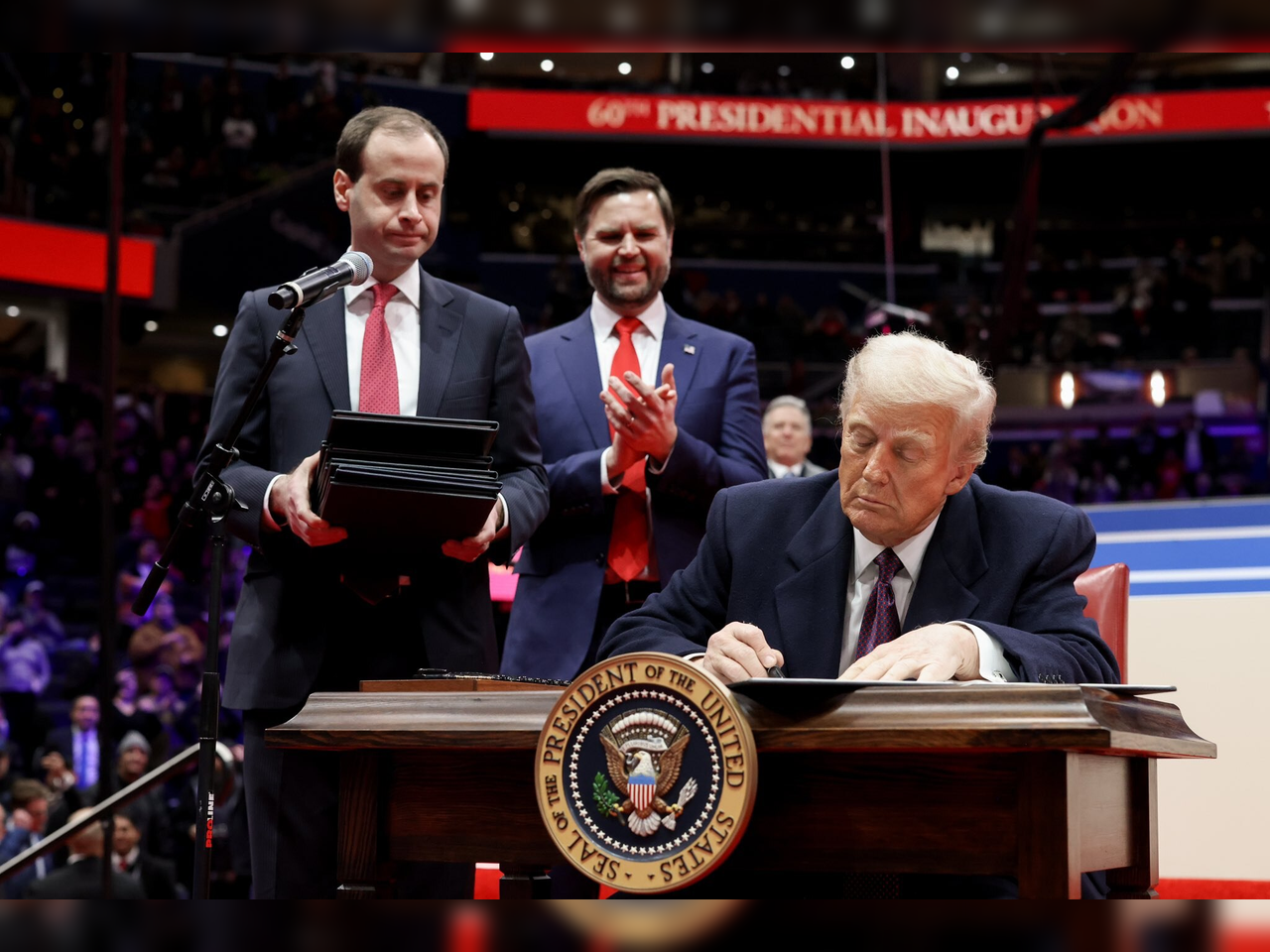
US President Donald Trump’s new year resolutions seem to be wide ranging : from abducting the Venezuelan President from his bedroom to abandoning climate action.
One year after withdrawing from the Paris Agreement, Trump on Wednesday signed an executive order to withdraw from 66 organisations, which include UN-related and other global organisations working on climate change, labour and migration concerns, sending a clear signal that the US is distancing itself from the global effort to address climate change.
Among the 31 UN-related organisations that the US is withdrawing from are the UN Framework Convention on Climate Change (UNFCCC) and UN Population Fund. The withdrawal from UNFCCC is particularly significant, as the Paris Agreement was built upon it. The exit from UNFCCC signals that the US wants to be outside the ambit of the entire framework of climate negotiations.
The US had previously withdrawn support to the World Health Organization, UN Human Rights Council and UNESCO, the UN cultural agency, among other UN organisations. It had slashed help to the US Agency for International Development (USAID). which affected the work of non-governmental organisations worldwide.
The US is now the only country in the world to have withdrawn from UNFCCC.
The non-UN global organisations that the US is exiting from, according to Wednesday’s executive order, include Intergovernmental Panel on Climate Change, Partnership for Atlantic Cooperation, International Renewable Energy Agency, International Solar Alliance and International Institute for Democracy and Electoral Assistance.
‘Redundant and mismanaged’
“The Trump Administration has found these institutions to be redundant in their scope, mismanaged, unnecessary, wasteful, poorly run, captured by the interests of actors advancing their own agendas contrary to our own, or a threat to our nation’s sovereignty, freedoms, and general prosperity,” a US State Department statement said.
The withdrawal comes less than a week after Trump’s decision to abduct Venezuela’s President Nicolás Maduro. Trump has said that US companies will start work on the oil in Venezuela, which has the highest oil reserves, signalling the priority fossil fuel has in his economic vision for his country. He has been criticised severely for abducting Maduro and for his plans on using Venezuela’s fossil fuel.
Trump himself has always been contemptuous of any attempt to counter climate change, pushing a business model heavily dependent on fossil fuel, despite the world moving towards an economy based on renewable energies. He has been similarly intolerant of views on migration, labour and gender nonconformity, dismissing them as “woke” views.
“Climate change con job”: Trump
Recently, Trump had described climate change as a “con job”.
Speaking in September 2025 at the UN General Assembly he had said: “This ‘climate change,’ it’s the greatest con job ever perpetrated on the world, in my opinion…All of these predictions made by the United Nations and many others, often for bad reasons, were wrong. They were made by stupid people that have cost their countries fortunes and given those same countries no chance for success. If you don’t get away from this green scam, your country is going to fail.”
Experts are concerned about the fall-out of Trump’s actions not only on the world, but also on the US and its economy. They feel that with the Trump administration’s exit from global agencies, it is prioritising the needs of the oil industry over the interests of the United States and the world.
Good news for China?
The cost of promoting a fossil fuel economy is another concern. China may be the highest carbon-emitter in the world, but it is making remarkable advances with renewables.
Experts also stress that the energy transition globally will not be halted, despite Trump’s actions. In what may not be music to Trump’s ears, with these two factors acting together, China may benefit from his actions.
In 2025 renewables emerged as a cheaper form of energy compared to fossil fuels, which indicates good health for its markets. The International Energy Agency estimates that global renewable power capacity is expected to shoot up now, doubling between 2026 and 2030, going up to 4,600 gigawatts (GW). Renewables constituted for 92.5% share of the total capacity expansion in 2024 at a record rate of annual growth at 15.1 per cent.
China has emerged the world leader in renewable energy.
Former US top officials countered Trump
“Nothing is surprising about (the Trump administration’s) attitude about the climate crisis or the value of institutions. This is par for the course. But it doesn’t change the fact that it’s a gift to China and a get out of jail free card to countries and polluters who want to avoid responsibility. It’s another self-inflicted wound on the world stage, and the price is always paid by kids, in lost health, squandered jobs, rising costs, uninsurable infrastructure, and worse consequences,” said John Kerry, 68th US secretary of state and former special presidential envoy for Climate.
Sue Biniaz, former US state department’s principal deputy special envoy for climate until January 17, 2025, after which Trump took over as President for his second term, reminded that Trump’s actions may not be final for the US or overwhelm global movements: “Climate action won’t stop because of the latest US treaty withdrawal, either in the US or globally. And the federal retreat is, hopefully, a temporary one. There are multiple future pathways to rejoining the key climate agreements. For example, I agree with treaty scholars who consider that the US could rather seamlessly rejoin the UNFCCC based on the Senate’s approval in 1992.”