
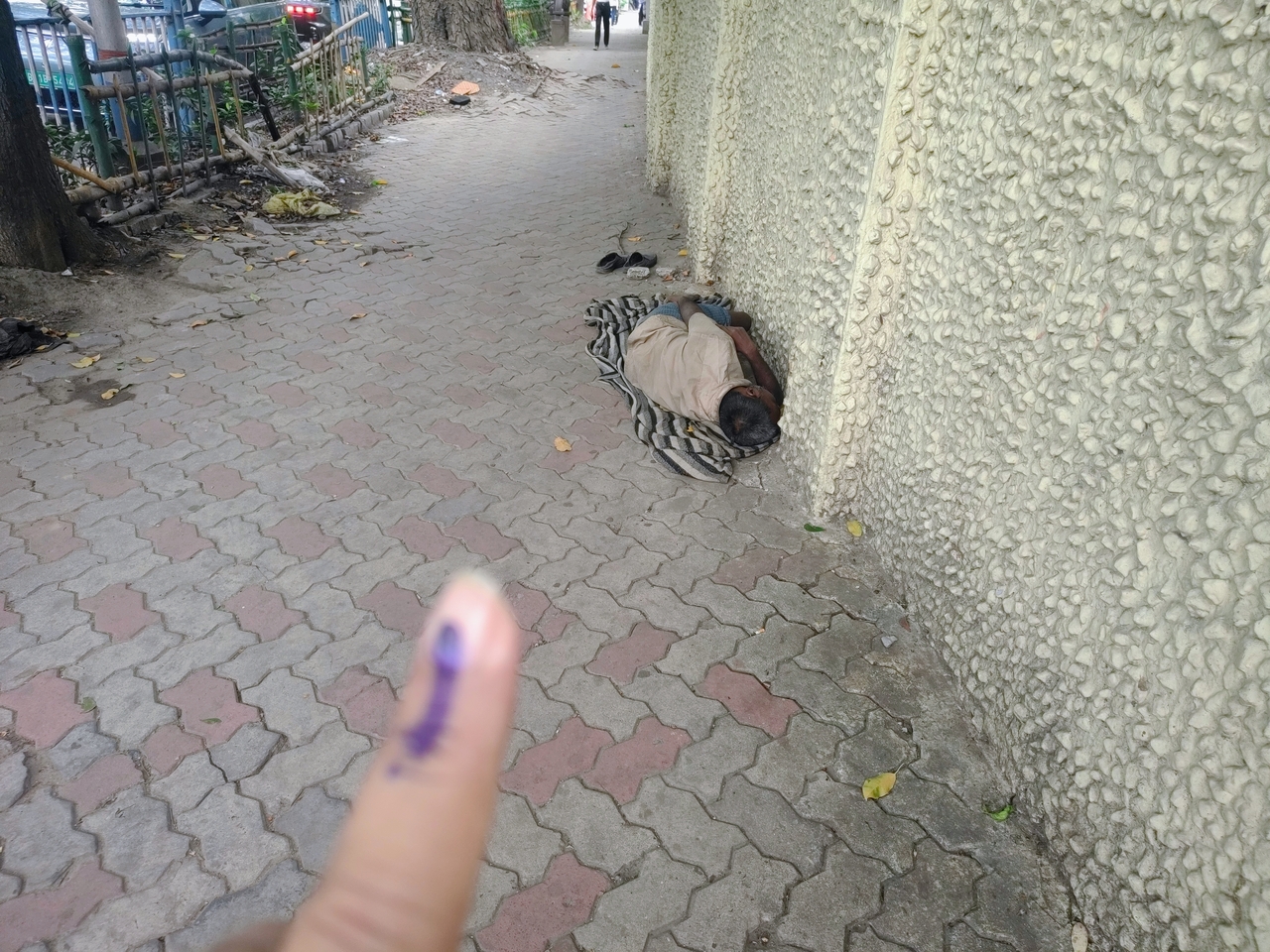

“I have all the documents possible except the death certificate,” chuckles Bapi Pal, who lives under the Gariahat Bridge in south Kolkata. “But nobody came to me for SIR.”
Pal, a middle-aged street dweller, has been living under the bridge, home to many more street-dwellers like him, since the late 90s even before the bridge became operational. Having identity papers and other documents is not easy for a street-resident; eviction, incidents of violence or flooding are regular reasons for their displacement. Pal, however, maintained all his papers meticulously, prepared for the day they would be perhaps required.
But no one approached Pal. No one approached an estimated population of several lakhs like him in Kolkata, who live in streets or pavements. and they could not vote in the just-concluded Assembly elections in Bengal. It seems the homeless were invisible to the Election Commission of India (ECI), which conducted SIR.
Falling from the map
The names of more than 9 million people have been deleted from the electoral rolls in West Bengal during the SIR process, which has drastically revised electoral rolls. The deletions include the names of 2.7 million, who were mapped initially but then were dropped after being placed under the “logical discrepancy” category. About 3.4 million, including many whose names were deleted on account of “logical discrepancy” have now moved SIR tribunals to get back their voting rights, but that may take years to come.
The missed pavement dwellers do not belong to either in the “unmapped” or the “mapped” categories. They were simply invisible to the latest electoral process in the largest democracy of the world. “As per our information, there has been no specific effort to include the pavement dwellers in the voting rolls, which is unfortunate,” pointed out Sabir Ahamed, a researcher representing Sabar Institute, a Kolkata-based organisation that has been closely analysing the SIR process in the last few months.
Street dwellers fall through the gaps of the “system”, just the way COVID made apparent that migrant labourers also do.
Lakhs may be living in Kolkata streets
According to the 2011 Census of India, there are nearly 70,000 pavement dwellers, categorised as “houseless population”, living in the streets of Kolkata. Several independent studies, though, indicate that the number may reach up to several lakhs, depending on how “homelessness” is classified. The last Census also shows that West Bengal had a total homeless population of 134,040 individuals. More than half of them live in Kolkata, with the remaining population lives scattered across other districts such as Howrah, North 24 Parganas and South 24 Parganas.
Clearly a large section of the pavement dwellers could not vote in the Bengal elections, held on April 23 and April 29, and therefore, will have no role in choosing the next government in Bengal.
According to the 2011 census, there are approximately 1.77 million homeless people in India, a figure that is likely to be around 2 million at present. If the ECI continues to ignore the pavement dwellers from SIR, a population around three times larger than that of Maldives will be excluded from the national electoral process.
Mandal and others
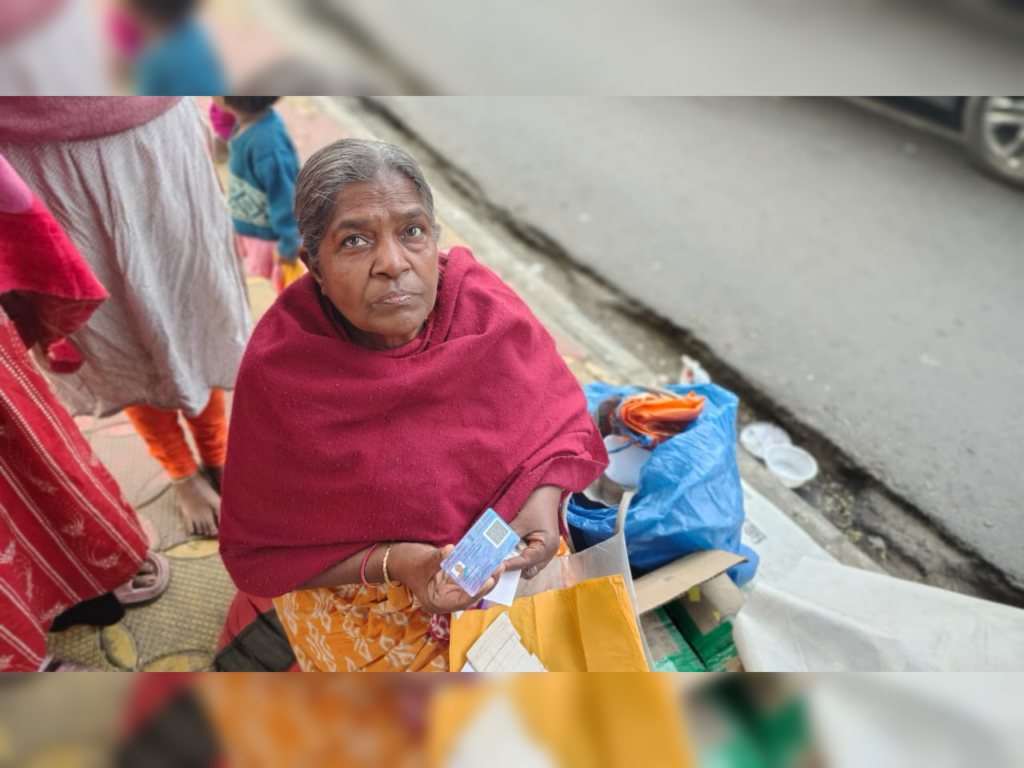
Sabita Mandal, a pavement dweller staying in a street near Golpark in south Kolkata for the last seven years, is one of them. On April 29, the day Kolkata voted, Mandal, in late sixties, watched with a blank face people queuing up at a nearby booth to vote. Mandal, who is partially blind, lives on the pavement with her frail husband after having left her erstwhile home due to family discord, has a voter card, but no one reached out to her for the much-vaunted SIR process. “Amar voter card ache, kintu keu aseni (I have a voter card, but no one came to me)”, said the elderly lady.
Many like Mandal have Aadhar cards and PAN cards, but the ECI is seen to have made no effort to reach out to these people despite repeating its “no voter to left out” slogan.
A team from The Plurals, comprising this correspondent and social workers Sanjit Ghosh and Jayati Ghosh, recently surveyed nearly 25 pavement-dwelling families across the city. The team found that the majority did not get an SIR-related call, barring the few who retain a connection with their native places and got mapped through those linkages.
No order from ‘SIR’
Several senior officials of the ECI and Booth Level Officers (BLOs) confirmed to this correspondent, on condition of anonymity, that there has been no clear directive to include pavement dwellers in the SIR process. A question on whether ECI has passed a specific order to include pavement dwellers in the SIR process in Bengal, sent through WhatsApp to the Election Commission chief executive officer in the state Manoj Agarwal, in this regard, went unanswered.
Pavement dwellers in India have the legal right to vote, just like any other eligible Indian citizen. Article 326 of the Indian Constitution and the Representation of the People Act, 1951, grant every Indian citizen aged 18 or above, who is not otherwise disqualified, the right to be registered as a voter and to vote in elections.
The law mandates, experts point out, that being homeless or living on the pavement cannot be a ground for disqualification as a voter.
The homeless has right to vote
“No documentary proof of residence is mandatory for homeless applicants. In Form 6, the application form for voter registration, if no standard address proof is available, the BLO must conduct field verification by visiting the location, such as a specific pavement, streetlight, flyover or night shelter at night, often multiple times, to confirm the person actually sleeps or resides there. Once these are verified, a person can be enrolled,” said Kallol Bose, a senior lawyer on Thursday.
Biswajit Mukherjee, a retired chief law officer in a West Bengal government department, reiterated this. “Being a pavement dweller does not rob one of exercising his or her voting right. Rather the ECI should make an extra effort to include them in the voter rolls,” he said.
“However, during the last SIR process there was no effort to include this marginalised population, many of whom are vagabonds, beggars or work in the unorganised sectors, such as brick fields, construction sites and small industries. The ECI never approached these people in Chandannagar, where I stay,” added Mukherjee.
The Union law minister in 2015, DV Sadananda Gowda, had confirmed in Parliament that “being homeless is not a disqualification for enrolment (as a voter).” He had assured, in a written response, that the ECI strives to enrol every eligible citizen. Law Ministry is the administrative ministry for the ECI. The ECI’s Manual on Electoral Rolls also explicitly covers “Homeless/pavement Dwellers” under ordinary residence determination.
Debasish Sen, a former chief election commissioner in Bengal, agreed that every Indian citizen is entitled to vote including the pavement dwellers. “When I was in charge, we introduced a system to enrol pavement dwellers, linking their location to the nearest lamp post,” Sen had said to this correspondent. According to sources, in areas such as Delhi, addresses like “House No 0” or locations under flyovers or streetlights have been used in voter lists for mapping pavement dwellers.
Are not we Indian citizens?
Most pavement dwellers, with whom The Plurals team interacted, said even if they would have got a call for SIR, it might not have possible to show all the documents the process demanded from a person.
“In any case, we barely exist. How can we show so many documents? In the first place, we never have many papers. Also a number of them were lost when there was a large-scale waterlogging in the area,” said a middle-aged pavement dweller near Ballygunge Phari in south Kolkata, who wanted to remain anonymous in fear of a reaction from administration. “Moreover, when the police and corporation people come to evict us, they often damage our documents. My question is, can’t the ECI consider our cases favourably? Are we not Indian citizens?”
Others agree. “Many of my documents got lost, how can you possibly save those in the face of the challenges we regularly have to face?” asked Jamuna Kapadia, who stays on a pavement close to Ballygunge Phari. Jamuna, who grew up in the streets, completed her graduation from a nearby college and was awarded for her exemplary effort, could get her name enrolled in the voter list with the help of local political workers who know her for her achievement.
Kabita Bahadur, who, like Bapi Pal, the man who said he just lacks his death certificate, stays under the Gariahat bridge, not far from Ballygunge Phari, echoed Kapadia: “I have Aadhar card and also PAN Card, but no voter card; and none came to me for SIR.”
But election candidates did, seeking votes. “See the irony, candidates from several parties came to us seeking votes, not perhaps knowing that we did not have votes. We did not tell anything to them, but enjoyed the attention,” laughed a neighbour of Bahadur.
When the system cannot see you, you can laugh at it.