
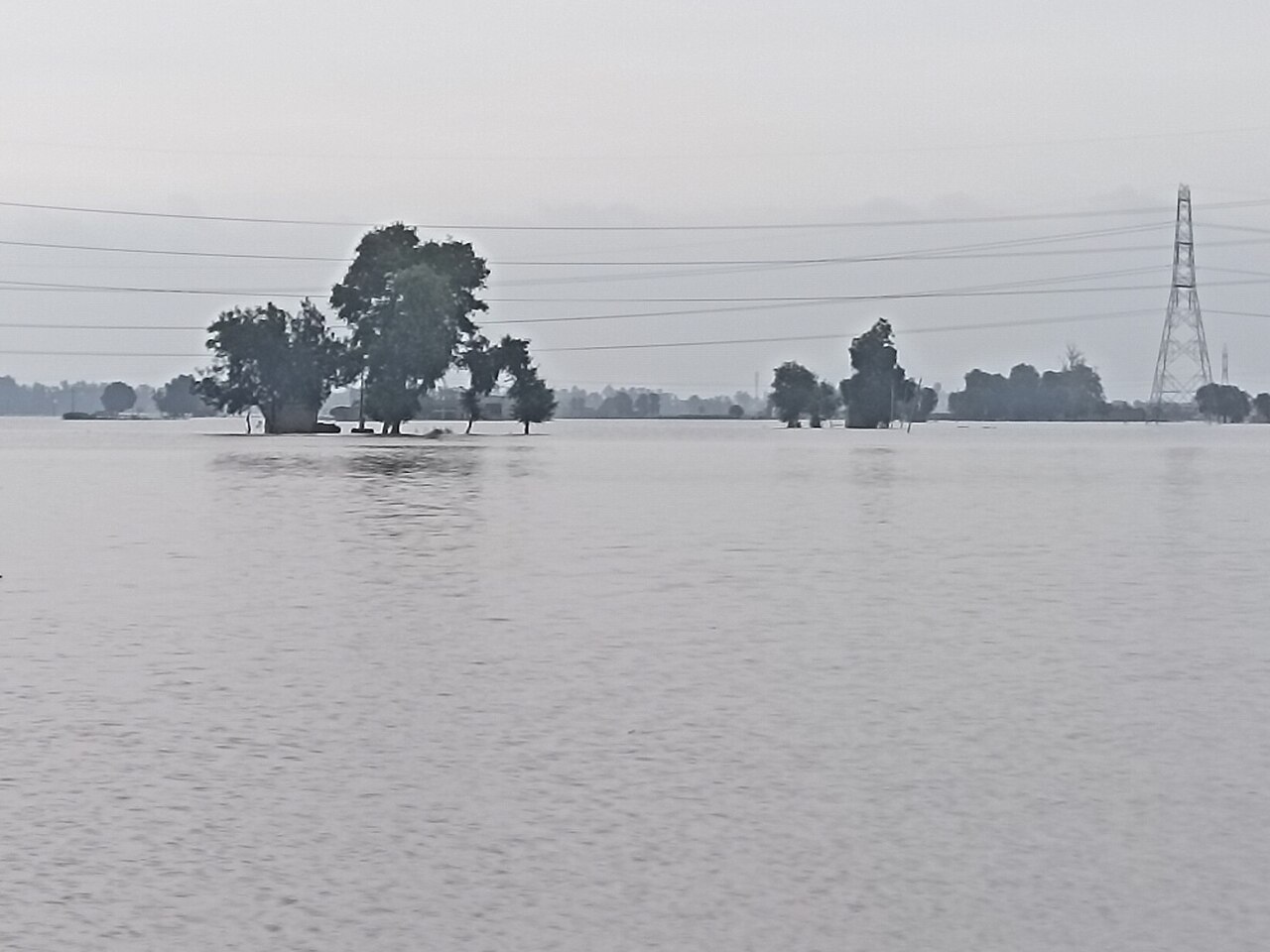

The latest Indian monsoon season, which recorded 8 per cent more than normal rainfall and was one of the highest in recent years, has triggered the greatest number of fatalities among the top global disasters during 2025. It is also the fifth highest in terms of cost among climate disasters of the year, alongside similar disasters in Pakistan, shows a global report that was published around midnight of Saturday in London.
The new Christian Aid report, ‘Counting the Cost 2025’, has found that heatwaves, wildfires, droughts and storms cost the world more than USD 120 billion in 2025, when only the top ten disasters affecting the world were counted.
“The report underscores the escalating cost of climate change, with fossil fuel companies playing a central role in driving the crisis … the greatest toll (being) felt in the world’s poorest counties,” reads the report, a copy of which is with The Plurals.
“The fingerprints of fossil fuels are all over the list of the year’s most expensive disasters. Whether it is the storm-ravaged coasts of the US or the flooded plains of South Asia, the common denominator is clear: a warming world driven by oil, gas, and coal. This year’s balance sheet of destruction proves that no border is safe from the fossil fuel crisis,” said Harjeet Singh, global climate activist and Founding Director, Satat Sampada Climate Foundation.
“The latest Christian Aid report shows that while climate disasters are growing more costly, the US continues to treat climate action as optional, doubling down on fossil fuel expansion even as two of the world’s most expensive disasters struck the US this year,” observed Sanjay Vashist, director of Climate Action Network South Asia (CANSA), a leading global civil society platform, on Saturday morning.
Costliest 10 disasters
The report identifies the year’s 10 costliest extreme events influenced by the climate crisis, each causing over USD 1 billion in damage. No continent was spared from the devastation of climate disasters in 2025, with at least one disaster in each of the six populated regions of the world finding mention in the report.
Two of the top 10 costliest disasters occurred in US, including the Palisades fires and Eaton wildfires in California that cost more than USD 60 billion. The financial loss due to the monsoons from June to September triggered extreme rainfall, flooding and landslides in India and Pakistan, and cumulatively, was estimated at USD 5.6 billion, more than Rs 50,000 crore. Asia accounted for four of the six costliest disasters with flooding in India and Pakistan killing more than 1,860 people, adds the report.
The disasters caused by cyclones in Thailand, Indonesia, Sri Lanka, Vietnam and Malaysia together have been ranked the second most expensive causing an estimated USD 25 billion loss, while China’s extreme rainfall and flooding from June to August was responsible for a loss in the tune of USD 11.7 billion. Category 5 hurricane Melissa, which devastated Jamaica, Cuba and Bahamas in end October, was the fourth most impactful financially with a loss of USD 8 billion followed by the monsoon of India and Pakistan .
The report points out that most of these estimates are based only on insured losses, meaning the actual financial costs are likely to be higher, while the human costs are often uncounted.
“These disasters are not ‘natural’ — they are the predictable result of continued fossil fuel expansion and political delay,” said Emeritus Professor Joanna Haigh from Imperial College London. “This year has once again shown the stark reality of climate breakdown…The poorest communities are first and worst affected. These climate disasters are a warning of what lies ahead if we do not accelerate the transition away from fossil fuels,” added Patrick Watt, Christian Aid CEO.
Marauding monsoons
India’s monsoon season started with the wettest May since records began. By September, the country had received 8 per cent more rainfall than the average, with 2,277 flood and heavy rain events recorded,” reads the report.
“The last summer was above normal and it was on predicted line,” admitted Mrittunjoy Mahapatra, the director of Indian Meteorological Department (IMD) to The Plurals on Friday night.
The IMD report says that the rainfall during the “2025 southwest monsoon season (June- September) was 108% of its long period average (LPA)” with figures higher than normal in all regions barring Northeast India. The report identifies the 2025 monsoon as one of the strongest in recent years, the biggest since 2020.
“The total rainfall from June to September 2025 was 937.2 mm, which is considered ‘above normal’ … This marked the second consecutive year of above-normal monsoons,” says the IMD report, adding that 14 of the 18 monsoon weeks delivered excess or large excess rainfall.
The Christian Aid report echoes this. “From June to September, large parts of India and Pakistan experienced an exceptionally heavy monsoon season. Torrential rains began early, triggering deadly floods, landslides, cloudbursts, and flash floods, particularly in mountainous regions. Across the region, rivers overflowed, farmlands were inundated, glacial melt worsened flooding, and thousands of towns were submerged,” reads the report.
Not a single monsoon day was spared
A recent assessment carried out by the think-tank Centre for Science and Environment (CSE) on disasters in India during 2025, mainly based on official data, highlights the devastating impact of disasters during 2025, particularly the monsoon.
“India faced extreme weather events on 99 per cent of days in the first nine months of this year, marked by heat and cold waves, lightning and storms, heavy rain, floods and landslides. These events claimed 4,064 lives, affected 9.47 million hectares of crops, destroyed 99,533 houses, and killed approximately 58,982 animals,” reads the CSE report, adding that the damage is likely to be underestimated due to incomplete data.
The CSE report shows that India witnessed extreme weather on all 122 monsoon days in 2025, spanning 35 states and union territories. “Heavy rain, floods, and landslides occurred daily, followed by lightning and storms on 104 days, cloud bursts on 17,” states the report. It adds that Himachal Pradesh was worst hit, as it was affected on 103 days, followed by Gujarat and Madhya Pradesh, with disasters happening on 94 days for each state.