
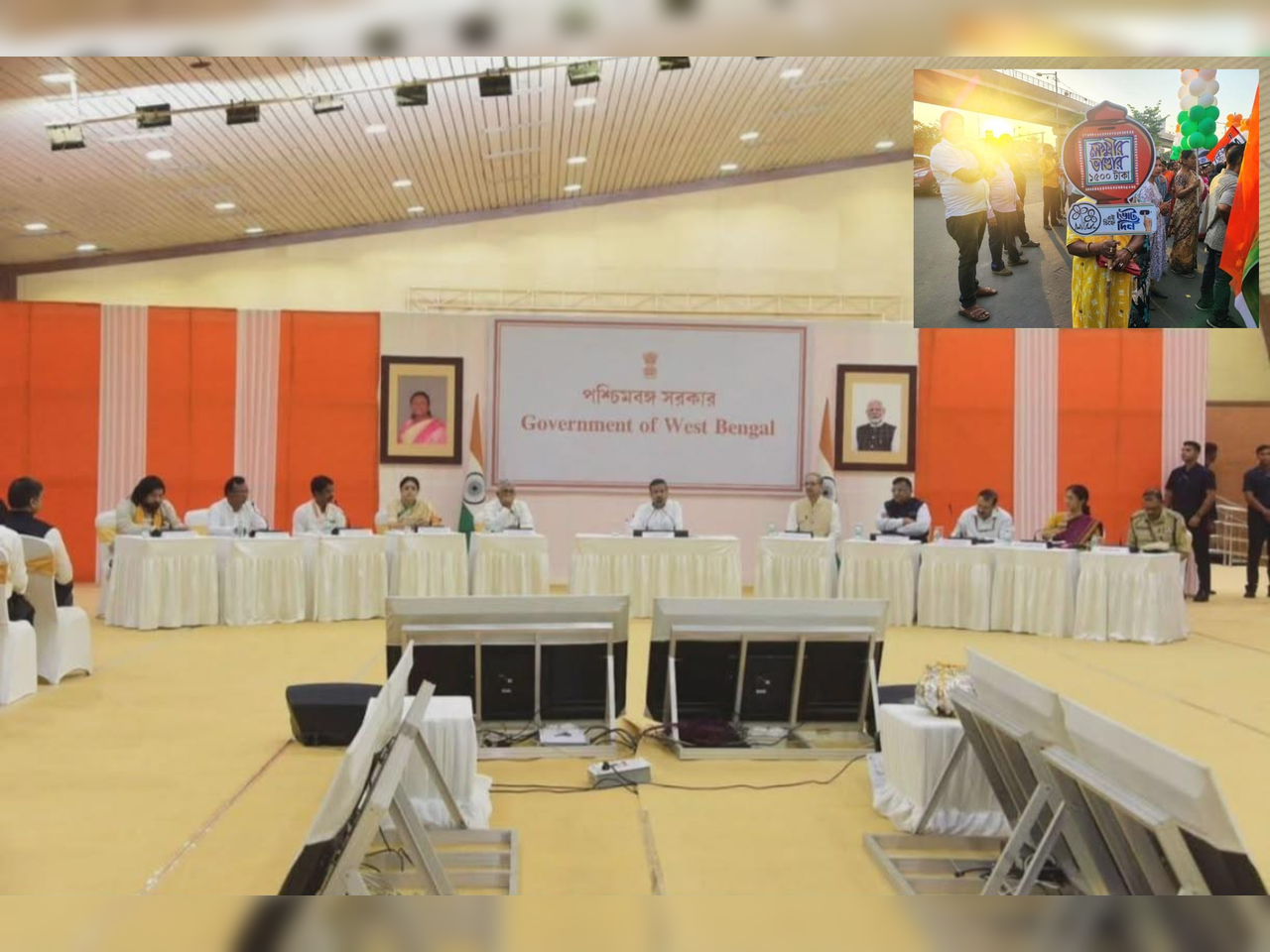
Lakshmir Bhandar is dead. Long live Lakshmir Bhandar.
As the Bhartiya Janata Party (BJP) formed its first-ever government in West Bengal on Saturday, defeating the Mamata Banerjee-led Trinamul Congress (TMC) and proving many poll pundits wrong, economists and experts pointed out that the social welfare-heavy governance of the erstwhile 15-year-old regime was one of the key factors behind the TMC’s loss.
However, the Mamata model is set to continue in the state, albeit with rebranding: Lakshmir Bhandar is to be changed into Annapurnar Bhandar and Swasthya Sathi into Ayushman Bharat. Several other central schemes, over and above Ayushman Bharat, have been formally cleared on Monday by the new state government to be introduced in the state. In the Mamata era, many of these could not be introduced in the state as differences mounted between the then state government and union government mostly on the naming and administrative control of the projects.
On Monday, after the first cabinet meeting of the new BJP government held at Nabanna, Chief Minister Suvendu Adhikari reiterated the policy by stating that all the welfare projects of the earlier government would “continue with transparency” without specifying details. “Let me clarify, no ongoing social welfare projects will be stopped … we said it even during our election campaign. Any ongoing project, be it 30 years old or 10 years old, will not be closed down,” said CM Adhikari.
However, experts in the social sector expressed apprehension that stringent norms may apply to the eligibility of the beneficiaries in the future, leading to the cutting down of its numbers.
Bengal sucked into a debt trap
Mamata Banerjee’s government introduced more than 90 social welfare schemes, covering education and health to rural development and financial aid for women. These led to an annual cost of approximately Rs 1.8 lakh crore on welfare schemes, around 7.5–7.8% of the state GDP and nearly 45% of the state’s projected expenditure in 2026-27, which was around 3.95 lakh crore.
Out of this expenditure, Rs 42,000 crores was earmarked for Lakshmir Bhandar—a monthly amount of Rs 1,500 for all women of West Bengal aged between 25 and 60 years barring those working in the government sector and Rs 1,700 for women from the scheduled castes and tribes. Rs 5,000 crore was earmarked for the financial support scheme for unemployed youth, named Yubasathi, introduced just before the election.
In contrast, spending on physical infrastructure had fallen to around 3% of the GDP spending, which was around 5.3% in 2019. Economists and experts said that the state moved towards a debt trap of approximately Rs.6.9 lakh crore by 2025. This was around Rs 2 lakh crore when Mamata assumed power in 2011, defeating the left rule of 35 years.
“West Bengal is a case study on how a state’s finances can go haywire through excessive investment in the social sector. While no one denies the need to invest in the social sector, it must keep a balance with investment for long-term development by funding industry, infrastructure, and the like,” said Buroshiva Dasgupta, a senior business journalist and academic.
Yet the Mamata model survives
Despite such opinions, however, the Mamata-built welfare model, particularly the direct monthly cash transfers supporting women and unemployed youth, is set to continue in West Bengal. The BJP, in its Sankalp Patra, or manifesto, leading to the election, had committed to continuing the same model by enhancing the amount of cash allotment to neutralise Mamata’s political weapon—women-centric welfare schemes, which critics called a newer version of dole. These schemes were mainly responsible for her election victories between 2021 and 2026. The BJP had initially opposed the cash transfer schemes.
BJP president Shamik Bhattacharya accepted the political compulsion of pursuing the model even for a cash-strapped state like West Bengal before the elections and had assured that once the BJP came to power, schemes such as Lakshmir Bhandar would continue, though rebranded.
“We made a course correction after initially opposing such schemes, as they are clearly working as an election tool across the country, even during the latest Bihar and Jharkhand elections,” admitted a senior BJP leader.
Dole factor lost steam, adding to anti-incumbency wave
In the 2021 Assembly elections, when the TMC won with a vote percentage of 48.5—a 10 percent lead over the BJP—many credited the slew of social schemes for the victory. In 2026, the positions reversed with an 8 percent swing away from the TMC, which got 40.8 percent of valid votes, while the BJP received 45.84 percent.
“Alongside the Special Intensive Revision (SIR) that led to deletions in lakhs, complaints of large-scale corruption, joblessness, and excesses by TMC leaders during the Trinamul rule, Mamata Banerjee’s government’s failure to balance spending in the social sector with infrastructure and industrial development was a major reason for the slide,” claimed a poll analyst.
Even a section of common people, beneficiaries of the Trinamul schemes, started to doubt their future due to the state’s worsening economic situation. “Two women in my family get Lakshmir Bhandar, and my parents receive bardhakya bhata (financial support for elders); I have applied for Yubasathi. There are other benefits as well. Overall, we tend to get around Rs 8,000 per month on average from government schemes. However, we became sceptical about how long this might continue because we heard that Mamata Banerjee’s government had no money. As the BJP is linked to the central government, we expect them to continue the support,” observed Sibabrata Haldar, who stays in Gosaba in the Sundarban region, on the southern fringe of the state. Haldar, originally a TMC supporter, also accepted that the BJP’s promise of doubling the amounts played a role in reversing the support.
The BJP won the Gosaba seat, despite having hardly any organisational strength. As a matter of fact, a large-scale erosion in the TMC support base in south Bengal, a Trinamul bastion until recently, could be seen in the recent elections.
Trinamul leaders disagreed. “I do not think that people doubted the financial support schemes. As a matter of fact, their success prompted the BJP and the Indian national Congress to propose similar schemes in West Bengal even after ridiculing them initially,” said senior TMC leader Sovandeb Chatterjee, who has been appointed the leader of the Opposition in the new Assembly. “We feel that a large section of voters, especially female voters who voted in record numbers, supported us in the last election due to these schemes,” he added.
Economists debate model’s worth
“This (dole economy) is all about politics. The sectors such as education, health, and infrastructure, which need investment for long-term development, received much less funding compared to what they deserved; and hence, the supply side will get affected. If this continues, there will be a significant shortage of funds soon for even taking forward the populist projects,” opined Ashok Lahiri, economist and politician, who has been recently appointed the vice chairman of Niti Ayog, the premier policy think tank of the Indian government.
“More money needs to flow into capital expenditure if West Bengal wants to pursue a high growth path that will create an enabling business environment, crowd in investments and create jobs,” said Nilanjan Ghosh, economist and head of think tank Observation Research Foundation (ORF), Kolkata. “This can be achieved by reallocating social sector spending, which sometimes results only in a transfer of payments without creating productive services, thereby increasing underemployment in the economy,” he said.
Amit Mitra, former finance minister of West Bengal and one of the architects of the direct cash transfer model, disagreed. “Studies and data show that if you give money directly to the poor, nearly 90 percent of it is spent, returning to the market and emboldening the local economy, while the affluent tend to underspend in comparison. Hence, the direct cash transfer, apart from helping those who need most, also helps the economy to a large extent,” Mitra had told this correspondent in the run-up to the elections.