
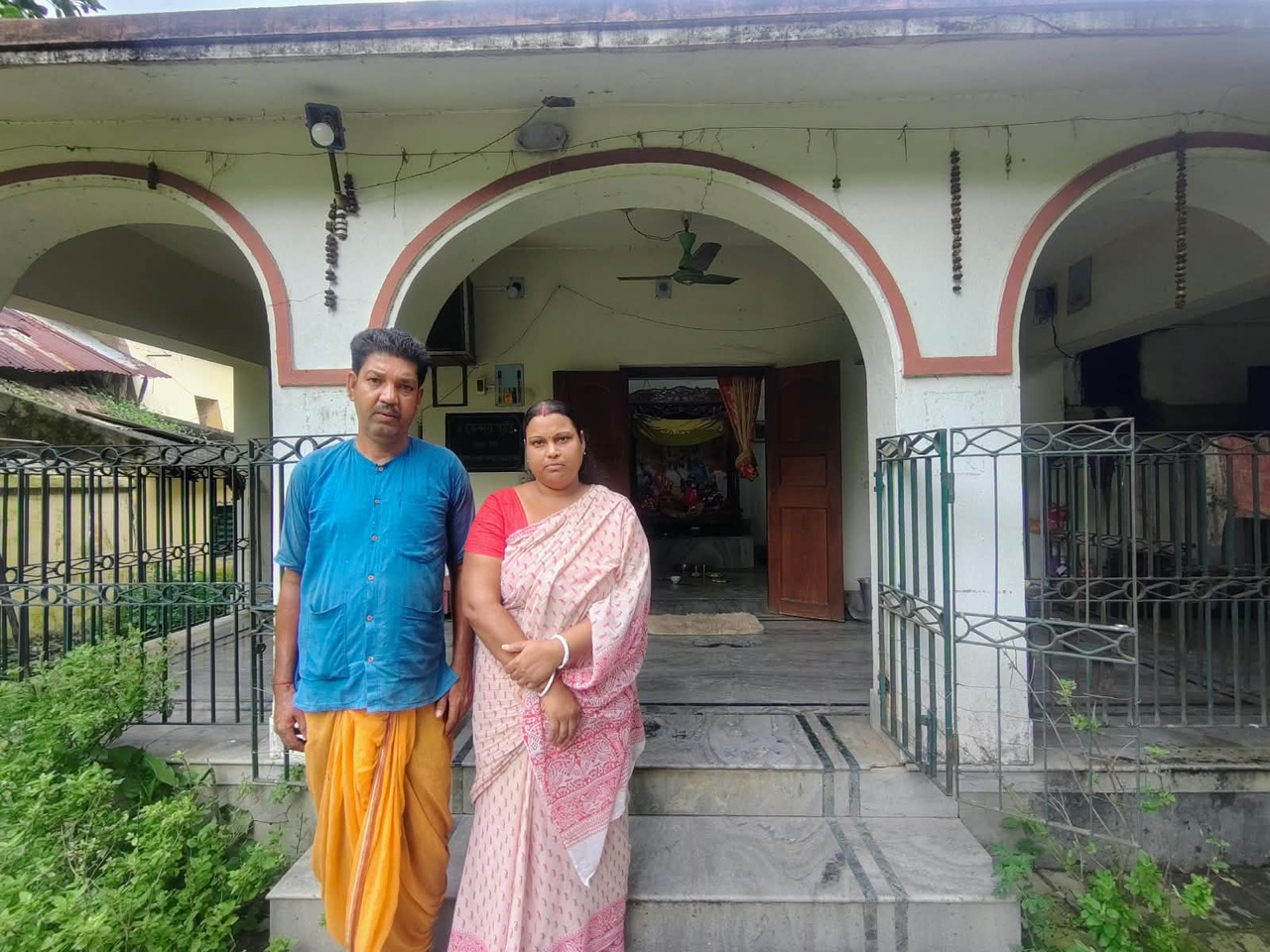

Barnali Mukherjee, an Integrated Child Development Services (ICDS) worker in Jadavpur village in Birbhum, has seen the demographic transition in her village literally in front of her eyes: how family compositions have changed over recent years.
Mukherjee, who was born, brought up and married in the village that is hardly 14km from Tagore’s iconic Santiniketan and has both Muslims and Hindus living peacefully together for decades, pointed out how that the size of families have been shrinking of late, including in her family.
“We are four brothers and sisters, but I have only one child. He is preparing for his board examination. The trend is similar in most families,” claimed Barnali, echoed by her husband Debu Mukherjee, who works in agriculture and works as a private tutor for a few students to support the family with Barnali.
“As an ICDS worker, I have to look after the pregnant women in the area. I have been working for about eight years. Earlier, I had to deal with 20 to 25 pregnant women simultaneously, but now the number has reduced to 5 to 6 in average. This applies more or less similarly to both Hindus and Muslims,” explained Barnali, adding that the rising educational and financial empowerment of women in rural Bengal, coupled with a much-reduced risk of infant mortality, contributes to the trend.
Survey shows clear pattern
Barnali’s version is more the rule than the exception in rural households across West Bengal. This correspondent spoke in detail with nearly 15 families from three districts—Birbhum, Hooghly, and South 24 Parganas—to understand the pattern and found that the trend is largely similar, though responses to some key questions vary slightly from area to area, mainly based on different socio-economic positions.
While Satjelia in Gosaba block of South 24 Parganas is the poorest among all three areas surveyed, Jadavpur, falling within the Sriniketan block in Birbhum district, is a moderately poor village dotted with many mud houses. In contrast, Krishnarampur in Chanditala 1 block of Hooghly seems much better off socio-economically, with predominantly brick-built houses on both sides of the narrow blacktop road running through the village like a spine.
Overall, almost all respondents interviewed across the gram panchayats—in a few cases, both husbands and wives were questioned together—agreed on most points linked directly or indirectly to the total fertility rate. The family size, especially the number of offspring, has reasonably shrunk over the last decade, though the reasons cited showed a wide range.
Reduced IMR strengthened few children choice
The infant mortality rate (IMR) has come down everywhere due to an improved health infrastructure, both physically and through governmental advocacy via an active network of ASHA workers and similar initiatives. However, heightened awareness among mothers, supported by better education and access to communication channels, has also contributed.
“The infant mortality has definitely declined significantly in our village and adjoining areas, and that must be giving parents confidence to have fewer children,” observed Chandan Mukherjee, who lives adjacent to Jadavpur village but works there. He and his wife Sharmistha have only one child, though both have several siblings.
This has been echoed by almost everyone surveyed.
Market force major driver
The majority, however, pointed out that the critical trigger for not having a large family is the rising cost of living coupled with reduced livelihood opportunities and income. “Life has become tougher, especially after COVID, with shrinking income. In villages, agricultural land has generally become smaller for each family as the larger family splits over time, and the cost of agricultural production has gone up a few notches; hence, no one can afford a big family like before,” observed Prasenjit Bag of Krishnarampur, who has only one daughter, who attends primary school.
“Akta bacchake ke bhalo kore manush kori (Let’s bring up one child properly),” is the popular refrain in most families, pointed out Ranu Mandal (name changed on request) from Satjelia village in Sundarbans, as the cost of living shoots up and families understand the value of education. “One of our close relatives, who had three daughters and two sons, died in a tiger attack while collecting fish and crabs in the forest, and I can see how the family is suffering now trying to find food for so many mouths,” remarked Asnara Begum, a neighbour of Ranu.
While many admit that poorer families often have comparatively larger numbers of offspring, they emphasised that the driver behind the trend is not poverty, but rather the government’s failure to reach the sector closely, apart from distributing some freebies and health workers making occasional rounds. “We have three daughters and a younger son. “Though the ASHA didis come to our house for polio, etc., we never had detailed discussions about family planning… we remain busy with one work or another,” said a middle-aged homemaker from a poor household in Sundarban. Her agriculture labourer husband never used any modern family planning device, the woman confided, when asked why they have so many children.
Many pointed out that many rural women now marry at a later age compared to earlier, which enables them not only to be more educated— almost all reaching at least Class 8 to 10—but also gives them a greater tendency to have fewer children.
Patriarchy push, shrinking space and migration matter
Others also pointed out the patriarchy factor. “Many poor and even non-poor families want sons to carry forward the family lineage and thus end up having a large family when they initially have one or more girl children,” explained Sanjay Mandal, who runs a tourism business in Sundarbans where many poor women work.
Apart from rising costs, shrinking space—as the joint family structure has mostly given way to nuclear families with hardly a room to reside for most families—and rising climatic impacts, mainly in Satjelia, Gosaba, which fall within Sundarban, one of the topmost global hotbeds of climate change, has triggered a lot of migration of men. This has played a role in determining family size.
Women’s empowerment
The majority perception is that women’s empowerment, especially regarding contribution to family decisions, has increased significantly over the last few years, mainly because women are now much more educated in general compared to earlier. “In our remote village, nowadays girls have better education compared to boys as the later often leave school after Class VIII, or at most after completing Madhyamik (school leaving examination) in search of jobs, either locally or outside,” stated Rani Mondal of Satjelia.
“It’s a fact that girls are more serious about education now, while boys mostly get sucked into labour-oriented work,” said a middle-aged farmer from Jadavpur.
Most respondents also feel that a slew of women-centric direct cash transfer schemes brought by the erstwhile Mamata Banerjee-led Trinamul government have played a role in empowering women more in making family decisions. “Schemes like Lakhsmir Bhandar during Didi’s (erstwhile Bengal’s Chief Minister Mamata Banerjee’s) time, as well as other social schemes for women, played a key role in empowering women in Bengal and contributed to this demographic shift as they started to gain more importance in their families,” said another person from the Jadavpur area.
“We expect the trend to continue during the BJP era through schemes like Annapurna Bhandar, but it is still to be settled at the implementation level, as many eligible families are still not receiving the monthly amount,” pointed out the respondent. “We are also not sure whether other women-centric schemes like Kanyashri (for school-going female students) and Rupashri (for supporting women in their marriage) will continue, although they initially promised to continue all social schemes run by the earlier government,” added the middle-aged woman.
Nothing unofficial about the response
The analysis of the National Family Health Data (NFHS) for West Bengal over the last two decades or more—NFHS 3 to NFHS 6, which was released earlier this year—corroborates the finding coming out of the ground.
The parameter, ‘total fertility rate’ (TFR)—children per woman—was 2.5 in NFHS 3, released in 2005-06, within rural Bengal, while it has consistently plummeted to 1.7 in the latest NFHS 6, vindicating what the respondents stated. The increased age of marriage, which enhances the probability of being educated, also contributed to the trend. Incidentally, the parameter, ‘women age 20-24 married by 18 years’, was 63.2 percent in NFHS 3 within rural Bengal, while it has nosedived to 41.5 percent in the latest NFHS 6.
More direct evidence supporting the trend comes from the couplet of parameters: ‘women age 15-19 years who were already mothers or pregnant at the time of the survey’ and ‘married woman using any modern method of family planning’.
While the first indicator declined nearly 10 percent in two decades, the second one increased about 9 percent over the period.
The data about ‘infant mortality rate’ has been categorical; reducing about one-third in two decades – 48 percent in the 2005 survey to 17 percent in the 2026 results. Institutional delivery rose by nearly three times during the period, from 33.5 to 94.9 percent, complementing the earlier trend.
The analysis of the parameter ‘married women who usually participate in three household decision’ shows how the woman empowerment evolved in rural Bengal. The figure was 19.7% in 2005-06, sharply increased within a decade to 89% in 2015-16 during the Trinamul era, declined marginally to 85.8% during 2019-21, and recorded another slight rise to 89.5% in the latest survey carried out in 2023-24.