
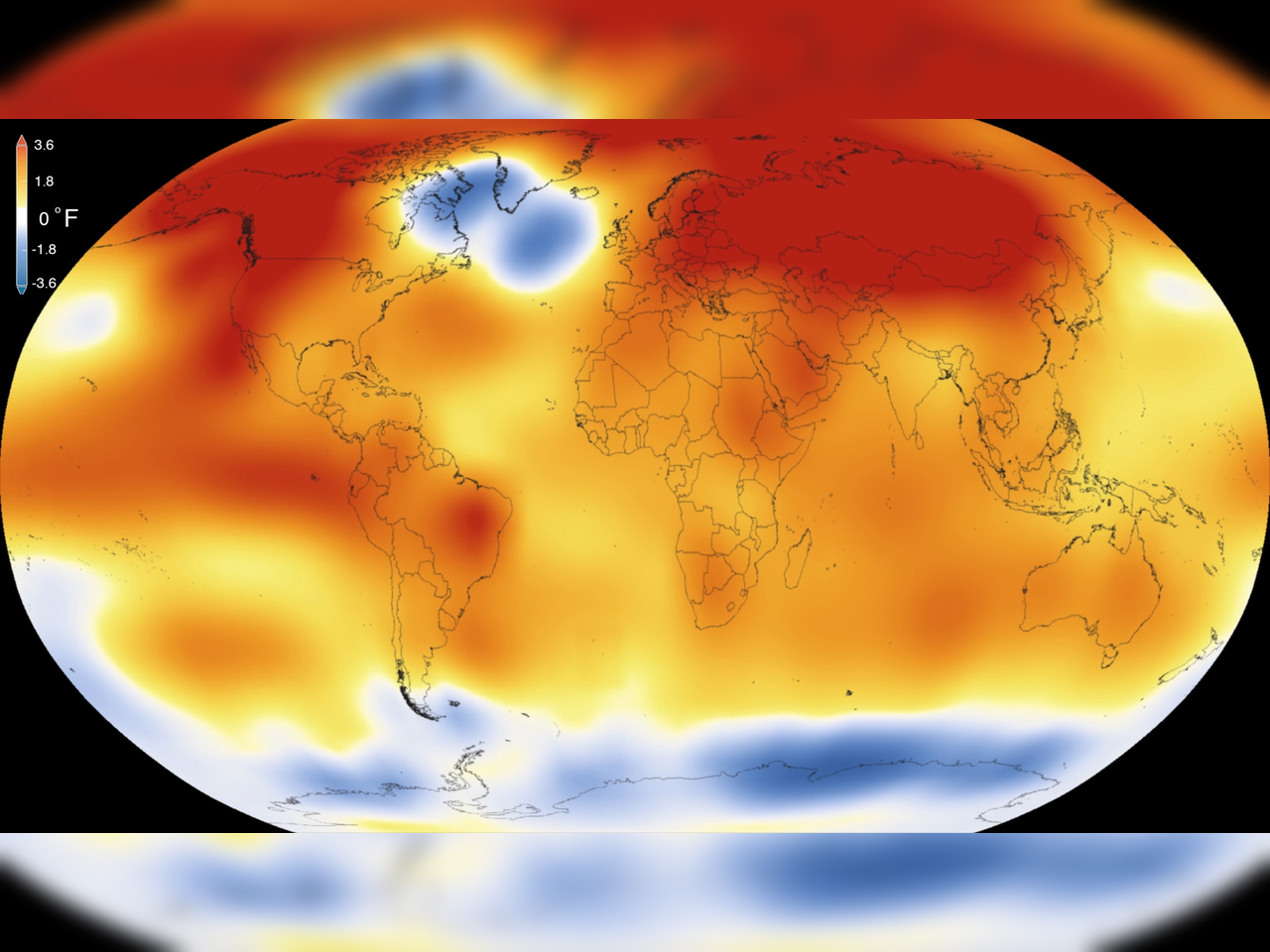
The world is at existential risk and has literally entered an intensive care unit as a global report published on Tuesday pointed out that 7 out of 9 planetary boundaries had not only breached safe limits in 2025 but continued to worsen over earlier years putting global stability and resilience under scanner.
The experts told The Plurals that India is one of the most impacted countries globally regarding several earmarked planetary boundaries and must leapfrog its environmental and climatic actions to minimise risk.
The report, Planetary Health Check, authored by more than 60 scientists and produced by the Planetary Boundaries Science Lab at the Potsdam Institute for Climate Impact Research (PIK), Germany, has underlined that record ocean heat, droughts, floods, wildfires and extreme heat have put the earth system under strain.
Critical boundaries breached
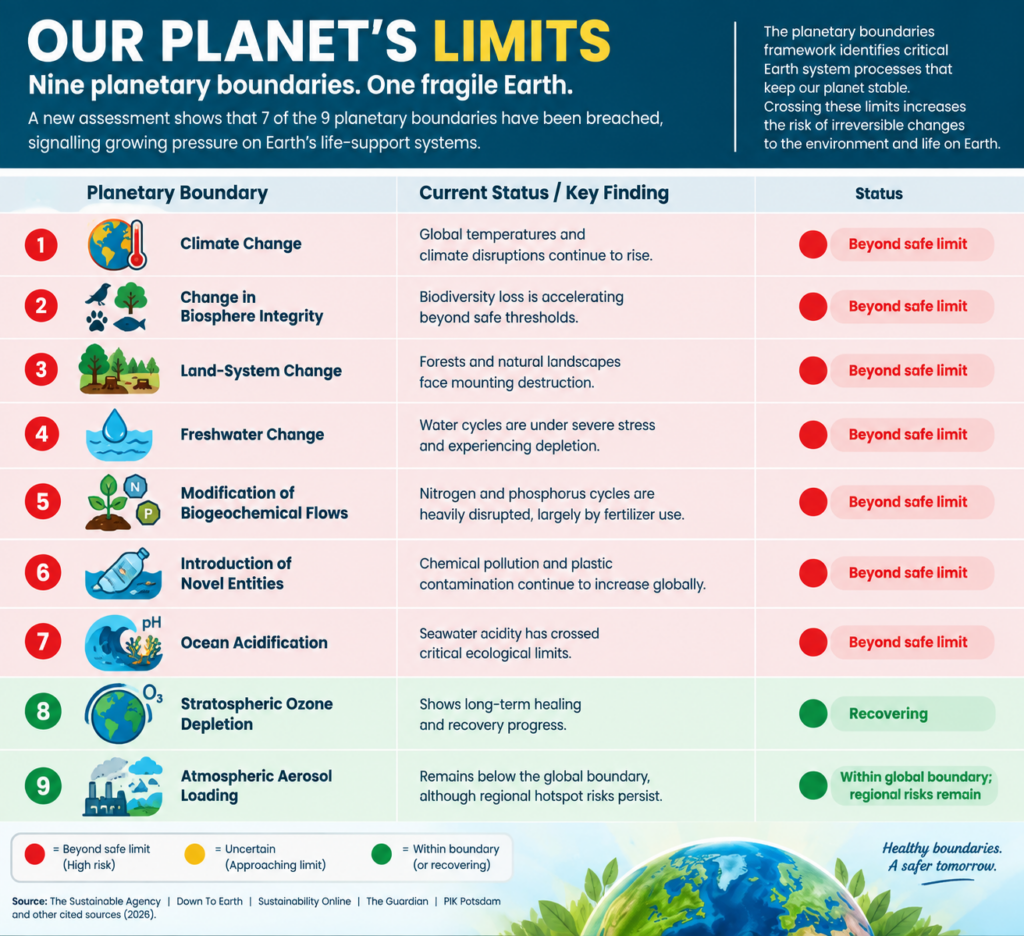
“The Planetary Boundaries describe the interconnected earth-system processes that must remain within safe limits to preserve the planet’s stability and resilience. Seven of the nine Planetary Boundaries are now transgressed, with ocean acidification the latest to breach its boundary in 2025. All seven are now at their highest recorded levels of transgression,” states the report, a copy of which is with the correspondent.
The seven transgressed boundaries are: climate change, change in biosphere integrity, land system change, freshwater change, modification of biogeochemical flows meaning natural cycles through which essential elements like carbon, nitrogen and others move, and, introduction of novel entities meaning human introduced elements like plastics, synthetic chemicals, pesticides, genetically modified organisms and others, and, ocean acidification caused primarily due to seawater absorbing excess carbon dioxide from the atmosphere.
Only the stratospheric ozone depletion and atmospheric aerosol have shown improvement over the last decade.
Diagnosis is unambiguous
“The diagnosis is unambiguous. Pressure is rising across every Planetary Boundary already outside the safe operating space. It means that the risk of large-scale, persistent and potentially irreversible change is increasing, while our margin for error in tackling these problems is shrinking,” commented Boris Sakschewski, lead author of the report.
The report referred a range of extreme weather events during 2025 as a testimony of escalating risks; ranging from south Asian flood that affected millions, global ocean heat content reaching a new record explaining how Hurricane Melissa rapidly ramped up to most devastating status after passing over exceptionally warm seas, heat stress impacting approximately 84.4 per cent of the world’s coral reef.
“In 2026, Western Europe experienced its hottest June-July period on record, accompanied by drought across France, Spain, Germany and the United Kingdom, with major wildfires across Europe and Canada. Record-breaking heat was also recorded in Japan, South Korea and parts of the Middle East,” says the report.
India needs to leapfrog on climate actions
“For India, this is not abstract science but lived reality. With northwest India emerging as a heat epicentre and this year’s monsoon tracking towards its driest in 17 years, the transgression of boundaries on climate, freshwater, land and biosphere integrity is hitting home,” opined Anjal Prakash, an UN climate report author and a professor on public policy, FLAME University on Tuesday evening.
The expert pointed out that India should focus on both adaptation and mitigation; accelerate a just energy transition ; embrace nature-based solutions, and embed climate risk into every infrastructure and fiscal decision..
“India cannot afford to ignore the planet’s warning signs. Clearly earth’s life support systems are under severe stress affecting millions of Indians. We need to leapfrog actions on climate change, ecological restoration, climate finance, and resilient development to protect India’s people, economy, and future,” added Sanjay Vashist, director of Climate Action Network South Asia (CANSA).
Biodiversity, ground water status critical in India
According to accessed data, India ranks ninth among the countries most affected by long-term climate risks globally, facing severe threats from habitat fragmentation, uncontrolled urbanisation, and land-use changes that compromise genetic and functional diversity.
India, hosting 7.8 per cent of all recorded species on just 2.5 per cent of the land, is critically impacted in maintaining its ecosystem; while it’s also suffering due to plummeting groundwater as it accounts for roughly one-fourth of total global groundwater extraction annually. “India holds only 4 per cent of global freshwater while sustaining nearly 18 per cent of the world’s population and its per capita water availability has dropped into the water-stress category and is projected to decline further to less than 1,350 cubic meters. The stress over River Basin is also set to increase with research shows that 11 of India’s 15 major river basins face severe water stress,” points out an expert.