
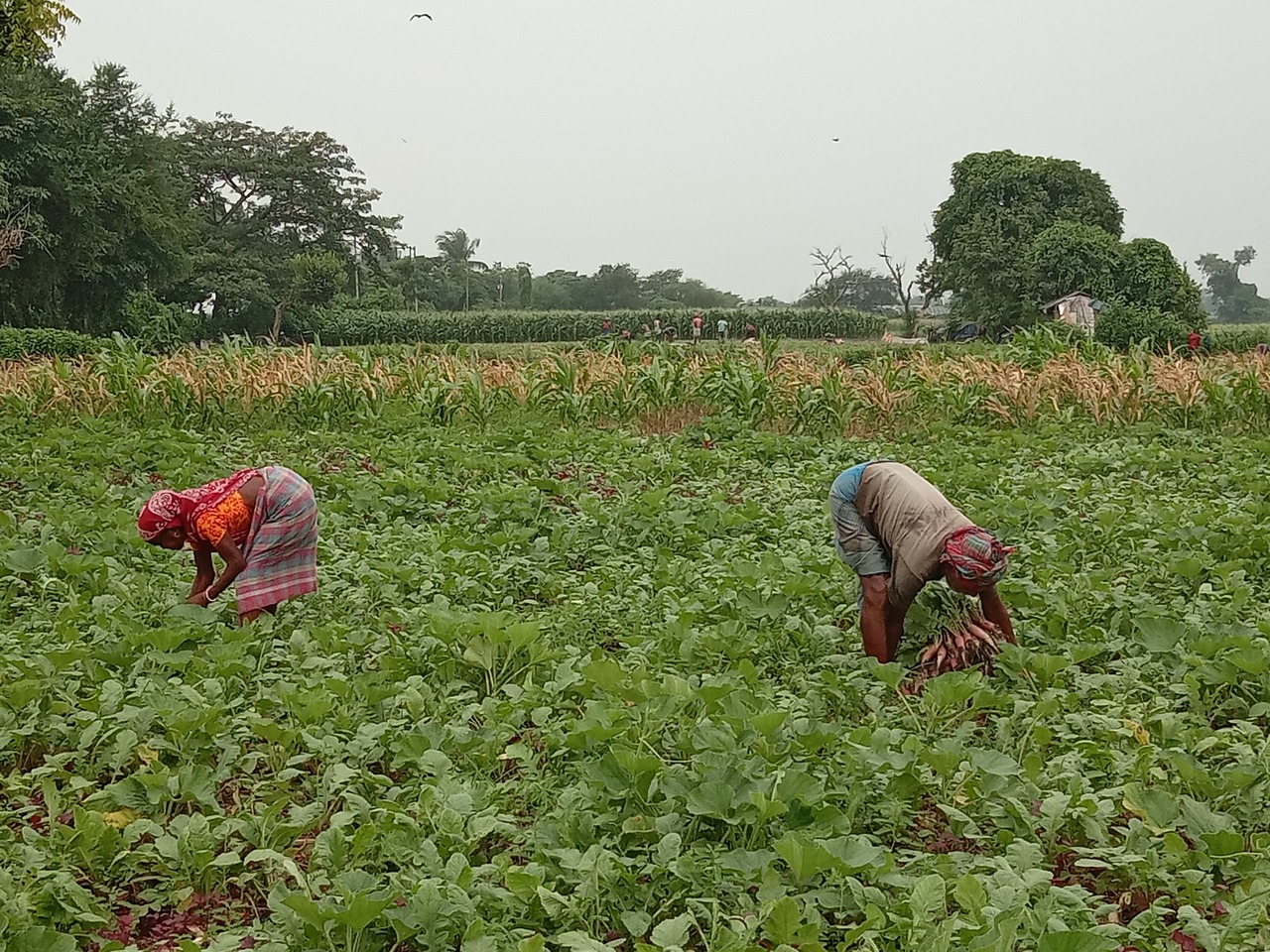

As a result of the conquest by the East India Company in 1757, the gradual shift from food grains to cash crops such as jute, cotton, and tobacco, broke the backbone of India’s diverse, food crop-based agriculture. This shift towards commodification of food crops, growing dependence on markets for food, food exports, and illegal storage, lead to multiple famines. The colonialists were primarily focused on expanding trade and sectors like transport that facilitated commerce, showing no interest in improving agricultural infrastructure. Moneylenders preferred lending for consumption rather than cultivation; they had neither the obligation nor interest in agricultural development—because if agriculture prospered, the business of money lending would suffer. Burdened by oppressive taxes, peasants also began to lose interest in agriculture.
In the midst of it all, came August 15, 1947.
Food security preferred over food sovereignty
Modernity—embodied in heavy industry, advanced vehicles, and new technology—became the obvious way forward. But once heavy industry arrived, even though under state control, it charted its own course. It disrupted the stable rural-urban relationship and the rural economy, which was rooted in a symbiotic relationship between farmers and artisans. Industries, hungry for labour and raw materials, began to take over the body and soul of the village.
The country was obsessed with rapid growth. We were in a hurry. After centuries of colonial rule, long neglect, lack of infrastructure, and investment, agriculture could not be easily rejuvenated. In free India, overall food security of the nation took precedence over food sovereignty.
In the first Five-Year Plan, about 45 percent of the budget was allocated to agriculture, rural development, irrigation, and energy. Land ceilings were fixed, and land was redistributed—but many people lost their land, nevertheless.
The tribals received infertile land, and some people got land that wasn’t enough to feed even their families. This conflict between equity and efficiency could have been addressed through investment in cooperatives—but this was never sincerely attempted. There was a dormant desire for local-scale planning in the Panchayati Raj system of 1959, but it remained unrealized.
Sucked into ‘mega syndrome’
Emerging from colonial exploitation, we got trapped in the ‘mega syndrome’—huge dams, long canals transporting water from one end of the country to another, and a relentless focus on the large-scale production of rice. In the process, we forgot our diverse food cultures. Perhaps, had we more time, we could have thought differently. But time was running out. The US stopped food exports. Under pressure, India signed the ‘Food for Peace’ agreement under Public Law 480—which made us believe that India could not feed its population unless it discarded its own seeds and adopted lab-grown, high-yielding varieties along with chemical fertilizers and pesticides. The Green Revolution was born in India. For the West, it opened up a huge market in the East—for seeds, fertilizers, and pesticide.
In 1967, soon after the Green Revolution technology was introduced, the first harvest exceeded expectations by three million tons. Since then, there’s been no looking back. India transitioned from a food-importing nation to a self-sufficient one. But everything—syllabuses in agricultural education, seed engineering, fertilizer design—was borrowed from the West. It was as if we were self-sufficient in rasgullas but not in milk.
Various schemes were launched to encourage the use of fertilizers, and subsidies were introduced. The Food Corporation of India was set up, and assured market infrastructure was built. But all these systemic changes were brought in to support a Western pattern of “development”— centred purely on increasing productivity.
Green Revolution killed food diversity
The Green Revolution reduced Indian agriculture to rice and wheat seeds dependent on chemical fertilizers and irrigation. When the seeds are not changed, yields drop. To maintain yields, more fertilizer is needed—leading to greater soil infertility. We forgot that rice fields also produce hay, edible wild greens, shrimps, and fish. They recharge vast amounts of water.
We forgot pulse cultivation, which sustains both soil and human health. Per capita pulse production fell from 61 grams in 1951 to 37 grams in 2009, while cereals rose from 334 grams to 407 grams. We gave up millets, buckwheat, safflower, linseed, thousands of leafy vegetables, Amaranthus, tubers, small fish and many more. Between 1947 and 2024, the population increased 3.6 times, while food production increased seven times. But did we eradicate malnutrition? Has starvation disappeared?
When the WTO was formed in the 1990s, we remained complacent. We believed we were agriculturally self-sufficient. Our focus shifted completely to growth, markets, and economic prosperity. Agriculture was gradually sidelined, and the burden of controlling food inflation fell entirely on the shoulders of the farmers.
Economic reforms did not help the farmers
Globalisation, in nineties, hardly improved the income of the farmers. Between 1990 and 2010, for nearly 20 years, farmers were not paid the market price for their produce—while incomes in other parts of society grew. From a monthly salary of Rs. 90 in 1970, schoolteachers’ salaries increased 300 times by 2015—whereas the price of wheat rose just 19 times.
For nearly three decades since economic reforms, agriculture has suffered deliberate neglect and apathy. In the name of creating economic opportunities, land grabbing and evictions became rampant. Food imports increased, undermining our farmers. In a country like ours, importing food is equivalent to importing unemployment. Small farmers are the first to suffer—abandoning their lands and migrating to cities.
Minimal Support Price supports farmers minimally
To maintain its socialist image, the government reluctantly introduced the Minimum Support Price (MSP) to protect farmers. But the MSP offered is often less than the cost of production. For example, in 2020, the cost of producing pigeon pea in Maharashtra was Rs. 6,240 per quintal, but the MSP was only Rs. 5,050—and the actual selling price was between Rs. 3,500 and Rs. 4,200.
In truth, it is actually the farmers who have been subsidizing the nation—at the cost of hungry nights, sometimes even their lives. The country witnessed a massive uprising of farmers in few years opposing newly brought union government farm laws. The Supreme Court of India stayed the implementation of those laws in January 2021. The stay order remained in effect until they were eventually repealed.
Thousands of farmers commit suicide every year
The National Crime Records Bureau data shows that while 296,438 farmers had died from suicide between 1995 and 2014; the number was a whopping 100,474 between 2014 and 2022. In 2022, a total of 11,290 persons involved in the farming sector (5,207 farmers and 6,083 agricultural labourers) have committed suicide in India, accounting for 6.6 percent of total suicide victims in the country. The year 2022 alone recorded one agriculture-related suicide every hour, or about 30 per day.
States most affected included Maharashtra (4,248 deaths), Karnataka (2,392), Andhra Pradesh (917), Tamil Nadu (728), and Madhya Pradesh (641) , It is no coincidence that the most affected states are those which happen to be the part of cotton belt of India where Genetically Modified BT cotton were introduced in 2002.
Each year, the agricultural crisis deepens. According to NSS 70th and 77th Round data, the average monthly income from farming was Rs. 3,081 in 2013, and only Rs. 3,798 in 2019. If we consider inflation at 35 percent, it is a reduction of 12 percent.
Lost almost all the native paddy varieties
With this, our independence has stepped into its seventy-ninth year. How are the farmers, who feed us? Clearly we are not helping their cause.
We’ve lost almost all our native paddy varieties. Our Public Distribution System has erased our food diversity. We now grow only those crops that the seed corporation allows, we eat what market feeds us. Don’t we, and the farmers, deserve the freedom to choose our agricultural future; the question hangs.
Anshuman das is a food activist and educator in the field of food system and agroecology