
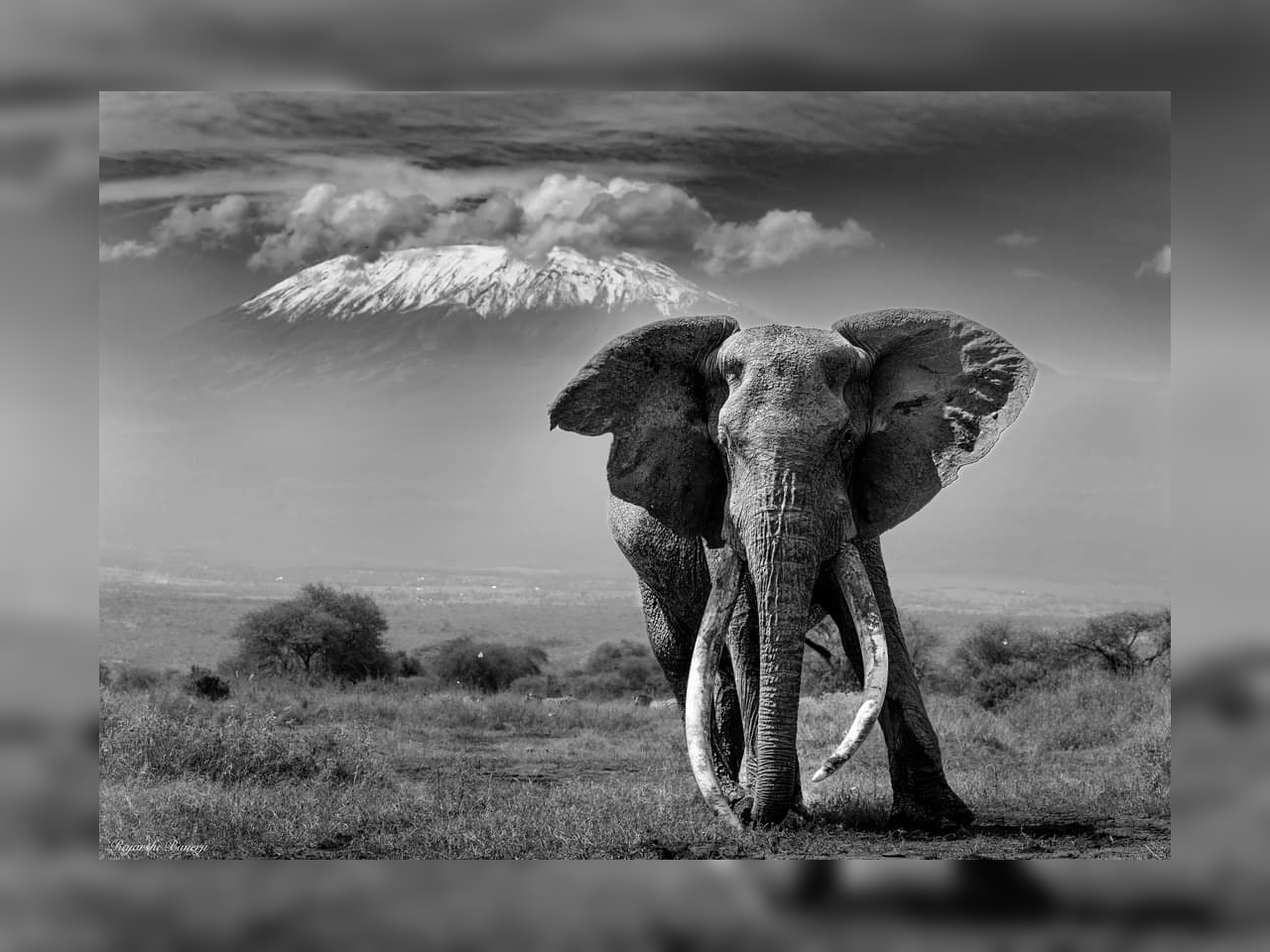
He towered over me, colossal and commanding, his presence filling the space around me.
For a single, electric instant, his hazel eyes seized mine — ancient, unreadable. As he strode past, his long, crow-dark lashes cut softly through the air. Never had I seen an elephant so humongous. Never had I stood so near to a wild super tusker. And yet fear did not find me; it was swallowed whole by sheer wonder.
For over three decades, I have been blessed to photograph elephants across the ancient landscapes of Africa, India, and Sri Lanka — bearing witness to the miracle of births in the wild, the sweeping movement of great herds across changing terrain, and the intricate rhythms of their social lives and survival.
Through the years, my dear friend Wim van den Heever — an extraordinary wildlife photographer himself and Grand Prize winner of the Natural History Museum’s Wildlife Photographer of the Year—often spoke of a legendary super tusker named Craig in the Amboseli landscape of Kenya. With growing insistence, Wim urged me to come and stand in Craig’s presence, certain it would be a life-altering encounter. He spoke with urgency too, reminding me that Craig was living on the last of the six molars granted to elephants over a lifetime — a quiet sign that his long journey was nearing its end. Finally, I went with Wim in 2024 to Amboseli to experience Craig.
Authority without violence
The first time I saw Craig, he took my breath away.
He was an awe-inspiring presence — among the last of East Africa’s great tuskers. Towering above the savannah with immense ivory that swept the earth like ancient pillars and a deep, subsonic rumble that resonated across the plains, Craig was a living relic of a bygone era. Each crease in his weathered hide carried a story etched by time: endurance through merciless droughts, the steady erasure of habitat in his homeland, and the constant shadow of human greed.
For the next six days, I went to Craig every day. Just to see him. Just to be with him. My blazing passion of many years to photograph him suddenly became irrelevant. Standing near him, feeling his calm authority, was like touching the soul of vintage Africa. Pure, majestic, and timeless. More than an encounter, it was a lifetime privilege. To me this was not just an elephant, but history, dignity, and the wild itself. And I was overwhelmed with a sense of my own smallness and insignificance. His sheer size and dignified presence made me feel like a mere speck in the vastness of natural world.
Craig made me believe again that elephants are among the most intelligent beings on Earth. They have language. Memory. Authority without violence. Playfulness without cruelty. In those few unforgettable days of my life, Craig showed me what trust between humans and wildlife can look like. Gentle, intelligent and deeply aware, it seemed he understood me, and I learned to understand him, as the snows of Kilimanjaro stood in mute witness to our beautiful understanding. I left Craig and Amboseli not just with some great images, but touched by something sacred, as though nature itself had revealed a quiet divinity.
He did not die alone
I was planning to repeat my pilgrimage to Craig this year. But a few days ago, I woke up to the shocking news that Craig had passed away. He had just turned 54 years old and had been showing signs of dietary distress (indigestion, bloating, constipation, etc) recently. This was a result of his molar teeth being worn down which made it difficult for him to chew his food properly and ultimately led to his demise in Kitenden Corridor on Olgulului, one of the community areas surrounding Amboseli National Park. On the night before his death, Craig began collapsing intermittently, standing up and moving only short distances between episodes. But he did not die alone. Dedicated rangers of Big Life Foundation stayed by his side through the night, keeping watch so he could pass in peace. In the quiet hours before dawn, at 3:32 AM, he took his final breath under the African stars.
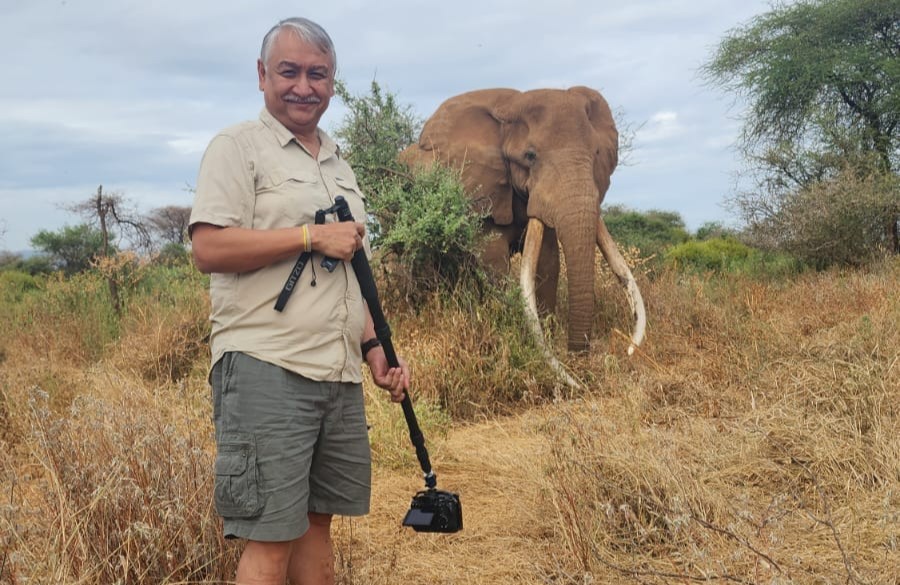
The familiar Kilimanjaro silhouette is gone
Now, Amboseli feels quieter. The familiar silhouette against Mount Kilimanjaro’s stunning horizon is gone, and the land mourns the giant who shaped it. For me, his passing feels deeply personal. I owe Craig a quiet debt — for teaching patience without words, for embodying a calm, unshakable authority, and for gifting moments that left me standing in reverent wonder.
Yet even in sorrow, there is solace. In a time when tusks like his summon immeasurable human greed, Craig claimed the rarest triumph of all. He lived fully, and he died as nature intended. No bullet found him, no snare claimed him. Time alone carried him to rest. His teeth, ground down by a lifetime of grazing, finally failed him — an unhurried, gentle closing to an extraordinary journey. He shared the land with people in mutual respect, and when the moment came, he departed on his own quiet terms. His peaceful death from old age is, in conservation terms, a profound victory. It proves that when local communities, national authorities, and international partners work together, even the most vulnerable of giants can live out their full natural lives.
Let the legacy light the path ahead
I offer my gratitude to every hand and heart in Amboseli that stood in protection of Craig and his kin—the community and county, rangers and conservancies, Kenya Wildlife Service, the tourism family, Save the Elephants, Big Life, Amboseli Trust for Elephants, Amboseli Ecosystem Trust, IFAW, and all who work for conservation. May Craig’s legacy light the path ahead.
Rest in peace, gentle giant.
You live forever in my heart and in Africa’s eternal spirit.
Rajarshi Banerji is an award-winning wildlife photographer, passionate about conservation. Based in Kolkata, he travels around the world