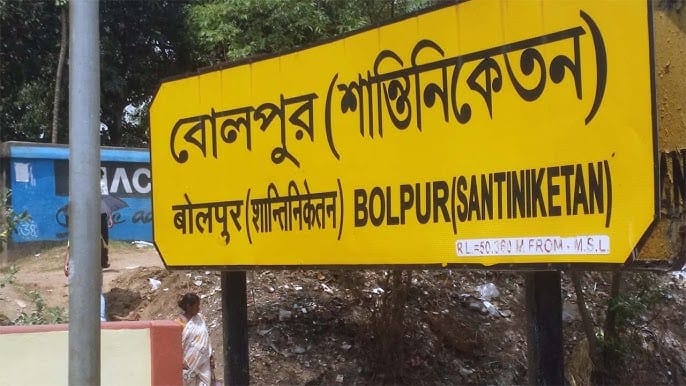
Shantiniketan, the Tagore turf, may literally turn into a hotbed by 2100 with mercury expected to go beyond 50 degree Celsius under worst possible carbon emission scenario; almost turning into a Rajasthan.
Most other south Bengal cities are expected to cross 50 degree Celsius as well by 2100 if the business as usual carbon emission continues; predicts the recently released report of Intergovernmental Panel on Climate Change (IPCC).
According to a Plural analysis of the interactive map provided with the report, cities like Asansol, Bankura, Purulia & Shantiniketan may reach 51.4 degree Celsius during 2080 to 2100 considering the worst emission scenario that is set to push up mean global temperature by 3.4 degree Celsius compared to pre-industrial period temperature which is seen as the natural benchmark.
The mercury level in Krishnanagar may touch 50.6 degree Celsius.
Presently the highest temperature recorded in India is 51 degree Celsius which was found in Phalodi in Rajasthan , located near Pokhran .
Other South Bengal cities like Howrah, Diamond Harbour, Chinsura, Haldia are expected to be barely below 50-degreeCelsius during the period.
The assessment also shows that almost in all cities, the increase of mean temperature will be in the range of 4.5 – 5 degrees during 2080- 2100, compared to 1850- 1900 benchmark, with more than 80% temperature rise expected to happen within 2015- 2100 underlining the sharp surge of climate change during the era.
The rise in mean temperature will be around 2.5 degree Celsius across South Bengal by 2100 even if the world is able to restrict the global temperature rise within 2 degree Celsius as mandated by Paris agreement in 2015 which has been ratified by more than 200 countries. Clearly, south Bengal’s temperature rise will be significantly greater than global temperature rise.
The analysis shows that even in nearer future, 2041- 2060, the mean temperature is projected to rise 1.5 degree Celsius or more in all places. Incidentally, earlier IPCC report had shown how even an 1.5 degree Celsius rise can push the world into chaos and instability; inundating many low land areas and turning millions into climate refugees as well as impacting biodiversity critically.
However, on rainfall count, the trend is less categorical.
While the total rainfall count shows sign of marginal to moderate increase considering pre industrialisation benchmark, more rapid increase is predicted for most cities post 2015.
However, the prediction about increase in major rainfall within short period is of higher confidence, much of it post 2015.
According to analysis, cities like Haldia are tipped to have 22.4 % increase in total rainfall under worst emission scenario ; while the increase in maximum one day rainfall may go up to 55%^.
Most of the cities in South Bengal have inadequate infrastructure in drainage hence huge deluge within short period, as predicted, may put the life of the people in these cities under extreme distress unless immediate actions are taken, said Prof. Arunava Majumder, water infrastructure expert and former director of All India Institute of Public Health & Hyegine.
ENVIRONMENT
NEWS
Tagore turf to turn Rajasthan by century end
Shantiniketan, the Tagore turf, may literally turn into a hotbed by 2100 with mercury expected to go beyond 50 degree Celsius under worst possible carbon emission scenario; almost turning into a Rajasthan. Most other south Bengal cities are expected to cross 50 degree Celsius as well by 2100 if the business as usual carbon emission […]