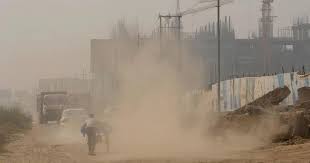
A report card released recently shows that the level of the most toxic ultrafine particulate – PM 2.5 – has improved marginally in Kolkata during the last 4 years even after pumping hundreds of crores for pollution reduction, though the level is still well above the permissible limit in the country.
PM 2.5 can penetrate the finest crevices of lungs and triggers a range of diseases including the fatal ones.
The report, prepared by environmental outfit Climate Trends, is based on the data generated by the Central Pollution Control Board under its flagship National Clean Air Programme (NCAP).
The trend, both for PM 2.5 and coarser PM 10 pollutants, is similar for several other cities – Howrah, Durgapur, Asansole – in the state identified for intervention by the union government under NCAP. Durgapur is the poorest of all with being listed as eighth most polluted based on PM 10 pollution level.
The report shows that the annual average concentration of PM 2.5 in Kolkata got reduced from 56 micrograms per cubic meter in 2019 – when NCAP was launched – to 50 micrograms in 2022; though the level is still 20 per cent higher than the national permissible limit of 40 micrograms.
Despite the marginal reduction, Kolkata improved its position from tenth poorest to twenty-ninth among the 77 critically polluted cities – the data of which has been shown in the CPCB list out of 131 cities under the programme – with several cities slipping down the pollution ladder. “We have definitely improved a lot” , claimed a PCB source.
In case of another key pollutant – PM 10 – Kolkata’s annual average was found to be 102 microgram in 2022 ; around 40 per cent higher than the national limit of 60 micrograms.
According to NCAP information, accessed by The Plurals, around 600 crores have been received by the state for pollution reduction within its critically polluted cities in the last 4 years, including 536 crores exclusively for Kolkata. “In September 2022, the centre has set a target of a 40 per cent reduction in particulate matter concentration in cities covered under NCAP by 2026; and clearly most non-attainment cities in Bengal are still way behind”, stated an expert linked to the NCAP programme.
The data shows that apart from Haldia, all other non-attainment cities in West Bengal had average annual PM 2.5 and PM 10 levels much higher than the national permissible limit. Incidentally Durgapur with an annual average of 170 micrograms in 2022, stands the eight most polluted city in the country considering PM 10 pollutants.
“It is difficult to achieve the target being set but we are trying our best. We have already prepared an action plan and are progressing according to that,” claimed state pollution control board chairman Kalyan Rudra.
“There is marginal improvement in air quality in 2022, especially when we observe the data from 2019 to 2022. However, the CPCB has already issued stricter reduction targets for the non-attainment cities and many cities are still far from reaching their reduction targets and may be unable to do so without aggressive plans and stringent measures,” said Aarti Khosla, Director, Climate Trends.
“Kolkata has taken certain steps and that seems to have contributed to slight reduction. However, the city needs to take several hard steps in reducing pollution from major sources like transport, construction, waste burning and likewise” pointed out Center for Science and Environment (CSE) air pollution expert Anumita Roy Choudhury.
“There is no reason for PCB to rejoice with this minor improvement despite pumping in hundreds of crores, Moreover, they should look at the entire state rather than only concentrate on Kolkata. Clearly the cities like Durgapur, Asansol and Howrah are quite polluted” pointed out environment activist Naba Datta of Sabuj Mancha.
Bengal pollution hotspots
City – 2022 (PM2.5)* – 2022 (PM 10)*
Kolkata – 50 – 102
Howrah – 58 – 117
Asansol – 59 – 135
Durgapur – 63 – 170
Haldia – 33 – 86
*all in micrograms per cubic meter of air
National limits – 40 micrograms (PM 2.5); 60 micrograms (PM 10)
Source: CPCB
ENVIRONMENT
NEWS
Bengal air pollution: marginal improvement but still a lot to catch up; Durgapur eight most polluted
A report card released recently shows that the level of the most toxic ultrafine particulate – PM 2.5 – has improved marginally in Kolkata during the last 4 years even after pumping hundreds of crores for pollution reduction, though the level is still well above the permissible limit in the country. PM 2.5 can penetrate […]