
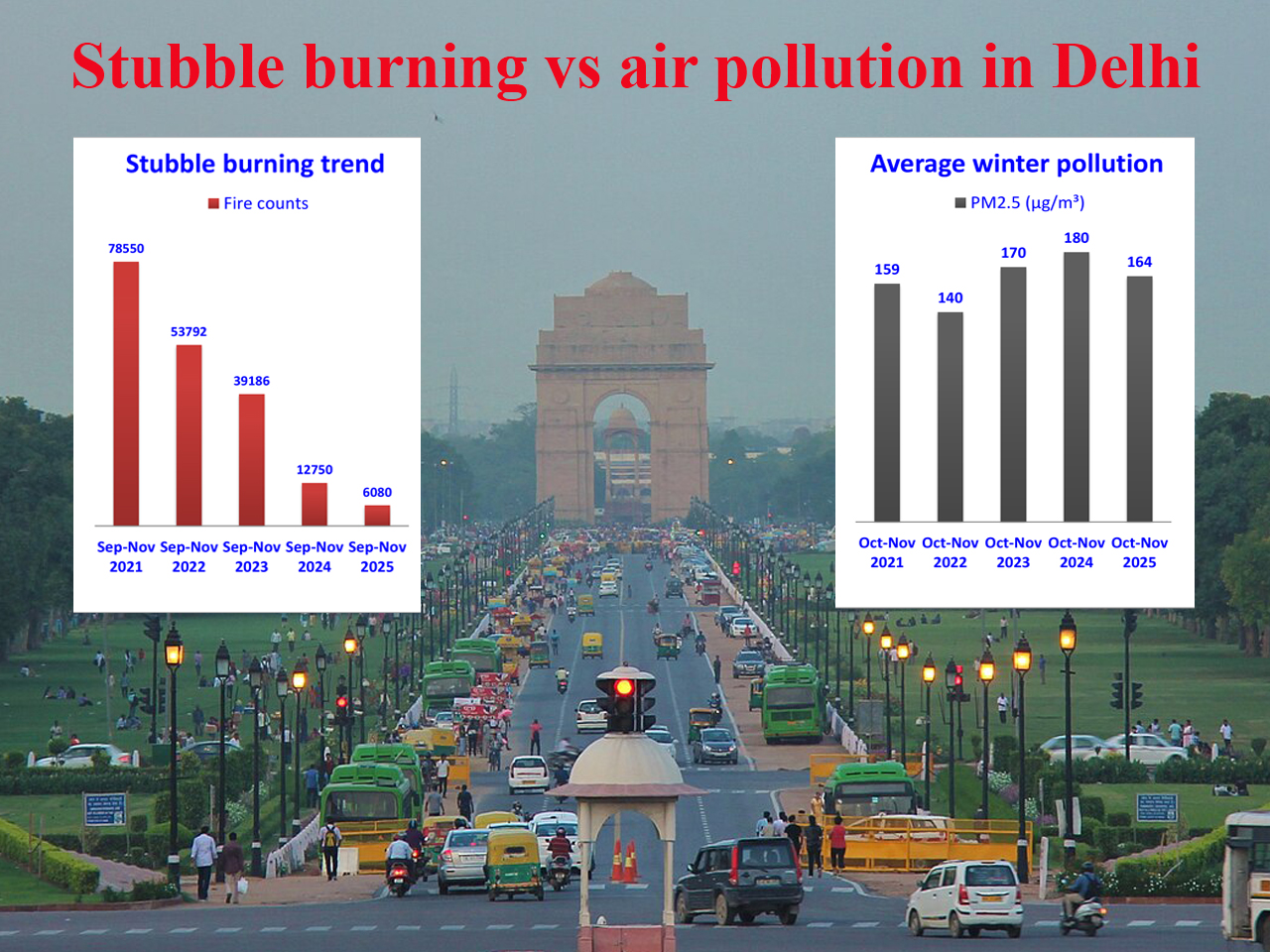
- Total paddy farm fire count at Delhi- NCR in 2021: 78550
- Total paddy farm fire count at Delhi- NCR in 2025: 6080
The number of stubble burning incidents has reduced to nearly one-thirteenth in 2025 compared to 2021 in the Delhi-NCR (National Capital Region), shows the Union environment, forest and climate change ministry’s data released on Tuesday. Though data is available till November, it can be considered as annual data as the cropping season is over, according to a government report.
The Delhi-NCR region includes Punjab, Haryana and parts of Uttar Pradesh and Rajasthan apart from Delhi National Capital Territory, though stubble burning incidents are most frequent in Punjab and Haryana.
“The paddy harvesting season 2025 has come to an end, witnessing a decline in farm fire incidents across Punjab and Haryana. With this the period of official recording, monitoring and assessment of paddy stubble burning events also concluded. The process is carried out annually from September 15 to November 30 according to the standard protocol developed by ISRO (Indian Space Research Organisation),” pointed out the report, a copy of which is with The Plurals.
The report further claims that there has been a steady reduction of stubble burning in recent years under the Commission for Air Quality Management’s (CAQM) coordinated framework to curb paddy stubble burning incidents in the region. “While meteorological conditions also influence air quality scenario in Delhi-NCR, the substantial reduction in farm fires this season has considerably limited the potential episodic deterioration driven by stubble-burning contributions,” claims the report.
Center for Science and Environment (CSE), a Delhi-based research and advocacy organisation, released an analysis recently to stress that there has been no improvement in longer-term trends in Delhi air quality, particularly during winter, when it assumes critical proportions despite reduction in stubble burning. CSE emphasised the role of local pollution sources, particularly vehicular pollution, in contributing to high air pollution trend in the region.
Steady decline
The lowest number of farm fire counts since 2021 was recorded during the paddy harvesting season this year, says the government release. “Punjab recorded 5,114 such incidents. This reflects a reduction of 53% over 2024, 86% over 2023, 90% over 2022, and 93% over 2021,” says the statement.
Haryana recorded 662 farm fire incidents this year. “The state registered a 53% reduction from 2024, 71% reduction from 2023, 81% from 2022 and 91% from 2021,” the statement continues.
The overall reduction in the region was found to be around 92%; from 78550 in 2021 to 6080 in 2025 (till November). The number of such incidents was 12750 in 2024.
Delhi still ‘very poor’ or worse
The findings reflect another recent report, released by the Delhi-based research and advocacy organisation Center for Science and Environment (CSE). It has also highlighted the reduction in stubble burning and underlined its implications.
Stubble burning has long been considered one of the main reasons behind air pollution in the Delhi-NCR region, which has been hovering between ‘poor’ to ‘severe’ over the last few years, as Delhi has repeatedly registered as one of the most air-polluted metro cities of the world. But the CSE report pointed out that since stubble burning has gone down steadily, it is a clear indication of the role local factors, mainly emissions from vehicles, are playing in making the air unbreathable in the region. The blame needs to shift from farm fires.
“Delhi-NCR cannot hide behind the smokescreen of farm fires any more. While farm fires have contributed much less to local air quality this winter, the state of the air we breathe has been ranging from ‘very poor’ to ‘severe’. This exposes the huge impact that local sources are having,” says the new assessment by CSE.
CSE data shows the average winter pollution (Oct – Nov) in Delhi, expressed through level of toxic pollutant PM 2.5 that can go deep into the lungs and trigger range of diseases, has remained largely unchanged over the last 5 years. The levels of pollutant were 159 micrograms per cubic meter of air in 2021, 140 in 2022, 170 in 2023, 180 in 2024 and 164 in 2025. The national limit is 60 micrograms while the World Health Organisation set guideline is 15 micrograms.