
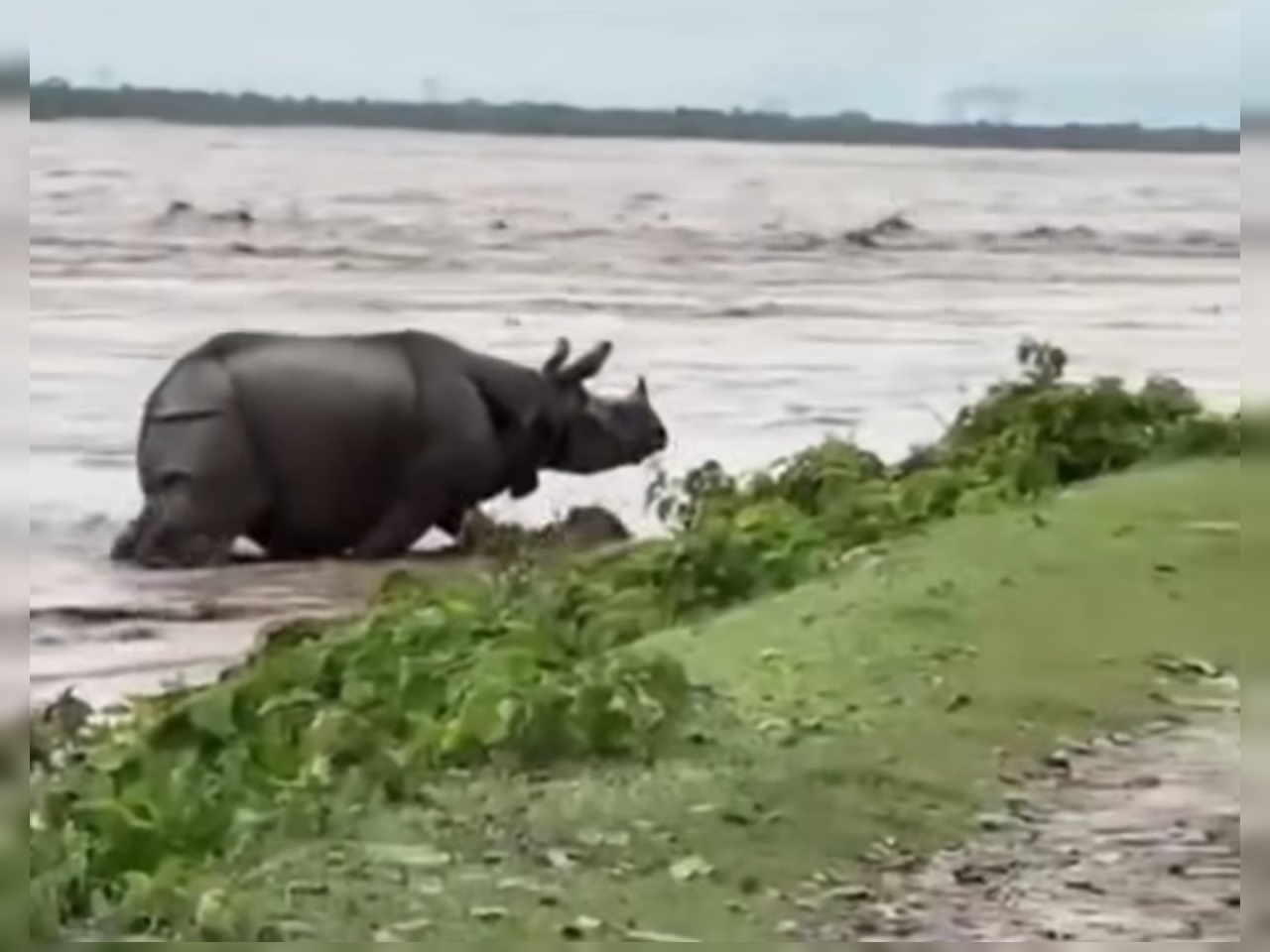

Wiser by the recent flood experience, the West Bengal Forest department is planning to build mud built raised platforms or highland areas as temporary flood shelters within the forests of north Bengal for wild animals in case of similar incidents in future; confirmed a senior official from the forest department of West Bengal to The Plurals.
The intense rain, flood and hundreds of landslides over the last weekend not only had killed around 40 people in north Bengal but also left a deep scar on its forest ecosystem with several animals dead while many others got swept away.
The official pointed out the artificial highland areas at north Bengal Forest would be built emulating the Kaziranga forest model but based on local requirements and customisation.
Incidentally, both north Bengal and Kaziranga are the habitat for the royal Bengal tiger, Indian elephant, one-horned rhinoceros, leopards, buffalo, and Indian bison.
State forest minister Birbaha Hansda admitted that the actual scale of damage could not be yet ascertained as forest workers found it difficult to enter into remote parts of forest areas. The damages have been more in Jaldapara National Park and Gorumara National Park; both being important habitats for the one-horned Indian rhino.
“As per our record, two rhinos died in Gorumara from Jaldhaka river flooding, one got washed away about 140 km in Bangladesh. Apart from that one leopard, 17 bison and two deer died in Jalpaiguri” added Bhaskar.
The official added that apart from animals, there had been significant infrastructural losses including four bridges and solar panels being devastated; while the forest vegetation was significantly impacted due to mud spill.
Deluge pushed the flood shelter idea
“Post the latest deluge and flood like condition because of intense continuous rain over several hours, we are planning to set up raised mud platforms and highland areas within north Bengal forests where animals can quickly relocate themselves during future flood like situations within forest areas. These will broadly be structured in line with the similar highland areas being built up within Kaziranga forest,” said Bhaskar J V, chief conservator of forests (wildlife) north Bengal to this correspondent on Thursday. “We plan to build such artificial highlands in all the forests in coming years based on our local requirements and situation, and, we have seen the Kaziranga highlands”, added Bhaskar
“As these will be mud platforms, the cost will not be very high. We intend to build several such platforms in due course of time within all forests of north Bengal; and will start working on the programme once we can settle down post the recent disaster” added the official.
“We welcome the proposal. If one looks closely at the topography of north Bengal Forest, while animals have access to natural highlands in Buxa, Mahananda, Chapramari; such highlands are not available in Jaldapara and Gorumara” observed Anujit Basu, a wildlife expert from north Bengal.
Highland model is successful in Kaziranga
Sonali Ghosh, the director of Kaziranga, pointed out that the model has been successful in Kaziranga. “Highlands serve as a temporary measure for the animals to take shelter during high floods. Roads, embankments and artificially created highlands have been effective in Kaziranga” said Ghosh; adding that around 150 such highlands have been built over the last 15 years.
“Kaziranga National Park uses 144 man-made highlands and 8.5 km of road-cum-highlands to provide refuge for animals during annual floods …” reads the national park’s website that gets submerged into water regularly during monsoon.
The website further points out that “around 90 percent of the Kaziranga National Park” gets affected during the flood; and adds that during floods “the animals from the park (move) out to highlands … walk out through the animal corridors and entire stretch of the national highway”.
“The highlands, many in the range of one to one and half kilometers and even more, are playing a very important role in protecting animals during floods.” observed Nazimul Haque, a local safari conductor.