
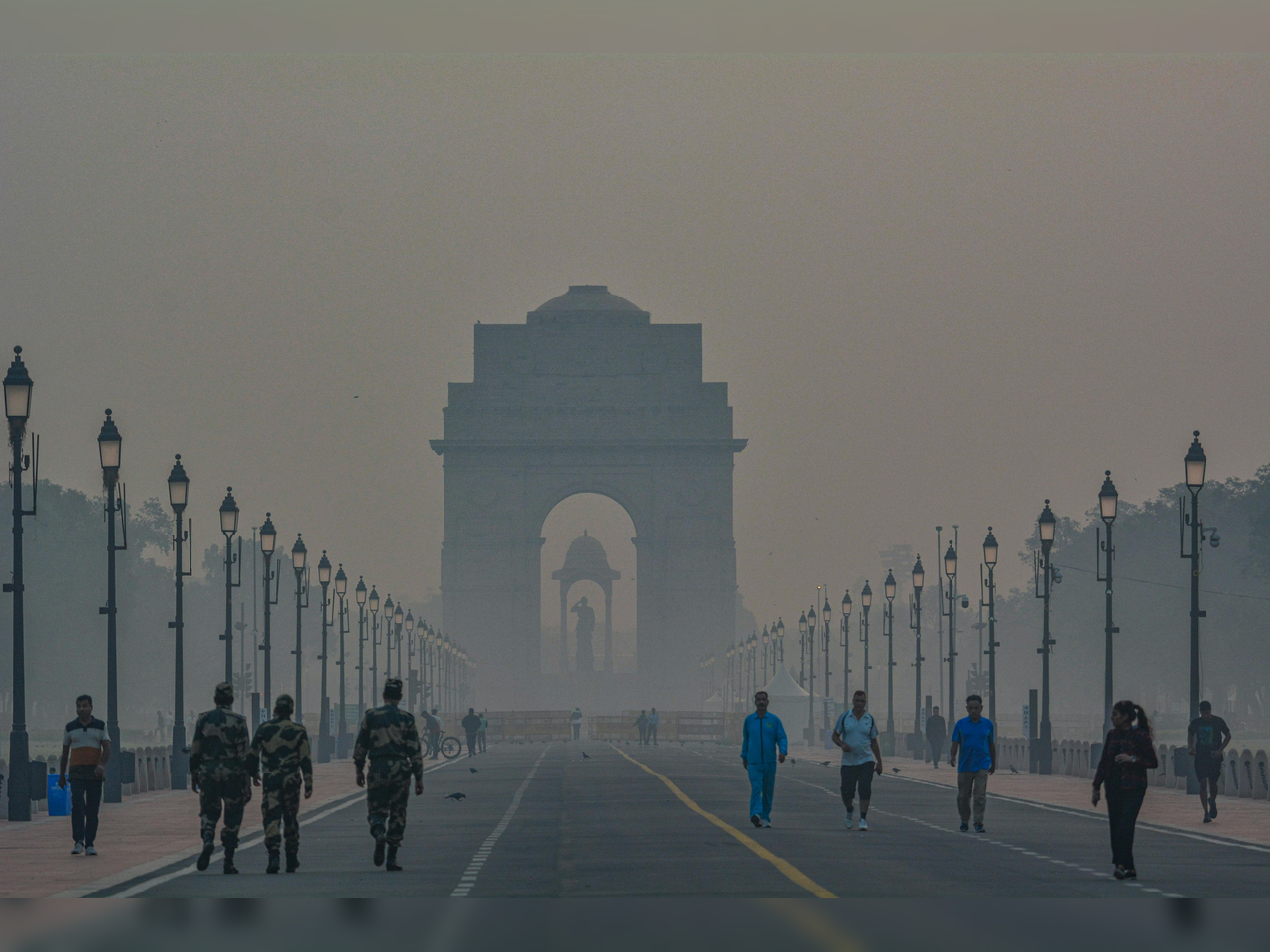

The number of high-level air pollution related meetings led by the Union environment ministry is on the rise, and so is pollution in the air quality index (AQI) in Delhi.
AQI is the indicator of the level of pollution in the air calculated by measuring the dominant pollutant in the atmosphere, which, in most cases, is the PM 2.5, the ultrafine pollutant that can penetrate the deepest layers of lungs and trigger a range of diseases, including fatal ones.
On Friday evening, the Commission for Air Quality Management (CAQM), set up by the Union environment, forest and climate change ministry for undertaking day to day monitoring of Delhi’s air pollution, has invoked the third level of ‘graded response action plan’ – just a stage lower than the toughest action plan designed – in anticipation of ‘severe’ air quality soon.
The Commission for Air Quality Management (CAQM) for the National Capital Region (NCR) and adjoining areas was formed by the Centre through an ordinance in October 2020, which was later converted to a statutory body under the CAQM Act, 2021.
Poorest air quality in most places
The Plurals analysis on Saturday afternoon found Delhi air to be of the poorest quality.
The maximum AQI measured at Mandir Marg automatic air quality measuring station, located within 2km of Indian Parliament, was 500 during the last 24 hours till 4PM on Saturday, the highest measurable value possible. But the count was not an exception for Delhi.
The analysis of Central Pollution Control Board data shows that during the assessed period, the average AQI of Delhi stood at 394, technically ‘very poor’ but below the borderline of ‘severe’, which starts at 400.
A closer look shows that during the last 24 hours till Saturday afternoon, 25 out of the 39 stations, for which data was available, recorded 500, maximum AQI measurable by the instruments used, as the highest figure. Data shows 23 stations recorded ‘severe’ air quality as average during the period.
“In the last few weeks, we find that the Union environment, forest, climate change minister as well as chief ministers of various NCR states have been engaged in a series of highly publicised meetings apparently to find solutions to souring air pollution in Delhi- NCR; but it’s a classic case of shutting the stable door after the horse has bolted…air pollution cannot be controlled overnight,” pointed out an environmental expert from Delhi.
AQI may turn poorer
“The AQI of Delhi, which stood at 343 at 4 PM on 15.01.2026, showed a rising trend and was recorded at 354 at 4 PM today (January 16), falling in the ‘Very Poor’ Category (AQI range: 301-400). Further, forecasts of weather and meteorological conditions by IMD and IITM indicate that Delhi’s average AQI is likely to breach the 400 mark and enter the ‘severe’ category in the coming days,” reads the CAQM communication on Friday evening.
“In view of deteriorating air quality in Delhi, the sub-committee on the Graded Response Action Plan (GRAP) of the Commission for Air Quality Management (CAQM) in NCR and Adjoining Areas convened a meeting today…reviewed the prevailing air quality scenario in the region, along with forecasts for weather and meteorological conditions and the Air Quality Index, and observed…that the air quality is likely to deteriorate further and may enter the ‘severe’ category in the coming days…” reads the statement.
“In view of the prevailing air quality trend, and with a view to preventing further deterioration of air quality in the region, the sub-committee has decided to invoke all actions envisaged under Stage-III of the extant Graded Response Action Plan (GRAP) – ‘Severe’ Air Quality (AQI range: 401-450) – with immediate effect across the entire NCR, as a proactive measure,” says the directive.
“This is in addition to the actions under Stages I & II of extant GRAP already in-force in NCR. Various agencies responsible for implementing measures under GRAP including Pollution Control Boards (PCBs) of NCR and DPCC have also been directed to ensure strict implementation of actions under Stage-III of extant GRAP in addition to actions under Stages I & II of GRAP during this period,” the direction reads.
Construction stopped, online classes and work from home
A nine-point action plan acording to Stage-III of GRAP was invoked in the entire NCR region, including steps to be implemented and ensured by different agencies, such as pollution control boards of NCR and Delhi Pollution Control Committee.
The steps are:
1. Enforce strict restrictions on construction and demolition activities resulting in dust generation and air pollution, except the projects for railway services and stations, metro rail, airports and inter-state bus terminals, national security and defence related activities, hospitals and health care facilities, public interest projects, sewage treatment and water supply projects; though they will have to operate under stringent norms.
2. Close down operations of stone crushers in the entire NCR.
3. Close down all mining and associated activities in the entire NCR.
4. NCR state governments to impose strict restrictions on plying of BS-III petrol and BS-IV diesel run four-wheelers in Delhi and in the districts of Gurugram, Faridabad, Ghaziabad and Gautam Buddha Nagar.
5. Delhi government to impose strict restrictions on plying of Delhi-registered diesel operated medium goods vehicles to BS-IV standards or below, in Delhi, except those vehicles carrying essential commodities or, providing essential services.
6. Delhi government not to permit BS-IV diesel operated goods carriers registered outside Delhi, to enter Delhi, except those carrying essential commodities and providing essential services.
7. Schools to undertake classes for children up to class V in a “hybrid” mode allowing online mode wherever feasible.
8. NCR administrations to allow public, municipal and private offices to work on 50 per cent strength and the rest to work from home.
9. Central government to permit work from home for employees in central government offices.
Advisory for citizens
The CAQM has also issued an advisory for citizens urging them to walk or use cycles for small distances, choose a cleaner commute and share a ride to work or use public transport. People, whose positions allow working from home, may work from home, it further states.
“Do not use coal and wood for heating purposes (and) individual house owners may also provide electric heaters to security/other staff employed by them to avoid open burning of biomass/wood/ MSW(municipal solid waste),” reads the statement.