
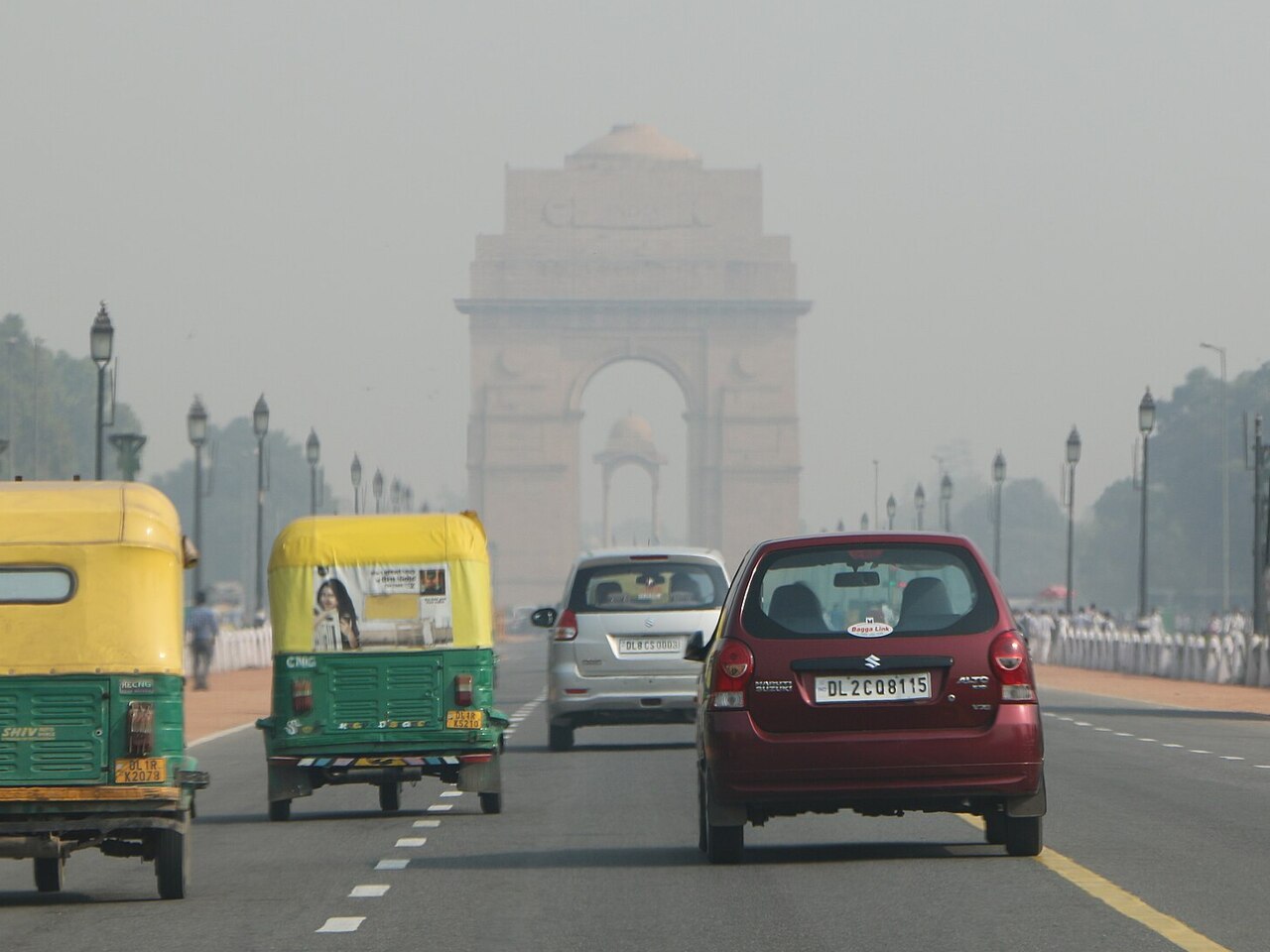
The cloud seeding has not worked and the air that Delhi breathes remains among the most toxic in the world. According to some surveys, it is the most toxic globally. Swiss air quality firm IQAir judged Delhi the most polluted city in the world in October, 2025. The city slips from this position once in a while, but remains among the world’s worst. The national air quality monitoring data, undertaken by the central pollution control board, shows that Delhi’s air reached ‘severe’ level of pollution, the most harmful measurable, in most of its monitoring stations during recent days.
Whether no. 1 or among the top 10, the city’s air is unbreathable, finds a report by the Delhi-based Center for Science and Environment (CSE). The analytical report is based on real-time air quality data of Central Pollution Control Board’s and traffic data from Google map.
“This is a public health emergency,” says the report. The sources of pollution are well-known — vehicles, industry, power plants, household fuel, waste burning and dust (coated with toxic emissions) — but their extent remains staggering.
Vehicles biggest polluters
While the emission from regional sources, particularly stubble burning in adjoining areas with 2024 data showing that its contribution to overall pollution can be as high as 25 per cent on particular days, remains a critical contributor; the contribution from local sources stands dominant. “… The contribution of local sources of pollution in Delhi remain high, with the bulk coming from vehicles. In the weeks after Diwali, when pollution is also high, most of it comes from Delhi’s local sources or the neighbouring region—again, with vehicles contributing the bulk,” finds the study.
In Delhi, transport and industry contribute equally to PM 2.5 — 41 percent each. In NCR, transport contributes 39 percent and industry 22 percent, found SAFAR (System of Air Quality and Weather Forecasting and Research) in 2018.
The sources of pollution remain generally the same throughout the year though the respective contribution varies . Winter makes it worse, because cold air is heavier and the moisture traps pollutants close to the ground. Congestion makes it worse, too. “During peak hours (5 pm-9 pm), when traffic speed averages 15 km/h, NO2 levels rise 2.3 times compared with midday (12 pm-4 pm), when traffic moves at around 21 km/h,” the report observes. (Source:
7-point agenda
“Some action has been taken. Fuel has become cleaner. But emissions much be cut drastically, and hence we recommend a seven-point agenda in the report to clean the air,” pointed out Anumita Roy Chowdhury, an executive director of CSE who has led the study.
The recommendations are :
1. All old commercial vehicles must be replaced. Scrappage to be incentivised.
2. Number of vehicles need to be cut down drastically. For this the public transport system needs a big boost.
3. Polluting industries in the Delhi-NCR region must be identified and must switch to clean fuel.
4. Farmers must be incentivised to reuse straw. They burn stubble because they have a small window between harvesting paddy and planting wheat.
5. Waste from is not to be burnt. It adds to the pollution.
6. Enforce measure to reduce emissions at power plants, brick kilns, stone crushers and construction sites.
7. No new plan is needed, “act with speed, at scale, across the year.
“While the prescription is fine but we need to see whether the local economy and socio-economic condition of the people can absorb it or not,” says a Delhi based economist.
Lessons from China
India can learn two major things from China, the report said.
“1. Large-scale introduction of natural gas/closure of industry that did not conform to new standards. 2. Large-scale vehicle fleet replacement/electrification,” the report said.
“The GRAP or the Graded Response Action Plan was brought in as an emergency-alert system … to immediately bring down pollution,” pointed out Sunita Narain, director-general, CSE. “The idea was, you have to close schools, stop trucks and ban construction; this will inconvenience people. So, we need to act through the year,” Narain added.
“If action is taken throughout the year, there will be no need to invoke GRAP and close schools. GRAP is not a proxy for action that needs to be taken,” the report says. It further warns that cloud seeding will not work, and “such annual charades must stop.
“We need to act, and fast,” points out the report.