
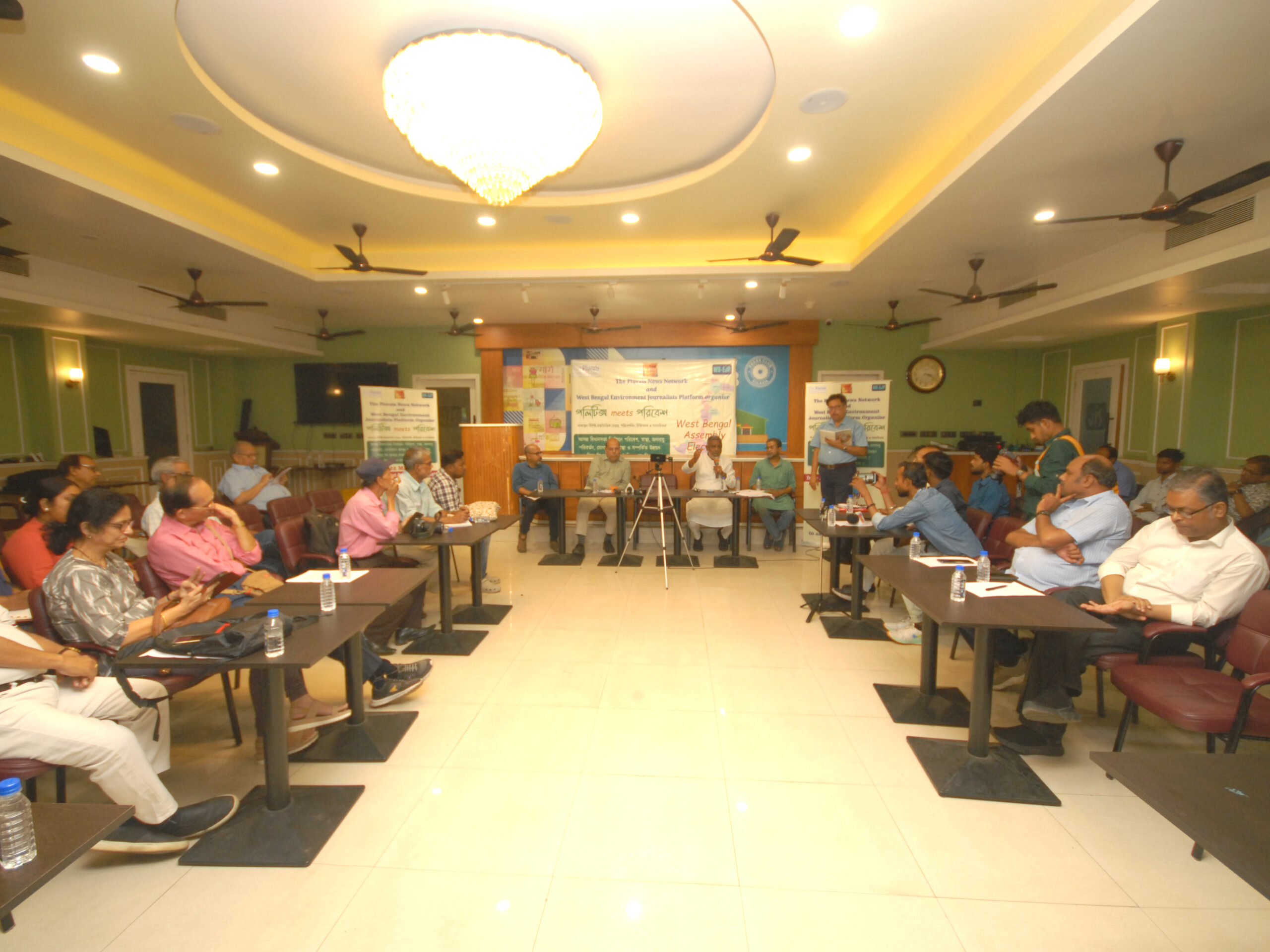
Several activists and civil society members raised their concerns on environment and climate change agendas vis-à-vis political discourse in West Bengal at a meeting in Kolkata on Saturday. The meeting was attended by senior political leaders from several mainstream political parties in the state.
The civil society – political interface was organised at Kolkata Press Club by The Plurals News Network alongside West Bengal Environmental Journalists Platform and non-profit EnGIO, where the activists and citizens came up with several recommendations on environmental concerns for political parties in the run-up to the April Assembly elections in Bengal.
The three pollutions
Pollution emerged as a key theme. Environment activist Subhas Dutta, who said that political parties have never made the environment a central concern, a fact he has experienced for several decades as an activist, stressed three issues that he wanted the parties to take up: Air pollution, water pollution and sound pollution.
Pulmonologist Arup Haldar pointed at the growing intensity of air pollution in the city. With a touch of humour, he pointed out how increasing pollution has literally enriched doctors, but that is not the desirable outcome. “Development doesn’t mean building concrete structures. Real development will factor in the well-being and health of people,” he said. He also suggested that political parties prioritise climate change and also audit their own manifesto to see how far they have been working on ground.
Down with DJs!
Several persons spoke about how unrestrained high-level noise invades our lives, especially during festivals. Yet sound pollution is often not taken seriously. Activist and former chief law officer of the West Bengal Pollution Control Board Biswajit Mukherjee said the sound level during election campaigns need to be controlled. He pointed out that during the recent Ram Navami political parties had been using “DJ”s, sound amplifiers, without permission, which affects the environment and public health. He added that environmental concerns must be included in election manifestos.
Chemical corrodes
Protecting agriculture from chemicals and misguided development was a major theme at the conference. Agriculture expert and seed conservationist Anupam Paul stressed the need of increasing the use of indigenous seeds and stopping the use of chemical fertilisers and pesticides. He pointed out that the soil is being drained of its resources from the continuous use of chemicals and warned of the dangers of using seeds such as gene-edited paddy, which, he claimed, is a form of genetically modified grain. Paul drew attention to the delta region Sundarbans, bordering the Bay of Bengal, as an extremely environmentally vulnerable region.
Sundarban and north Bengal priority
It is ironic that Sundarbans, the land of rivers, is suffering from a huge water crisis, with residents in several parts of Sundarban having to buy drinking water every day. Biswajit Mahakur, environment activist from Basanti, Sundarban, said one main reason behind the depleting groundwater level is the large-scale farming of Boro paddy during winter, a relatively new trend. He said that because of lack of potable water Sundarban schools are not able to prepare mid-day meals for their students.
“Rivers are in a sorry state. Most of the rivers in north Bengal are affected by pollution, encroachment, environmental violations and climatic impacts that affect biodiversity and livelihoods of local people, but hardly any political party seems to be bothered,” said Animesh Bose, an environmentalist from the non-profit HNAF based in north Bengal. Tuhin Suvra Mondal, another river activist from Dinajpur, urged the political parties to focus on the river Atreyee, reportedly affected due to reduced water from Bangladesh.
Concise list
Former Rajya Sabha MP and retired bureaucrat Jawhar Sircar highlighted several concerns. He spoke about sound pollution that continues at a stretch during the Durga Puja days; the filling up of water bodies and the need to protect Sundarban. He also made the suggestion that all recommendations about environment and climate change be made in a concise manner, and in not more than two pages, so that it is easy to go through them.
River activist Tapas Das spoke about the problem of siltation of riverbeds and the theft of river water, and riverbed mining. Dipankar Porel, an activist from Howrah, drew attention to the felling of trees. He said local organisations are capable of playing a key role in protecting biodiversity.
‘Real’ reasons
An expert, preferring to remain anonymous, spoke about what he thought wear the “real” reasons why political parties do not consider environmental agendas as key to election promises and campaigning.
“A large section of the supporters of all political parties are environment violators. Moreover, they feel that too much push to a green agenda will affect the “roti, kapra aur makan” issued of common people, though the opposite is true. A large-scale lack of knowledge and understanding also exists among a huge section of political leaders,” the expert felt.