
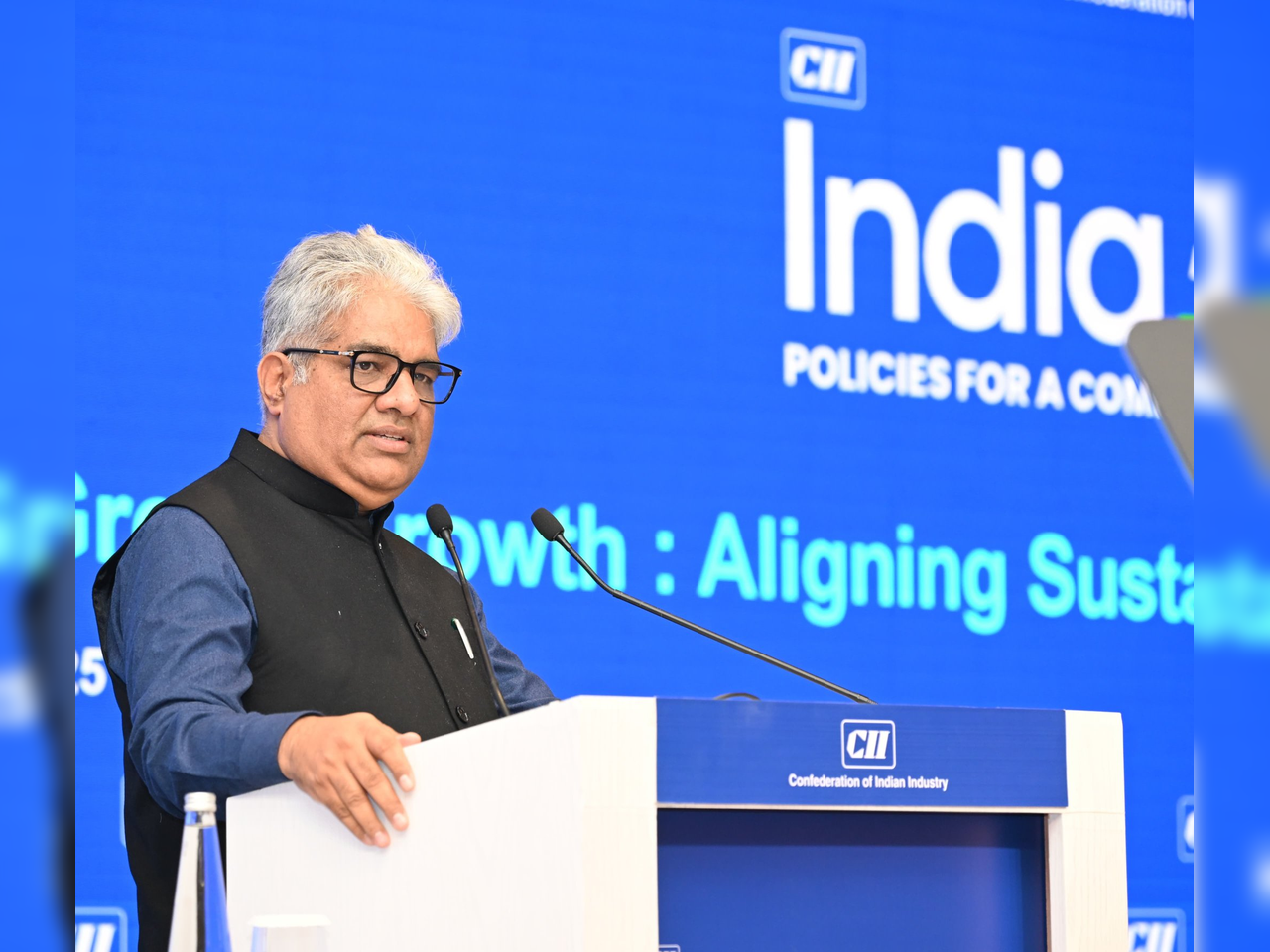
Union environment minister Bhupender Yadav has claimed that India has made a steady progress towards sustainable development, adding “clean” industrialisation is the key to economic progress.
Speaking at an industry meet in New Delhi on Thursday, Yadav stressed India’s strategic shift toward sustainable and resilient economic growth. “Clean industrialisation is not a constraint: it is a catalyst for economic expansion, innovation, resilience, and future prosperity,” said the minister, rooting for industrialisation and pointing at India’s developmental trajectory under Viksit Bharat@2047.
The Sustainable Development Report 2025, which assesses progress on the 17 Sustainable Development Goals (SDGs), shows that India is currently ranked 99th out of 167 nations; it shows India’s improvement over earlier years but the country is still behind the global targets set for 2030. Experts point out that India, like many other countries, runs the risk of not meeting several SDG deadlines.
Minister boasts green reforms
Yadav delivered the special plenary address titled ‘Green Growth: Aligning Sustainability with Competitiveness’, at IndiaEdge 2025, an event organised by Confederation of Indian Industries (CII). Decarbonising the Indian manufacturing sector is a strategic need to enhance India’s export competitiveness and avoid future carbon-related trade concerns, he said.
The minister appreciated the industry body’s role in shaping progressive policy and strengthening government–industry ties.
The minister further claimed: “India has emerged as a trusted global partner redefining development to correct imbalances, prioritising green technologies, embedding circularity, promoting sustainable manufacturing, and integrating nature-based solutions.”
Yadav listed recent reforms and initiatives that he said are driving India’s green industrial transformation. “GST 2.0 reforms reaffirm green growth by reducing tax rates from 12% to 5% on renewable energy equipment, biodegradable plastics, effluent treatment plants, and electric vehicles. Industry must seize this opportunity to invest in green manufacturing…,” he added. He referred to the Scheme to Promote Manufacturing of Sintered Rare Earth Permanent Magnets (REPM), National Critical Mineral Mission 2025, revised Green Credit Programme and Environment Audit Rules 2025. He urged industry to partner these efforts.
COP30, which Yadav had attended, had met India’s expectations, he said. “The 29 decisions adopted by consensus clearly reflect India’s priorities across critical areas such as climate finance, unilateral trade measures, technology and Just Transition.”
The Minister also underscored the transformative role of circular economy, which ensures materials are not wasted, and ‘extended producer responsibility’ (EPR), a policy approach that makes producers take responsibility for their products for the duration of the entire lifecycle. “EPR builds sustainable waste ecosystems, boosts recycling revenues, formalises informal workers, and can unlock 33 lakh new jobs, creating a green-skilled workforce,” argues the minister.
Climate action is a concern
However, several global reports have recently pointed at India’s not too encouraging status in the sectors of sustainable development, particularly in the sector of climate action.
Sustainable Development Report 2025 finds that India is currently placed 99th out of 167 nations. It is up from 109 in 2024, but the report reveals that several sustainability challenges remain for the country, especially in relation to achieving environmental, including climate, goals.
This report observes that only one-third of India’s SDG targets are “on track” for 2030, while other reports show limited progress or even the country slipping backwards.
India is clearly on track with two of the 17 SDG goals, ‘No Poverty’ (SDG 1) and ‘Reduced Inequalities’ (SDG 10); while progress on others, including ‘Zero Hunger’ (SDG 2), ‘Industry, Innovation, and Infrastructure’ (SDG 9), ‘Sustainable Cities and Communities’ (SDG 11), ‘Responsible Consumption and Production’ (SDG 12), and ‘Life on Land (SDG 15)’ is stagnating. Goals such as ‘Affordable and Clean Energy’ (SDG 7) and ‘Life Below Water’ (SDG 14), are showing moderate improvement.
‘Climate Action’ (SDG 13) remains a concern with a worsening trend, indicating that India’s efforts to take action to combat climate change and its impacts are not improving.
A global report released at the recently held COP30 at Belém, Brazil, also pointed at India’s poor climate performance among 63 countries and the European Union (EU).
According to the report, India has slipped to the 23rd rank in 2025 compared to 10th in 2024. The report, Climate Change Performance Index (CCPI), prepared by Germanwatch, NewClimate Institute, and CAN (Climate Action Network) International, and released annually, has identified India’s coal dependence as the main obstacle. India remains one of the largest emitters of Greenhouse Gases (GHG), though its per capita emission is not huge.
While the minister claimed that clean industry has been fostering economic growth in the country, official statistics show that industries are contributing an estimated 51 per cent of the country’s air pollution, apart from being responsible for one-fourth of the country’s GHG emissions.