
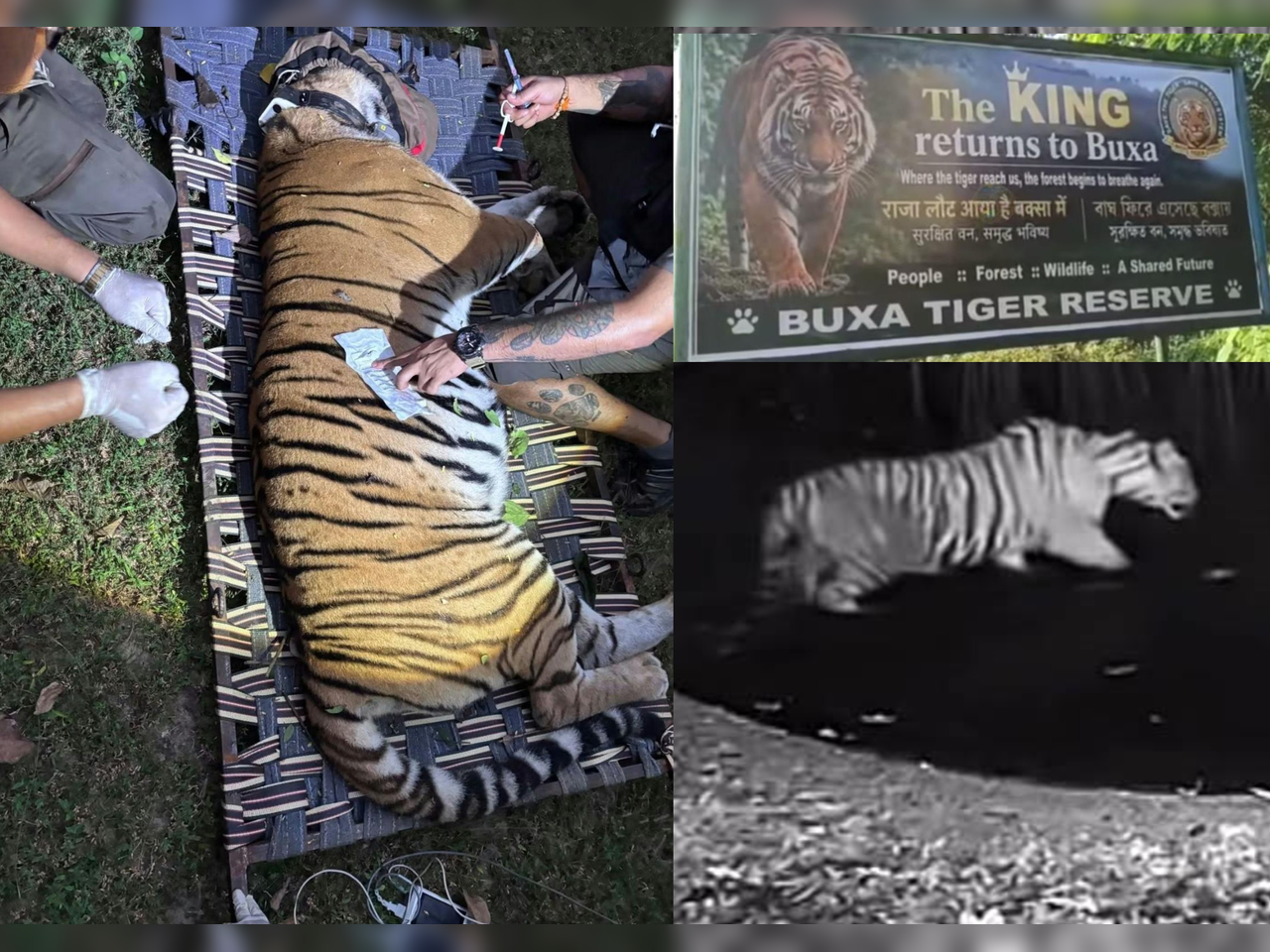
The king (or, should we say queen) is set to be back in Buxa tiger reserve which does not have a resident tiger for over two decades.
Bengal is all set to welcome a tiger in its second forest after Sundarbans as state’s chief minister Suvendu Adhikari and Union Minister for Environment, Forest and Climate Change Bhupender Yadav are scheduled to introduce a three-year-plus old tigress into the Buxa Tiger Reserve (BTR) in north Bengal on Friday, October 2.
Few experts pointed out that the introduction without appropriate preparation may backfire as it happened in Satkosia; while others urged government to engage strongly with the community to make the experiment successful as happened in Sariska tiger reserve.
The tiger reintroduction process kickstarted after BJP came to power in West Bengal with the National Tiger Conservation Authority (NTCA) identifying Buxa as a priority for reintroducing tigers in a recent report.
The tiger will be kept in a 2.3 hectare wide enclosure now
State environment and forest minister Manoj Oraon told this correspondent that the tiger, brought from the Valmiki Tiger Reserve Forest of Bihar on Wednesday, would be soft launched, to be kept within an enclosed and insulated territory of about 2.3 hectres as of now, after the introduction on Friday; and be released in the wild only after it gets acclimatised and settles down in its new habitat.
“We have plans to introduce 2 to 3 more tigers in phases to augment the tiger population,” added minister. The original proposal, a decade back, mentioned that at least 6 tigers are required to form a viable population. A forest official said that at least one male and another female are immediate priorities.
Responding to the apprehension of tiger-human conflict minister said that the forest department staff would be closely monitoring the situation – the tiger is to be radio collared – to ensure that no untoward incident happens. “We have undertaken the awareness programmes actively and also in the process of shifting the villages located within the Buxa forest area over time,” he explained.
Will Buxa go in Sariska way or Satkosia’s, experts mull
Several tiger experts expressed apprehension that introducing tigers without appropriate preparation may backfire.
“Bengal should not be in a hurry to reintroduce tigers in Buxa,” said senior tiger expert Qamar Qureshi, warning that the experiment of introducing tigers in the forest of Alipurduar district without adequate preparation may falter, as it did at the Satkosia tiger reserve in Odisha.
“Bengal should not rush to reintroduce tigers in Buxa without appropriate background preparation. Reintroduction in a hurry may become optics but cannot guarantee the sustenance of a viable population,” added Qureshi, a professor at the Wildlife Institute of India.
Qureshi referred to the Sariska vs Satkosia discord to drive home the point. “Sariska had zero tigers in 2008, three were reintroduced in 2008, and the present number is 56; a success story because both the prey base and habitat were ready for the reintroduction. However, Satkosia , which also had one tiger in 2018 and introduced two more that same year, does not have a single tiger now because its habitat was not ready. Buxa may go the same way if the tiger reintroduction is done in a hurry and not planned well,” he added.
Y.V. Jhala, a renowned wildlife scientist and former dean of the Wildlife Institute of India (WII), observed that while the Buxa Tiger Reserve (BTR) is a high-potential landscape for tiger recovery, but pointed out that careful habitat management is required before rushing into reintroduction.
Pray base under scanner
While a 2004 census recorded about 70 tigers in north Bengal, the resident tiger population in Buxa had disappeared by the late 2000s.
“The successful reintroduction requires availability of an adequate number of preys for the tiger, as well as a habitat suitable for reintroduction. It generally needs eight to 10 years; I do not think Buxa is ready for it yet,” added Qureshi.
A recent document released by the NTCA on tiger habitats, accessed by this correspondent, shows that prey base and habitat quality are declining in Buxa.
Habitat quality and security concern
“Even more than the prey base, the habitat is a challenge, as the core area still has several villages and a lot of human movement in the area,” admitted a forest department officer.
Only residents of two villages have been relocated while the shifting of a third village is in process, while still another 11 villages remain in the core area. “While major sections of the local people are happy with the hefty compensation, with every extended family getting around 45 lakhs rupees and close to 14 kantas of land, there are oppositions to shifting as well,” admitted the official.
Pradeep Vyas, a retired senior forest official in the state, said: “I initiated the proposal to reintroduce tigers in Buxa, and it got cleared by the steering committee of the NTCA in 2016-17, but got stuck over a range of reasons since then.”
Vyas said that reintroduction of tigers in Buxa would be tough unless the local community got more support for livelihood and awareness programmes were conducted more aggressively.
“The security issues in Buxa tiger forest also needs to be resolved properly, otherwise the reintroduction may face problems,” said Biswajit Roy Choudhury, a wildlife expert associated with a state-based nonprofit.
Forest department confident about the experiment
“We re confident that we will be carry out the experiment successfully,” observed a senior forest department official from north Bengal.
“Reintroduction of a tiger is a challenge in itself as there must be reasons why it disappeared in the first place. But the study and work for the reintroduction have been continuing for the past eight years, and the NTCA has taken the decision based on that,” said another forester.