
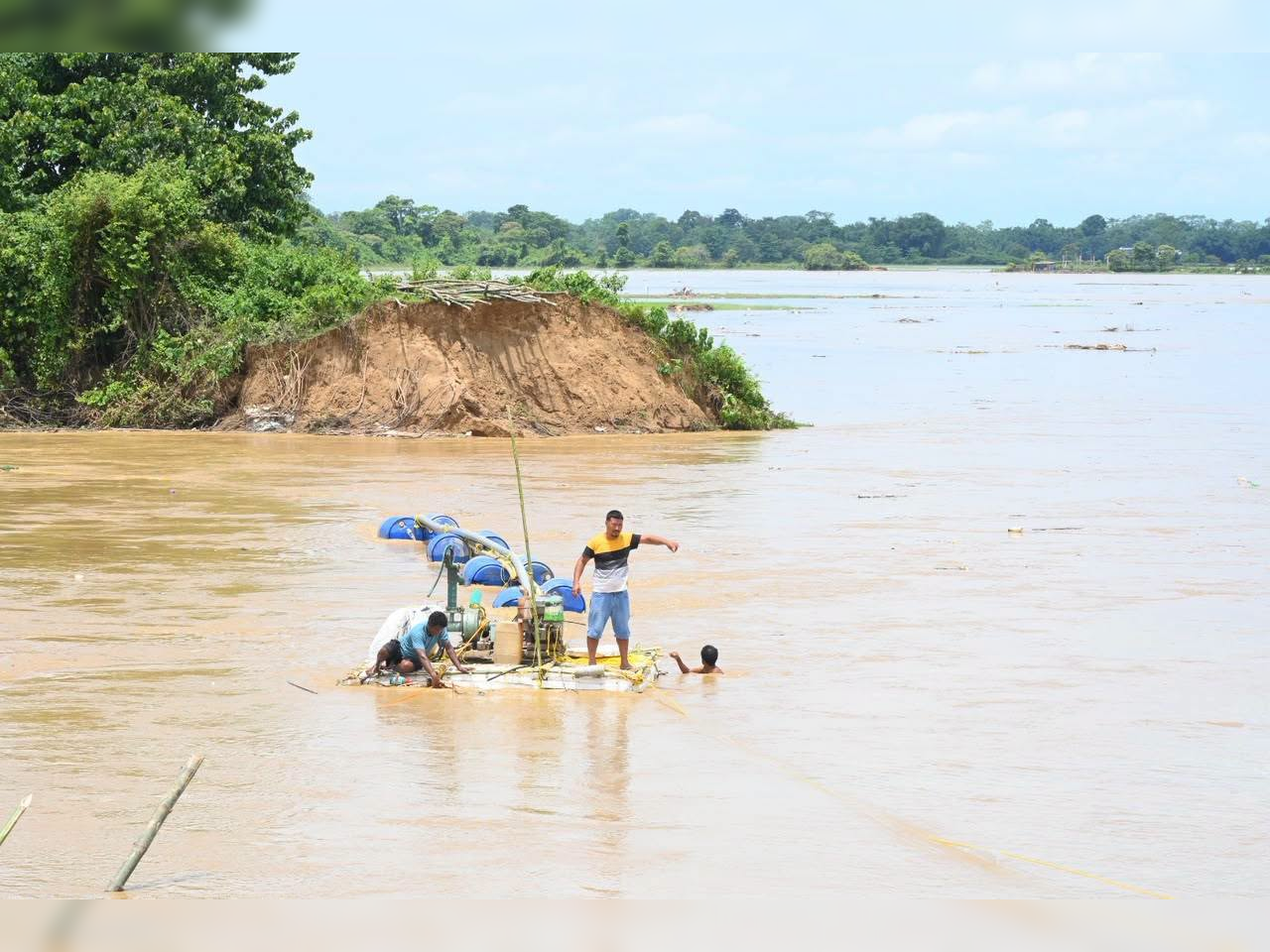
The recent Assam floods, which have killed more than a hundred so far, were man-made and climate change had little role in triggering the crisis, finds a recently released global report.
According to a new study by World Weather Attribution (WWA), a copy of which is with The Plurals: “Deadly Assam floods (were) worsened by human factors — but not necessarily climate change”. The WWA is a conglomerate of international scientists that fast-checks if climate change caused an extreme weather event including massive flood, heavy storm or heat wave.
“Heavy monsoonal rainfall in northeastern India remains within historical norms while land-use changes increase the impacts and risk to people and livelihoods. Devastating flooding … across Assam and neighbouring states in northeastern India were worsened by rapid urbanisation, deforestation and local vulnerabilities,” reads the WWA report, which has been prepared by about 20 international scientists from several frontline global research bodies, including Indian institutions, such as IIT Mumbai and Indian Meteorological Department (IMD).
IMD supports ‘non climate’ claim
The report goes on to say: “Scientists from India, Sweden…Netherlands, United Kingdom and United States analysed historical weather records and climate models and found that the rainfall totals were not exceptional, and are expected at least every 2 years.”
Experts who worked on the report explain the methodology. “To understand whether climate change played a role in the rainfall in the Upper Assam region and the surrounding hill catchments that led to the landslides and flooding, we analysed both short, high-intensity downpours and longer rainfall accumulations…overall findings suggest no discernible role of climate change,” Mariam Zachariah, research associate in Extreme Weather and Climate Change at the Centre for Environmental Policy, Imperial College London, and a key member of the research team.
IMD director general Mrutyunjay Mohapatra agreed: ” Every disaster should not be linked to climate change; there may be several other factors contributing to the flood. The data shows that cumulative monsoon seasonal rainfall is deficient, while there was episodic heavy rainfall,” stated the expert to The Plurals on Sunday.
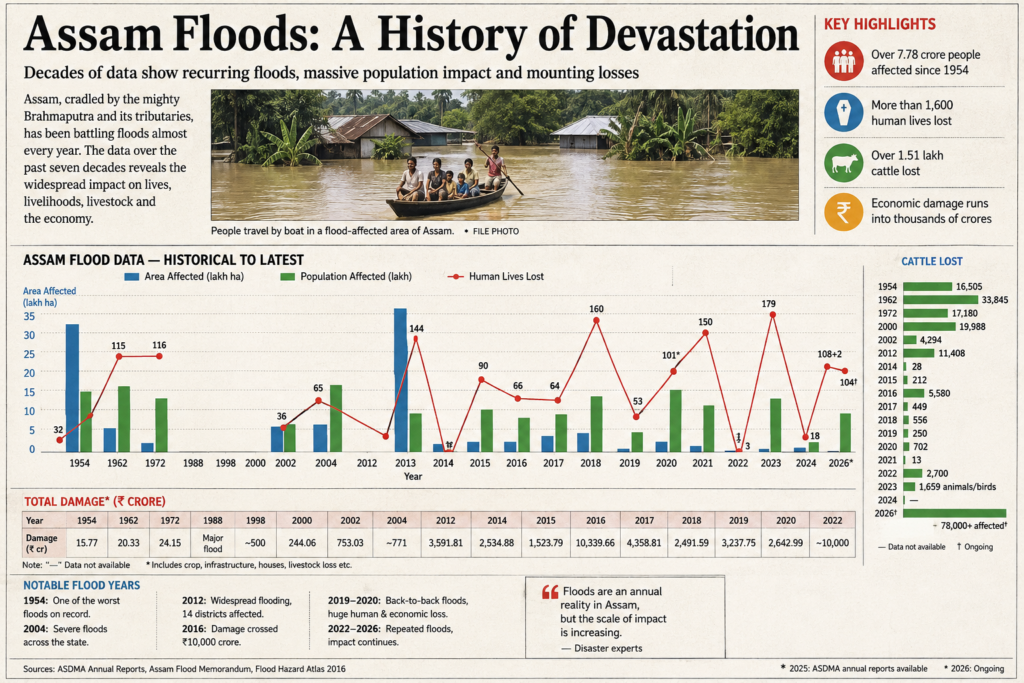
Environmental degradation, land allocation blamed
The report identified several reasons as the major causes behind the latest menace at Assam.
“Environmental degradation (such as) …Unplanned urbanisation, rapid deforestation, wetland destruction, and riverbank erosion has degraded natural drainage capacity, increasing flood height and downstream impacts,” the report reads. “Flood mitigation (solutions such as)…Reliance on concrete engineering and hard embankments has trapped silt, artificially raising riverbeds, and blocking natural runoff. Embankments frequently exacerbate flooding and increase the risk of catastrophic breaches,” it adds.
“Historical land reallocation contributed to some indigenous communities living on marginal, flood-prone riverbanks and sandbars (chars),” claiming that these historical patterns continue to trap low-income agricultural populations in cycles of repeated displacement.
Wetlands restoration and early action necessary
Friederike Otto, a professor of climate science at the Centre for Environmental Policy, Imperial College London, pointed out that “This report is a crucial reminder that building climate resilience isn’t only about cutting emissions. It’s also about sustainable land management, protecting ecosystems, and managing the exposure to disaster risk on the ground.”
He added: “While climate change is making life harder for most Indians, not every disaster is a climate change disaster. The devastating flooding in Assam was instead driven by extreme human exposure, environmental degradation, and infrastructure limitations.”
Emmanuel Raju, director of Copenhagen Centre for Disaster Research, University of Copenhagen, said: “True adaptation requires moving towards living with rivers through wetland restoration and proactive early action before floodwaters strike.”