
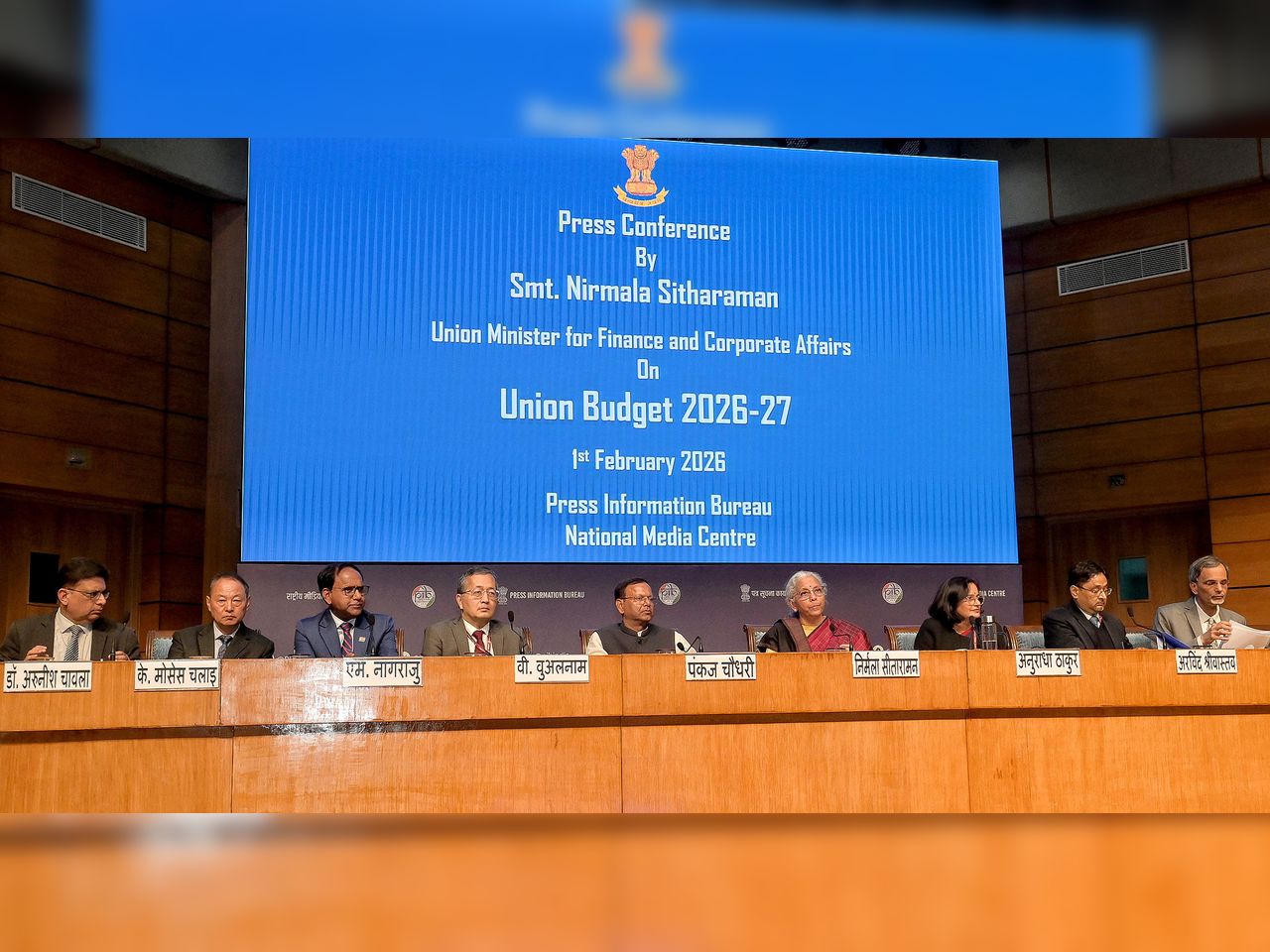
Poll-bound West Bengal received a few infrastructure projects in the 2026-27 budget placed by finance minister Nirmala Sitharaman on Sunday. But many political observers believe that the announcement was not at par with the pre-budget expectations, especially if Assembly poll-bound Bihar in 2025 was a benchmark, as the budget that year had allocated a bounty to the state.
A section of political leaders from the Trinamul Congress (TMC) and the CPM, and a few experts feel that Bengal being overlooked underlines a backhanded acknowledgement by the BJP that it may be difficult to dislodge the TMC government from Bengal in the Assembly elections this year. Others, however, feel that the Bihar and Bengal situations are not comparable.
“Bengal virtually got nothing in the budget. The BJP knows that they are going to lose the next elections in Bengal, hence no major support was provided for Bengal in the budget,” said Bengal chief minister Mamata Banerjee on her way to Delhi on Sunday.
For a change the CPM state secretary Md Salim agreed with the chief minister’s logic. “The budget, and the announcements, are proof enough that the BJP, all said and done, has a ‘setting’ with the ruling party here and plans to give back the state on a platter to the TMC. Clearly the BJP is making no real effort to challenge the TMC in the next elections through budgetary announcements,” Md Salim told The Plurals.
MLA from the BJP and economist Ashok Lahiri, though, pointed out that a national budget cannot be presented to appease a state, even as BJP state president Samik Bhattacharya claimed that the budget is meant to push overall development in Bengal.
But the Bihar bounty came up again. “While Lahiri is right, the question crops up: what happened in the case of Bihar when the state was given a special package of around Rs 59,000 crore before the last Assembly elections?” demanded an expert, pointing out that while infrastructure developments are extremely important, they normally take a long time to materialise and depend on a range of factors.
What Bengal got…
In tune with the overall thrust on infrastructure development in the Union budget 2026–27, Sitharaman announced three new major infrastructure projects in West Bengal, apart from continuing to support a few other ongoing projects.
The new projects include an East-West Dedicated Freight Corridor, between Dankuni in Bengal’s Hooghly district, and Surat, the textile hub of Gujarat, “to promote environmentally sustainable movement of cargo”. This will establish a major freight link to improve goods movement across the country, especially between industrial areas in western India and the eastern region.
The finance minister announced plans to build seven high-speed rail corridors — read bullet trains —connecting major Indian cities.
These include one from Siliguri to Varanasi. “In order to promote an environmentally-sustainable passenger system, we will develop seven high-speed rail corridors between cities as growth connectors,” said Sitharaman.
The budget also proposed the development of an Integrated East Coast Industrial Corridor, featuring a key, well-connected industrial node at Durgapur. This project is planned to boost manufacturing, logistics, and employment in the region under the ‘Purvodaya’ vision for eastern India.
The budget announcement saw that out of the three major Metro routes under construction, only two routes have been allocated funds. The budgetary allotment for most other on-going projects, including Farakka barrage renovation, remained more or less the same compared to the last financial year.
…And what the new projects mean
BJP officials claim that the proposed east-west freight corridor will bring investment, create job opportunities in the region and boost their election prospects in the region, close to Singur where the abandoned Tata project was scheduled to start. The Prime Minister had spoken about the corridor at a public meeting a few days back. At present, India has two operational Dedicated Freight Corridors, one from Ludhiana in Punjab to Dankuni, the other one from Dadri in Uttar Pradesh to Jawaharlal Nehru Port near Mumbai.
Experts termed this project as the most important out of the three announced as following the political turmoil in Bangladesh, India is focusing on the growth of its textile industry. Several parts of south Bengal, particularly the weaving hubs in Hooghly, Nadia and East Burdwan as well as Howrah and Kolkata, can benefit from the project.
The chief minister has claimed that state government has already started to work on six freight corridors and claimed that even the freight corridor from Dankuni was mentioned in her rail budget speech in 2009.
A north Bengal BJP leader claimed that the newly proposed high speed rail corridor will be a boon to the overall development of north Bengal and north-east India as Siliguri is the entry point for north-east India. “It will significantly push tourism, trade and overall employment in the area,” said the BJP leader.
“It’s like showcasing a new plate without any food. The budget has said nothing on key issues, such as the rejuvenation of tea gardens in north Bengal that is the lifeline for livelihoods for many. Moreover, north Bengal did not get any support under the announcement of new trekking routes or bird tourism though it has immense possibilities on those issues,” countered a local TMC leader.
MLA and economist Lahiri batted for the proposed Durgapur project. “Dr BC Roy, West Bengal’s first chief minister, had earmarked the area for industrial development. Durgapur is very important because of its strategic location for industries,” Lahiri said. While BJP leaders hailed the project as a “growth opportunity”; Trinamul claimed it was another announcement to garner votes.
“Prime Minister Modi laid the foundation stone, inaugurated, and announced projects worth over Rs 5,400 crore in Durgapur last August. Has the finance minister re-packaged the same one; or is it a new one?”asked a TMC leader. “Unless a specific announcement is made regarding the steps to be taken for development of Durgapur-Asansole area as an industrial corridor, it is difficult to comment on the budgetary announcement,” said Kabi Dutta, chairman of Asansol- Durgapur Development Authority.
Differing views
Academic and political analyst Sabyaschi Roy Choudhury agreed that the budget may be considered as a back-handed admission of the BJP that they do not stand much of a chance in the upcoming Bengal elections. “Apart from a low scale of investment, also look at the areas where they have not invested. These could have given them headways in the elections, be it tea industry in north Bengal or Metro lines in Kolkata,” added Roy Choudhury.
“It will not be prudent to link the budgetary announcement with election prospects taking Bihar as a benchmark. Bihar was much more critical, almost a make or break situation, to Modi and they had to grant a bounty to that state. But after a spate of electoral wins the BJP is now much more settled now and does not feel the need for the same model here. More so because increased investment is hardly expected to influence Bengal election prospects significantly with identity and dole politics ruling the roost here,” observed Biswanath Chakrabarty, another academic and political commentator.
Nilanjan Ghosh, economist and head of the think-tank ORF Kolkata, also sought to delink budgetary announcements with electoral results. “The announcements made are critical in context to the development of the state but I am unsure how they are going to influence the political discourse in West Bengal,” added the expert.