
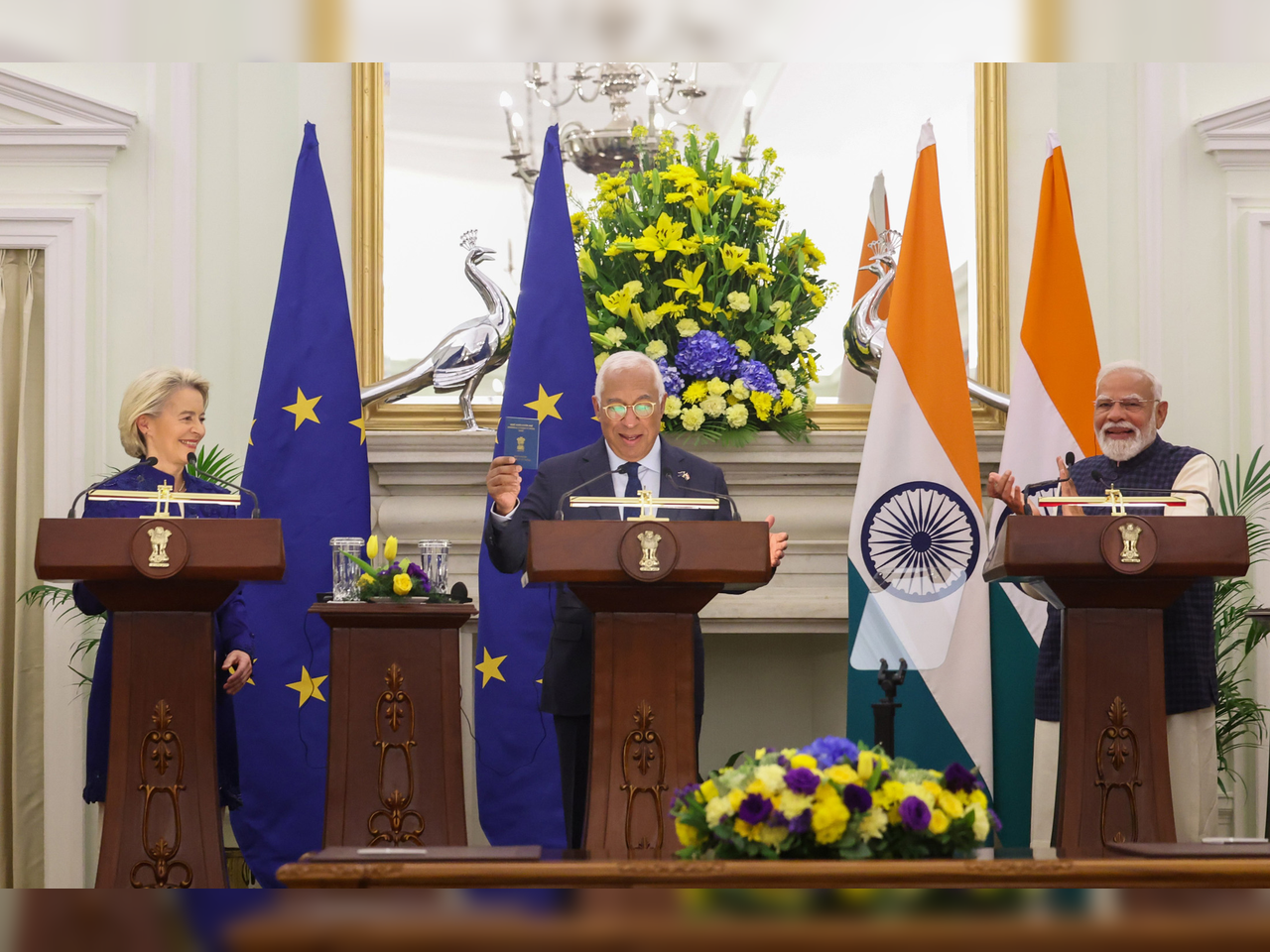
Climate-trade convergence has emerged as a key component in the just concluded talks regarding the long-expected Free Trade Agreement (FTA) between India and the European Union (EU), which is being called the “mother of all deals”.
The agreement, announced by Prime Minister Narendra Modi and European Commission President Ursula von der Leyen at the India-EU Business Forum, New Delhi, on Tuesday, is expected to double bilateral trade, estimated at €124 billion (US dollars 136 billion) currently, within five years.
It promises to be of great significance in a world threatened and fractured by climate challenges, bad politics and consequent market volatility.
During the inauguration of India Energy Week on Tuesday, Prime Minister Modi has underlined that India is the world’s fastest growing economy and noted that just yesterday, a significant agreement was signed between India and the European Union, which people across the world are calling the “mother of all deals” as the agreement represents nearly 25 per cent of global GDP and about one-third of global trade.
Modi pointed out that by the end of this decade, India aims to raise investments in the oil and gas sector to 100 billion dollars, with a target of expanding the scope of exploration to one million square kilometers.
Strategic insulation against US tariff tornado
“The FTA lands in a world of geo-economic confrontation where tariffs, carbon taxes, and industrial policy have become powerful levers, as was evident at the World Economic Forum in Davos where US President Donald Trump threatened to sanction European firms over Arctic minerals,” said a statement from Climate Trends, a research-based organisation working on environment and sustainability, headquartered in New Delhi.
“Both India and the EU came into this agreement looking to hedge against the resulting market volatility and policy fragmentation,” it adds. “With New Delhi chairing BRICS and Brussels rethinking transatlantic dependence, the deal is a deliberate move to stitch climate and trade into a stable, rules-based alternative.”
The agreement will eliminate tariffs on 90 per cent of Indian exports to the 27-nation EU, “unlocking €4 billion (US dollars 4.4 billion) in annual savings and positioning India to absorb services gains of up to US dollars 35 billion”, says the statement. This will bring relief to India, offering “strategic insulation” against a huge wave of US tariffs recently issued by the Trump administration in the US. For the EU, the FTA allows them long-term access to the Indian market, which is growing and is located at the centre of the Indo-Pacific.
A platform for green concerns
“Crucially, this FTA is emerging as a platform for climate-trade convergence,” says Climate Trends. “The climate dimension is not incidental — it’s already embedded in on-going India–EU frameworks. The Clean Energy and Climate Partnership (CECP), first signed in 2016, continues to coordinate joint work on renewables, energy efficiency, and clean hydrogen. Green hydrogen is a growing pillar in this partnership, with the EU and India both signalling the fuel’s centrality to their decarbonisation pathways,” the statement adds.
Energy boost for India
The message is that the EU will provide support in India’s energy transition. “Taken together, the FTA arrives as a hedge and a springboard that can help buffer India against protectionist headwinds from the US while reinforcing the case for middle-power leadership as BRICS chair. It also offers the EU a blueprint for climate-integrated trade — spanning hydrogen markets, carbon pricing alignment, and green investment — that survives tariff shocks and geopolitical fragmentation,” says Climate Trends.
“The deal signifies strategic alignment at a moment of high geopolitical uncertainty. The EU has been the reigning power and India is a rising power. The coming together of these global powers, especially on climate goals, green industry and clean tech shows which way money and markets are going,” said Aarti Khosla, founder-director, Climate Trends.
“The EU is already India’s largest trading partner. Conclusion of the FTA, long in the making, is a landmark moment. It can be the building block for something more ambitious: a strategic partnership that goes beyond trade providing a stable anchor to boost economic growth, build resilience, improve energy security, and build a future-ready, collaborative relationship,” said Madhura Joshi, programme lead, Asia, E3G.