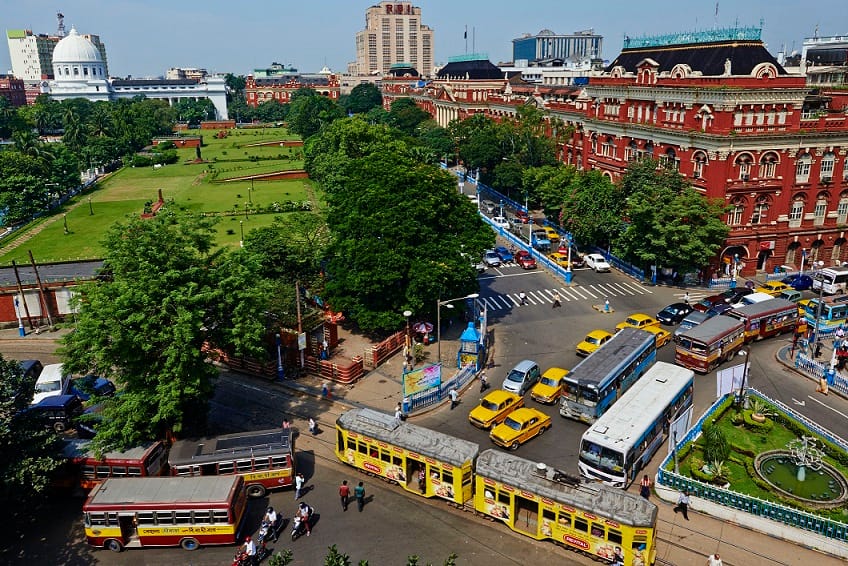
Both the immediate past and not too distant future has one prediction common for Kolkata, severe increase of heat in atmosphere; pointed out IPCC report (AR 6 – Working Group 1) released sometimes back. Kolkata recorded the highest rise in surface air temperature within the studied cities and regions across the world in 1950-2018, according to the report.
The pre-industrial period (1850-1900) is considered a benchmark; as after that period industrialization was initiated and, as a result, human-induced emissions started to increase.
Warming in the city increased 2.6°C, followed by Teheran (2.3°C) and Moscow (1°C) during this time. Urbanisation contributed to the rise in the city’s temperature, with more than 80 percent part of the warming having generated within the city itself, the report said. It added that “urban centers and cities were warmer than the surrounding rural areas due to the urban heat island effect”.
Urban heat island effect arises from several factors, including reduced ventilation and heat being trapped as tall buildings are closely packed in a small area; heat generated from human activities; heat-absorbing properties of concrete and other urban building materials; and limited amount of vegetation.
“Kolkata has all the required tell-tale elements of a highly unplanned city. It has high concretization and extremely low number of vegetation,” said SubhasDatta, an environment activist.
Kolkata may experience a 4.5 degree Celsius rise in annual mean temperature in 2081-2100 compared to the pre-industrial period (1850-1900) under the worst possible greenhouse gas emission scenario, according to the report.
The data analysis under various greenhouse emission scenarios showed that the annual mean temperature may increase 4.5°C by end of the century compared to the pre-industrial period under business-as-usual emission scenario, Representative Concentration Pathway (RCP) 8.5.
RCP 8.5 accounts for 3-4°C global average temperature rise compared to pre-industrialisation times.
Even under the best possible emission scenario RCP 2.6, which aims to keep temperature rise under 2°C, the rise will be 1.6°C during 2080-2100. The rise will be 2.4°C under the likely scenario of RCP 4.5, which acknowledges 2°C global temperature rise.
The report predicted that by end of the century, the city may experience a temperature of 35°C or more 150 days a year.
This rise in temperature has been quickened, and will further quicken in near future, with the rise of green house gas concentration; as about 80 per cent rise in the city’s temperature rise is likely to happen after 2014. During 2021-2040, the rise would be around 0.9°C compared to pre-industrialisation time; it will be 1.4-1.9°C during 2041-60.
“We can say with high confidence that extreme heat and heat wave phenomena are going to increase,” said Subimal Ghosh, scientist, Indian Institute of Technology, Mumbai. He is among the lead authors of the IPCC report.
“Kolkata, hardly 100 km away from the Sundarbans, will have to bear the brunt of sea level rise. High tides will become higher and there is a possibility of more acute and longer duration flooding,” said Ghosh.
“The situation will be particularly difficult for the city as it has an old, highly silted drainage system being prepared during the British era,” said environmentalist and drainage expert ArunabhaMajumdar.
The report predicted that while total rainfall in the city and adjoining areas may increase marginally, short-duration extreme rainfall events would increase substantially which generally leads to the generation of greater volume of water as run-off.
The report showed that ‘one day maximum rainfall’ in Kolkata may increase about 50 per cent by century-end. The city may also record 118 mm of rain during such days . Total rainfall, however, may rise in the range of 20 per cent compared to present statistics.
CLIMATE CHANGE
NEWS
Kolkata global topper in temperature rise
Both the immediate past and not too distant future has one prediction common for Kolkata, severe increase of heat in atmosphere; pointed out IPCC report (AR 6 – Working Group 1) released sometimes back. Kolkata recorded the highest rise in surface air temperature within the studied cities and regions across the world in 1950-2018, according […]