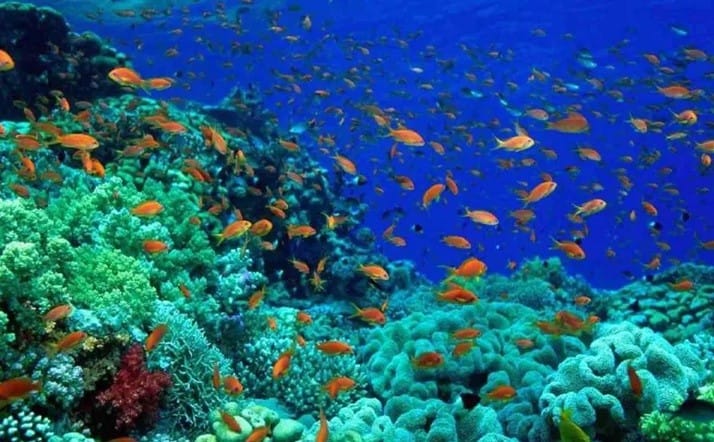
According to a new study, climate change is forcing marine life to change its distribution as it has started abandoning equator and tropics; and moving towards the poles.
The study – global warming is causing a more pronounced dip in marine species richness around the equator – authored by Chhaya Chaudhary, Anthony J. Richardson, David S. Schoeman and Mark J. Costello is a first of its kind one being undertaken at global scale that considered all species.
The research has been carried out by the University of Auckland and got recently published in the journal Proceedings of the National Academy of Sciences of the United States of America (PNAS).
“The number of species has decreased at the equator and increased in the sub-tropics since the 1950s (due to) climate warming” stated the study report, which reiterated that “this was the case across all 48,661 species” whether they live on the seabed ( called benthic) or in open water (pelagic) and applies to fish, molluscs and crustaceans.
Linking climatic angle, the study stated that “the number of open-water species found in equatorial waters has halved over 40 years, as the equator becomes too hot for some species to survive”; and explained that the dramatic shift in species has major implications for ecosystems and people who depend on marine life for seafood and tourism.
The study has waned that “if emissions are not cut rapidly and warming continues, it seems likely that these range shifts will continue, with species moving further towards the poles.”
According the various studies, species richness, number of species within an area, stands sensitive to temperature as it reaches plateau and starts declining above a mean annual sea surface temperature of 20°C for most groups.
Since1970s, species richness has declined at the equator and shifted north, a trend particularly visible among pelagic species; the species those remain in the open sea.
The results from the University of Auckland-led research showed that pelagic species had shifted poleward in the northern hemisphere more than the benthic; species those occur at the bottom of sea, and hence perhaps get less affected by temperature fluctuations.
The lack of a similar shift in the southern hemisphere was attributed to the finding that ocean warming has been greater in the northern than southern hemisphere.
Mark Costello, a professor in the university and one of the lead authors in the upcoming sixth assessment report of Intergovernmental panel for Climate Change (IPCC) , earlier showed that while marine biodiversity peaked at the equator during the last ice age, 20,000 years ago, it had already flattened before industrial global warming.
This latest study on a decadal timescale shows this flattening has continued in the past century, and the number of species now dips at the equator. The study shows that the number of marine species declines once the annual mean sea temperature is in the range of 20 to 25 degree centigrade though the rate varies from species to species.
CLIMATE CHANGE
NEWS
Climate change pushing marine life towards poles
According to a new study, climate change is forcing marine life to change its distribution as it has started abandoning equator and tropics; and moving towards the poles. The study – global warming is causing a more pronounced dip in marine species richness around the equator – authored by Chhaya Chaudhary, Anthony J. Richardson, David […]