
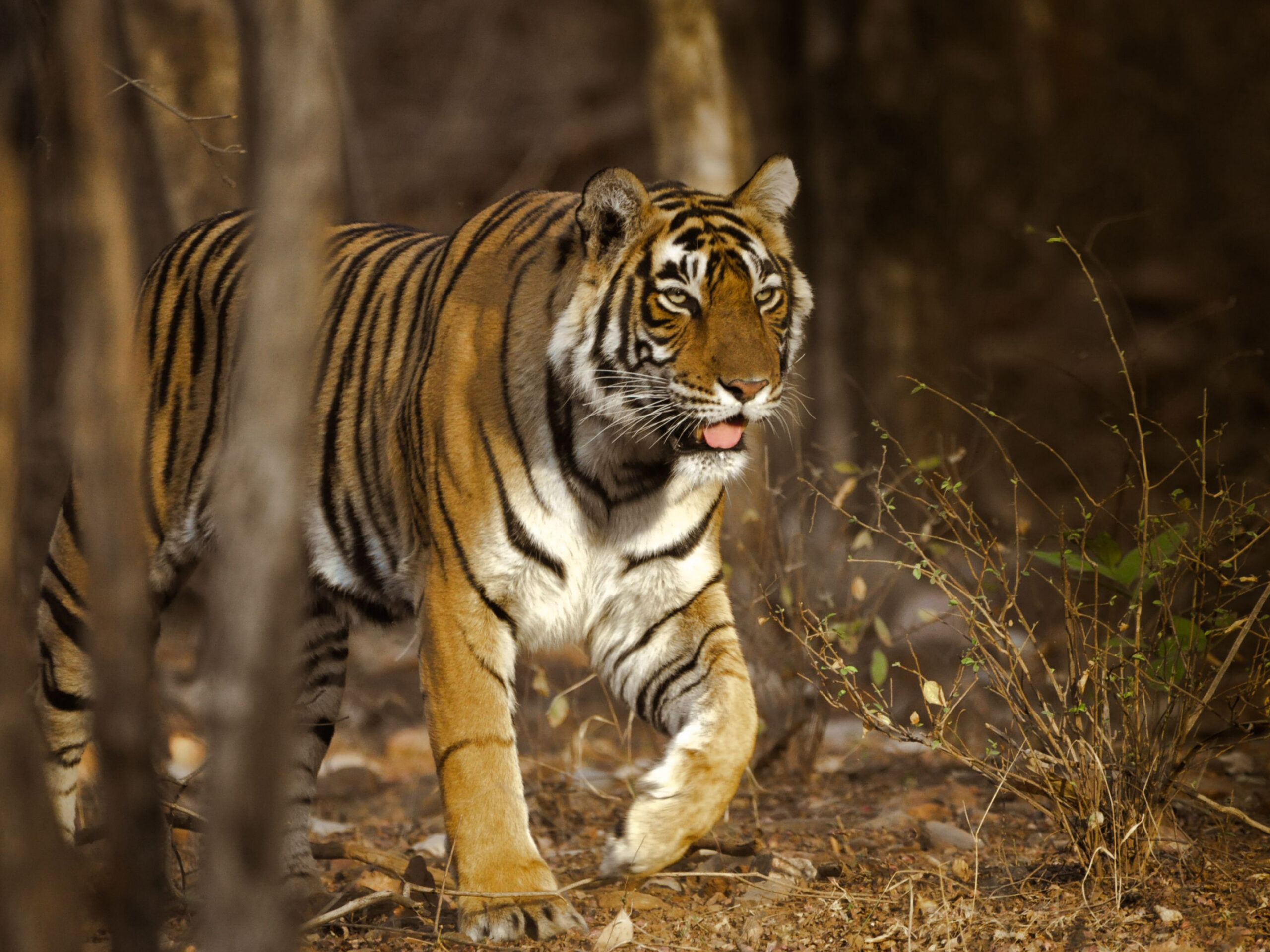
India stands out to be a beacon of hope in the trend of fast-declining global wildlife population, claims an international report released on early morning Indian time on Thursday,
“There has been a stark 73% decline in the average size of monitored wildlife populations over a 52-year period (1970- 2022),” reads the WWF’s Living Planet Report 2026, a copy of which is with this correspondent.
The report identified “habitat loss and degradation” as the most frequently reported threat affecting monitored wildlife populations, followed by “overexploitation, climate change, pollution, invasive species and disease”. The report observed that these threats are driven by “broader systemic failures across the food, energy and finance systems”.
Threat as well as a hope
The report, produced by Zoological Society of London, focuses on the population trend of 5,790 vertebrate species from 1970 to 2022; and points out that, “the strongest decline is in freshwater ecosystems (-85%), followed by terrestrial (-69%) and then marine (-59%).”
Ravi Singh, secretary general & CEO, WWF-India, said, “The Living Planet Report 2026 is both a stark reminder of the scale of the biodiversity crisis and a message of hope”.
The report also states that while “…Biodiversity indicators point to a significant decline in nature at a global scale, but the report also highlights recovery in populations of some key species globally, showing how conservation can be effective,” and referred India’s success in the context.
India stands out in the slide
“India’s latest tiger count is 3,682 individuals, according to the 2022 All India Tiger Estimation. Other species whose numbers have seen an upward trend in India include the greater one horned rhino, with a current population of 3,300+; the common leopard, 13,874; the Asiatic lion, from 674 in 2020 to 891 in 2025; and the snow leopard, 718,” reads the report.
The report also hailed India’s effort in conserving aquatic biodiversity, “India’s first-ever range-wide river dolphin population assessment was conducted during 2021–23, covering 8,507 kilometres of 28 rivers. The assessment contributed to India’s first science-based range-wide population estimate of 6,324 Ganges River Dolphins.
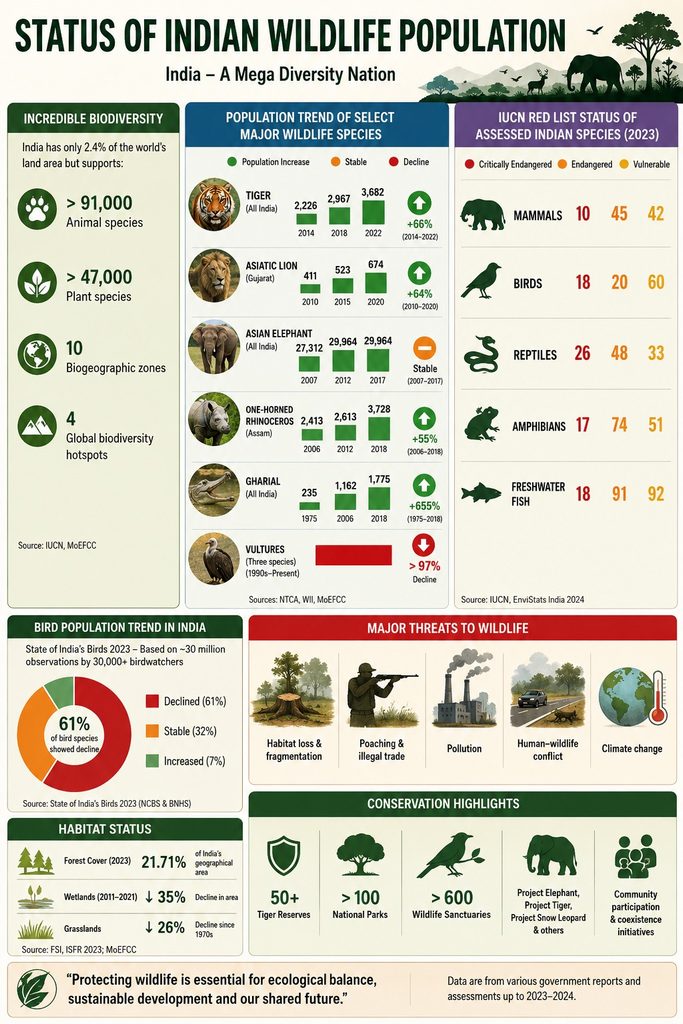
Experts hailed India’s success with riders
Experts underlined India’s positive role in global animal conservation while also striking a cautionary note.
“India is doing well in all five big cats and, no doubt, a global example in conserving wild life. India has world’s 70% tigers and the species is increasing at a rate of 6.1%. The country is also the hope for lions as the Asiatic lions are increasing in India while African lion number is rapidly declining. We have world’s largest leopard population, while third highest global population in snow leopard after China and Mongolia, and Cheetah, after reintroduction, is settling down” told S. P. Yadav, the director general of the International Big Cat Alliance, to The Telegraph on Wednesday evening. The expert attributed the success on a range of factors from consistent government funding to scientific evidence-based conservation roadmap pursued, to use of technology among others.
“India is doing well in the protected area-based species conservation but we need to prepare and follow appropriate conservation strategy for animals largely remaining outside the protected areas like the Great Indian bustard, Indian wolf, foxes and likewise; which is not there now,” explained Y S Jhala, a frontline Indian wildlife scientist and conservationist.
Qamar Qureshi, a wild life conservation expert and a professor in Wildlife Institute of India (WII), observed that the increase in number of several wildlife species particularly the big cats and other mammals have triggered a sharp increase in the man animal conflict affecting mainly the poor population as well as poaching.
The report also warned that, “the declines registered by the LPI and other biodiversity indicators cannot be reversed by conservation efforts alone.”