
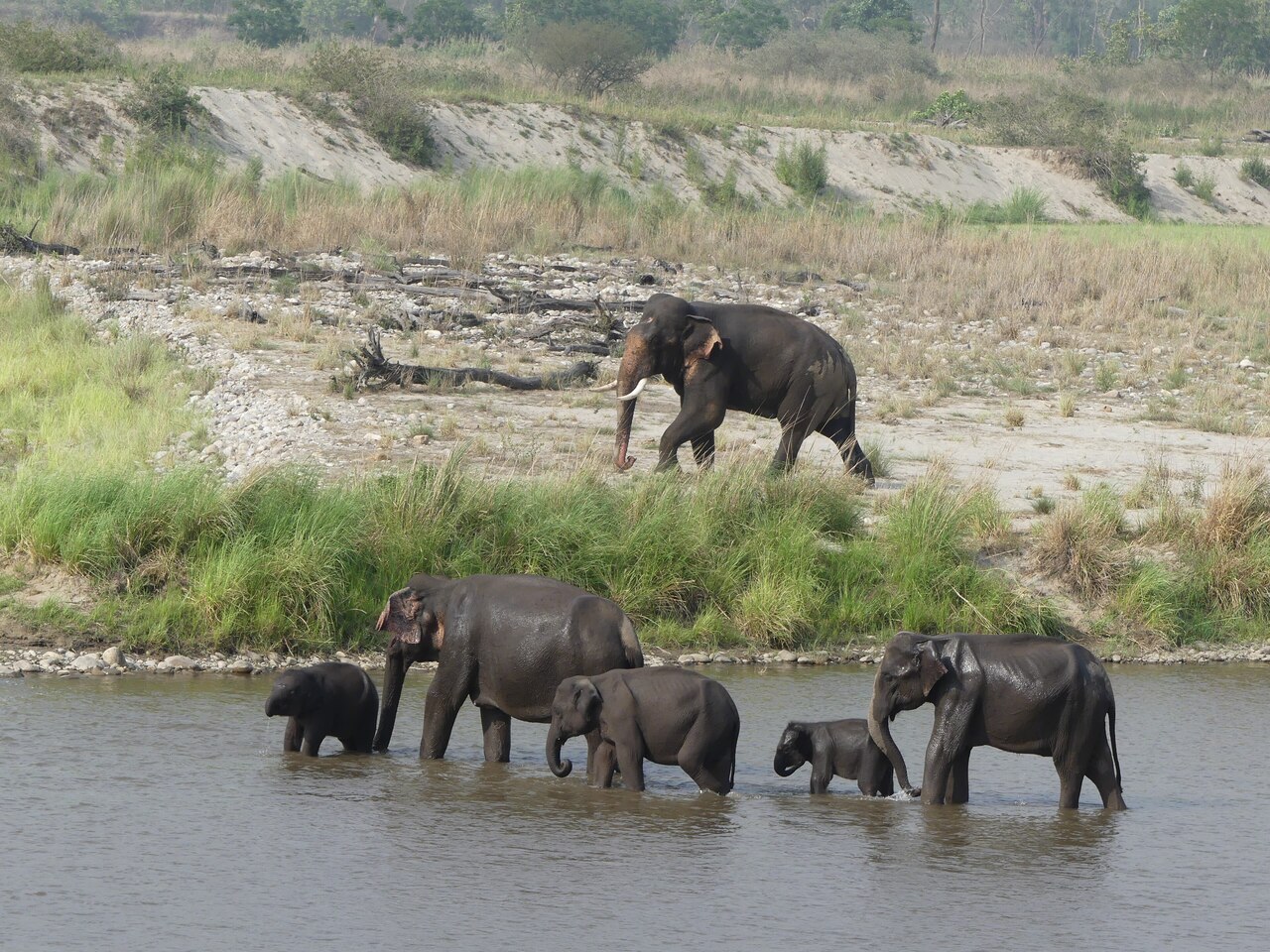
On August 12, World Elephant Day, the Union government issued a statement on the significant role that India, home to nearly 60% of the world’s wild Asian elephants, has played in global elephant conservation, but acknowledged that because of the large population, it faces greater conservation challenge.
The challenge is obvious if we look at the current scenario from West Bengal alone.
“The Synchronous All India Population Estimation of Elephants (SAIEE) 2021–25 estimates India’s wild elephant population at 22,446. These elephants are protected across 33 elephant reserves and 150 identified corridors,” says a government release. It adds that this elephant population also brings a responsibility to address growing conservation challenges and sustained global action.
Tech help
The government stressed on technology-driven efforts in conservation, including engaging AI. Project Elephant is the Centre’s flagship initiative for elephant conservation, in which technology is an important feature.
“Implemented by the Ministry of Environment, Forest and Climate Change (MoEFCC), the programme provides financial and technical support to states for protecting elephant habitats, conserving captive elephants and mitigating human-elephant conflict,” says the government. It is also using AI-enabled monitoring, radio-collaring, genetic databases and early warning systems.
The latest population estimate, using SAIEE 2021–25, used India’s first DNA-based synchronised elephant census. Dung samples were used to identify individual elephants through unique genetic fingerprints. This method improved population estimation by detecting repeat samples across landscapes.
Expanding reserves
Elephant Corridors of India, 2023, prepared with technical support from the Wildlife Institute of India, says the corridors span across four regions.
“Elephant Reserves have expanded steadily since 2014, now covering 80,777 km across 14 major elephant-range states. The expansion has brought an additional 8,610 km² under protection,” the government release adds.
The government claims it has taken decisive steps to reduce elephant deaths along railway corridors.
Rising human-elephant conflict
Experts are worried, however, that the rising elephant popularition is increasing the human-elephant conflict.
West Bengal has around 2% of India’s elephant population, but it demonstrates the high risks of the human-elephant conflict, which also results in agricultural loss. “Elephant-human conflict, particularly elephants raiding crops, has now become a common event in several south Bengal districts such as Jhargram, Paschim Medinipur, Bankura and Purulia,” says Mukti Roy, an elephant expert and researcher at the Indian Institute of Science.
Elephant raids have become a common problem in north Bengal districts, including in Jalpaiguri, Alipurduar and Darjeeling, particularly in areas such as Kurseong, Baikunthapur, Dhupguri, tea gardens and places along the India-Nepal border.
Experts and officials feel that elephants have changed their food habits, shifting from grass to crops such as paddy and corn, the latter being more nutritious and easily available in agricultural fields.
“With elephant numbers reaching around 800 in the state, and elephants showing signs of change in their food habits, preferring harvested crops, the problem is on the rise,” a senior forest official feel.
Loss and damage
“In south Bengal, the number of elephants was 96 in 2005. This rose to 210 in 2025, with several from Jharkhand and Odisha choosing to stay back in Bengal permanently,” an expert points out.
“The number in north Bengal is now around 630, which has also doubled in the last two decades. With habitats shrinking and the number of elephants rising, the threat is rising every day,” the expert adds
As a result, the forest department has to pay large amounts in compensation every year — around Rs 10 crore annually. “We spent around Rs 12.7 crore during 2023-24, Rs 10.17 crore during 2024-25 and Rs 6.15 crore during the ongoing financial year so far,” a forest department official says.
“Though the amount includes compensation for human lives and hut damage, agricultural loss dominates the compensation amount,” the official observes.
Community effort
Community-driven initiatives, combined with forest department efforts, can help. “In a few vulnerable areas, people of the community, with our help, have formed a Quick Response Team to monitor fields at night and stop elephants from damaging crops,” says Anujit Basu, an elephant expert from the non-profit Nature and Wildlife Association, or NWA, which works in north Bengal.
Basu points out that coordinated action by community teams, which use walkie-talkies operating within a range of 5 km to 7 km, can communicate the direction of moving herds. This move has been successful so far, say local farmers.
Biswajit Roy Choudhury of the non-profit NEWS says it is critical to plant grass varieties in forests that elephants prefer as food.