
If the BJP is to form the next government in West Bengal, it requires at least 45% of polled votes, which would need a swing of around 5% over its best performance ever, 40.64%, during the 2019 Parliamentary elections. However, data shows that the BJP has never reached 40% in an Assembly election, 37.97% being its best so far in the 2021 Assembly polls.
The mathematics was shared during a roundtable on the elections held on April 26 in Kolkata by The Plurals, attended by senior journalists, poll researchers and experts from several fields acquainted with ground realities. We are refraining from naming the speakers or attributing quotes to them following Chatham House Rules. The protocol, established in 1927 at the Royal Institute of International Affairs (Chatham House) in London, intends to foster free discussion by providing anonymity to speakers.
Dynamics of paribartan (change)
A poll data consultant, who closely analysed Assembly elections data from Bihar and is following the West Bengal elections, listed three conditions he felt necessary for a change of government in any scenario.
“We find that governments are most likely to lose power when three conditions come together,” the expert said. First, the government/chief minister becomes highly unpopular; second, the ruling party’s cadre or vote base develops major cracks, and third, a significant movement against the government emerges.
“If all three happen together, defeat of the ruling party is highly likely. If two occur, there is some possibility. If only one exists, the chances of losing are much lower,” he said.
Three ‘M’s favouring Mamata
Experts pointed out that consolidation of Muslim, mahila (women) and migrant votes in favour of the Trinamul Congress may counter the anti-incumbency factor against the 15-year-old Mamata Banerjee government in Bengal.
While many experts hailed Lakshmir Bhandar — a monthly direct cash transfer allowance of Rs 1500 for general caste women and Rs 1700 for women of the Scheduled Castes (SC) and Scheduled Tribes (ST) — as playing a critical role in drumming up support for the Trinamul, several were critical of it, terming it a “dole” and a poor substitute for appropriate wage-centric livelihoods. A journalist pointed out that women in rural Bengal do not want a dole; they want jobs for their families, while other experts feel the scheme has gone beyond being just a dole to become a tool of empowerment for women and the foundation of the support that Mamata enjoys from women.
“Bengal was the first state to implement such large-scale direct cash transfers to women in February 2021. Since then, many parties in other states have adopted similar models,” said the poll analyst. “Women tend to prioritise economic incentives over ideological alignment. That is why, overall, I feel the incumbent government on Bengal has a strong chance of getting another term,” he added.
Apart from women, the Muslim community also seemed to be consolidating in favour of Trinamul to play a key role in bringing Mamata back to power, particularly in the face of the SIR process that is allegedly discriminatory against Muslims. Murshidabad may prove an exception to the rule, where some minority voters are expected to return to the Congress fold.
Migrants, who returned in huge numbers to vote and kept their names registered because of their fear of being branded “outsiders” (“ghuspetias” according to BJP leaders) in other states where they work, are also expected to play an important role in the election outcome. “While there is definitely resentment against the ruling Trinamul for not creating enough job opportunities in the state, which caused many to move out, the majority, who are also Muslims, are likely to support Mamata Banerjee due to her strong support for migrants when many were recently victimised as ‘Bangladeshis’ in other states,” said an expert.
Saffron needs a 5% swing
The BJP has to considerably improve on its vote share to come to power in Bengal.
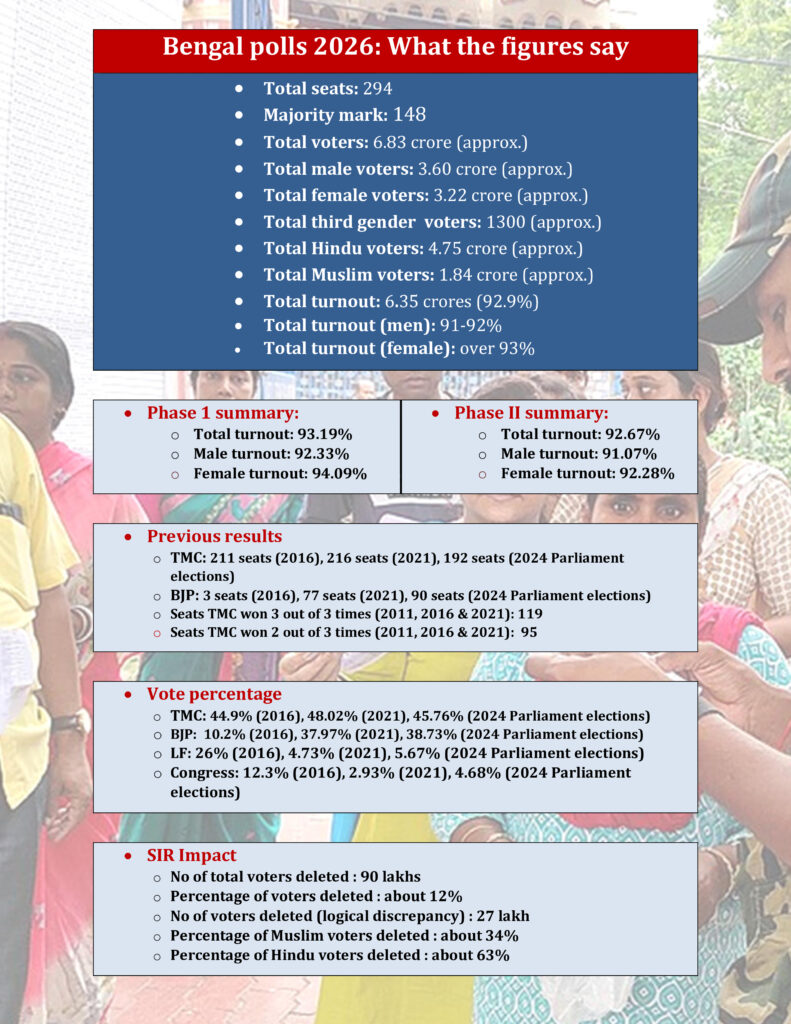
“Over the last decade, the BJP’s vote share plateau in Bengal has remained around 38–40%. To win Bengal, a party likely need at least a 45% vote share,” said the poll analyst, observing that without crossing that threshold, victory becomes difficult in such a bipolar contest.
“Currently, the BJP would need approximately a 5% swing, which is significant and usually visible on the ground. While small 1–2% shifts are harder to detect, 5%+ changes are generally obvious. I personally have not yet seen evidence of that scale of movement,” the analyst added. Other experts agreed that no discernible wave could be seen in the latest election in favour of any party.
“The BJP to win needs around 65 to 70% of the Hindu votes in Bengal. If Mamata Banerjee manages to retain even 25–30% of Hindu voters, her government is likely to survive,” he added. Many pointed out that the trend of voter turnout for the Congress and the Left Front, who fought separately in the just-concluded elections after several years, may play an important role as being increased percentage of voting in their favour may check the BJP’s march beyond the critical 45% mark. “While some Muslim votes in Murshidabad and Malda may go in the Congress way, a percentage of anti-TMC Hindu voters may go to the Left,” opined a journalist.
Another challenge for the BJP in Bengal is language and the lack of organisational structure within its party. In Bengal, the Hindi language, used by the Prime Minister and the Union home minister in their campaigns, can act as a barrier, especially in rural areas, said experts.
BJP’s counter strategy
A senior journalist, however, had pointed out that the BJP does its math without taking the Muslim voters into account.
“The BJP is making the entire electoral calculation excluding Muslim voters. They are banking on that remaining 74% of the population. How realistic is that?” she asked. “They’ve done this in Uttar Pradesh as well and got away with it,” she reminded, adding that in some parts of Murshidabad there was apparently a Hindu consolidation in favour of the BJP, including that of women, despite the fact that they are recipients of state government’s welfare schemes for women.
Many felt that the SIR was designed to target the Trinamul’s dominance based on the support of women and the Muslim community; consequently, these two categories were more affected by the process.
Will SIR be the game changer?
The possible implications of the factor that is the single biggest change in the elections this time, Special Intensive Revision, or SIR, was a constant thread through the conversation.
“There are allegations of electoral systems manipulation through electoral roll revision, voter deletion, institutional interventions and delimitation, from Haryana, Maharashtra, Karnataka, Assam, and elsewhere,” said a veteran journalist, reminding that, many believe, West Bengal may now face a similarly pre-planned political operation.
Even as everyone agreed on the huge implications of SIR through deletions of voters apparently favouring the BJP in the elections, many pointed out how the lives of the people were affected by SIR, their status as citizens being questioned, their future turning uncertain and their mental health conditions suffering a huge blow. One speaker said that after his name was deleted from the voter list, he felt “abandoned”, not only by the system, but also by his friends, who “blamed” him for his exclusion from the voter rolls for not having maintained the requisite documents. But he is clearly been a citizen of India and has all the evidence, including a two-decade-old passport, to prove his citizenship. The impact of SIR stands out as the key unknown factor in the Bengal elections.
A poll analyst, whose team has been meticulously analysing SIR data, spoke movingly about how SIR has deleted the most marginalized, including Muslim voters. He said how difficult it was to interact with those deleted, as they were feeling extremely vulnerable. “The toll on mental health is immense,” he said.
Will the deletions influence the elections results for or against the BJP?
Given the trial caused by the Election Commission of India introduced SIR process, the families whose members have been deleted are likely to be predisposed to vote in a certain way, said the expert. This may go against the BJP. Many did not rule out a SIR referendum pattern of voting following SIR, at least in some parts of the state where the deletion percentage is high, and pointed out that SIR may have been a trigger behind the record voting percentage this time.
“But what is the current situation with the SIR? The Supreme Court repeatedly says that the opportunity to vote should remain open until the very last day,” the expert said about the appeals made to tribunals by deleted voters for re-inclusion of their names.
According to sources, names of 1607 persons, originally deleted by the SIR process, were restored by the Supreme Court appointed SIR-tribunals before the election. More than 3.4 million people, whose names have been deleted, have moved the tribunals seeking restoration of their voting rights. The high ratio of acceptance, 115 to one, in favour of restoration, vindicates the allegation of unfair deletions, pointed out experts. They rued the fact that clearly millions of Indian citizens, whose cases are yet to be heard, lost their fundamental right to vote in the election.
At this rate of disposal, adjudicating 3.4 million appeals will take decades. How can free and fair elections be held in such circumstances, with so many voters excluded from the rolls? The question is likely to haunt the administration, whoever wins the Bengal elections on May 4, 2026.