
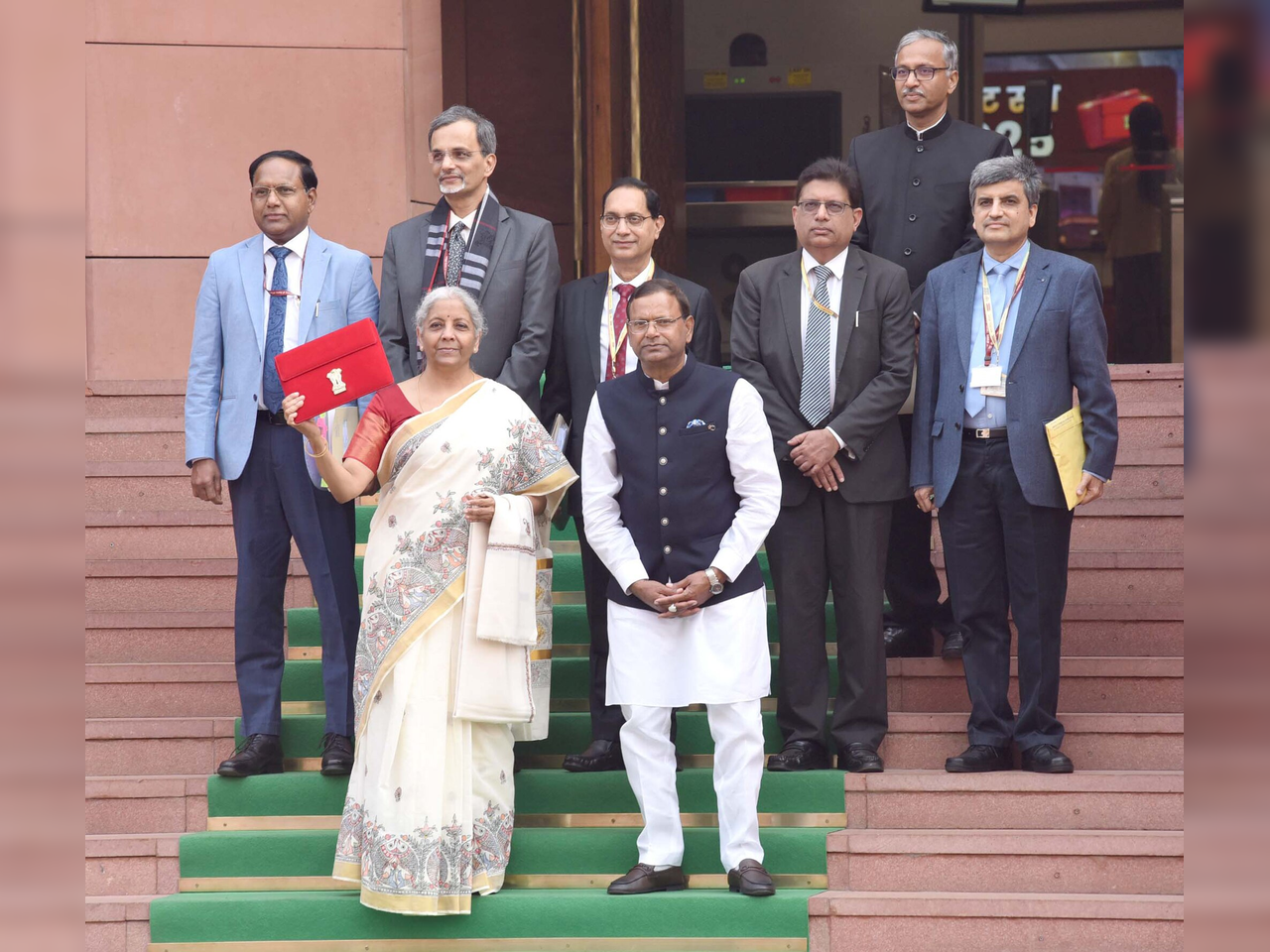
The Economic Survey 2025-2026, presented by the Union government on January 29, 2026, highlighted several developmental and environmental concerns. Among the top priorities were clean energy transition and adaptation to meet the challenges of climate change.
Overall, the survey found that the Indian economy is currently in its most consumption-driven phase since 2012; and observed that low inflation, relatively stable employment conditions and increased real incomes have helped to drive this spending.
The Plurals lists in detail what the survey has to say on different areas of green concern.
On energy transition
· Material intensity — the requirement for minerals and metals — and storage are the principal roadblocks to increased renewable energy utilisation.
· In recent months, the government has undertaken sweeping measures, including a major overhaul of the Goods and Services Tax (GST) framework, the opening of nuclear power generation to private participation, and permitting 100 per cent foreign direct investment in insurance.
· Government has notified four labour codes, easing green cover norms based on pollution potential.
· Nuclear energy and green hydrogen are proposed strategic pillars in the power sector.
On power scenario
· High capital costs, land acquisition delays, grid constraints need to be dealt with to maintain India’s renewable energy momentum.
· Battery storage and power efficiency are crucial for industrial competitiveness.
· Digital and financial reforms to transform electricity sector and enhance long-term growth.
· Make power sector efficiency central to India’s broader industrial and long-term growth strategy.
· A key reform highlighted is the proposed India Energy Stack (IES), envisioned as a Digital Public Infrastructure (DPI) for the power sector.
· A significant improvement has been noted in the financial health of distribution utilities. In a historic first, DISCOMs (distribution companies) and power departments recorded a gain of taxation value of Rs 2,701 crore in FY25, reversing years of losses.
· Coal remains central to the energy transition; India holds the world’s fifth-largest coal reserves and depends on coal for about 55 per cent of its energy mix and over 74 per cent of power generation. In FY25, coal production reached a record of 1,047.52 million tonnes, while coal imports fell by 7.9 per cent, reflecting stronger domestic supply.
· Renewable energy now accounts for 49.83 per cent of total installed capacity as of November 2025. Total renewable capacity has more than tripled in a decade to 253.96 GW, with a record 34.56 GW of non-fossil capacity added in the first eight months of FY25*** (this was mentioned as FY26).
On agriculture
· The 4.6 per cent agricultural growth was mainly driven by livestock (7.1%) and fisheries (8.8%) rather than crops.
· Despite a favourable monsoon, crop growth remained volatile.The government attributed this pattern to deeper structural issues within the crop sector, rather than weather shocks.
· Sustaining this livestock-led growth will increasingly become challenging, particularly due to persistent feed and fodder shortages.
· Raising urea prices and implementing direct cash transfers to farmers have been recommended.
· Imbalance in nutrient use, which may occur from both lack and excess of nutrients, was pointed out; a shift towards balanced fertilisation was urged.
On VB-GRAMG
· Government says a stronger rural (6,65,000 villages and 2,68,000 gram panchayats and rural local bodies) economy justifies replacing MGNREGA, which promised 100 days work on demand in rural India, with the new VB GRAMG Act.
· Pointers at rising rural incomes, consumption and falling demand for MGNREGA work.Person-days under MGNREGA are calculated as reduced by more than 50 per cent since the pandemic peak.
· Government initiatives have focused on infrastructure, access to credit, basic amenities and the development of agriculture and traditional industries.
· Recent research shows rural consumption is at its highest level in 17 quarters.
On rural migration
· The Union government is advised to look at solutions through revival of rural economy.The process of migration is extracting a huge price, with rural youth moving to urban areas and the elderly being left alone. To stop this exodus, the rural economy has to be revived.
· Urban India and peri-urban areas attract migrants seeking better education, health, livelihoods, services, entertainment and perceived well-being, viewing living in the city as a success.
· Inclusive development required to revive the rural economy and strengthen local institutions to address distressed urban migration.
· Creation of dedicated skill infrastructure in each district of the country under the Rural Self Employment Training Institute (RSETIs) programme is recommended.
On adaptation
· Great emphasis is laid on adaptation. In a chapter within the report, titled ‘Environment and Climate Change: Building a Resilient, Competitive and Development-Driven India’, it is mentioned that “development is, in itself, a form of adaptation”.
· Lack of adequate finance for taking adaptation measures, especially from international and private sources, is seen as a major disadvantage.
· Resilient infrastructure, enhanced agricultural productivity and reliable energy access advocated.
· The need for integrating adaptation with development plans highlighted.
· Domestic financial resources and public sector investment in core sectors are important to bolster climate resilience.
· Adaptation measures undertaken by the Centre through various schemes and initiatives throughout sectors detailed. These include the ‘Per Drop More Crop’ initiative under the National Mission for Sustainable Agriculture, for the more efficient use of water for irrigation.
· Adaptation along the country’s long coastline highlighted, through initiatives such as the Mangrove Initiative for Shoreline Habitats & Tangible Incomes (MISHTI).
· State-level planning and implementation of adaptation measures through the various State Action Plans on Climate Change (SAPCC) are crucial.
· Recent revisions of SAPCCs reflect a gradual shift towards adaptation-led development, with increasing emphasis on contextual risk considerations, sectoral vulnerabilities and alignment with district-level development priorities, where available.
On critical minerals, autonomy & global connect
· National Critical Mineral Mission (NCMM) is described as central to India’s energy and industrial security; securing critical minerals for energy transition is crucial.
· National Mission on Manufacturing (NMM), announced in Budget 2025-26, will be the foundational industrial policy framework for the next decade.
· Building resilient supply chains and enhancing domestic capabilities in mining, processing and manufacturing are essential.
· India’s path forward must balance strategic autonomy with global integration.
· At the core of the survey’s approach is a shift from passive participation in global value chains to active capability creation across mining, processing, manufacturing and recycling.
· The role of the state in nurturing strategic sectors through targeted incentives and risk-sharing mechanisms is growing; support is being extended to large industrial players where market failures persist.
On emissions cut
· Congestion pricing – the practice of charging users of public transport or goods more when demand is high — to ease traffic in India’s most crowded cities. London and Singapore are cited as successful global examples.
· Road pricing, combined with parking reforms, could cut emissions and improve travel speeds.
On ethanol risk to food security
· India’s ethanol blending programme, considered crucial for energy security and made from sugarcane, maize and damaged food grains such as of rice, is reshaping crop priorities, with farmers favoring maize over pulses and oilseeds, which is a risk to food security.
· Warnings of increased dependence on edible oil imports and food price volatility, highlighting a conflict between energy and food self-reliance.
· Comprehensive roadmap that balances ethanol expansion with food security required.