
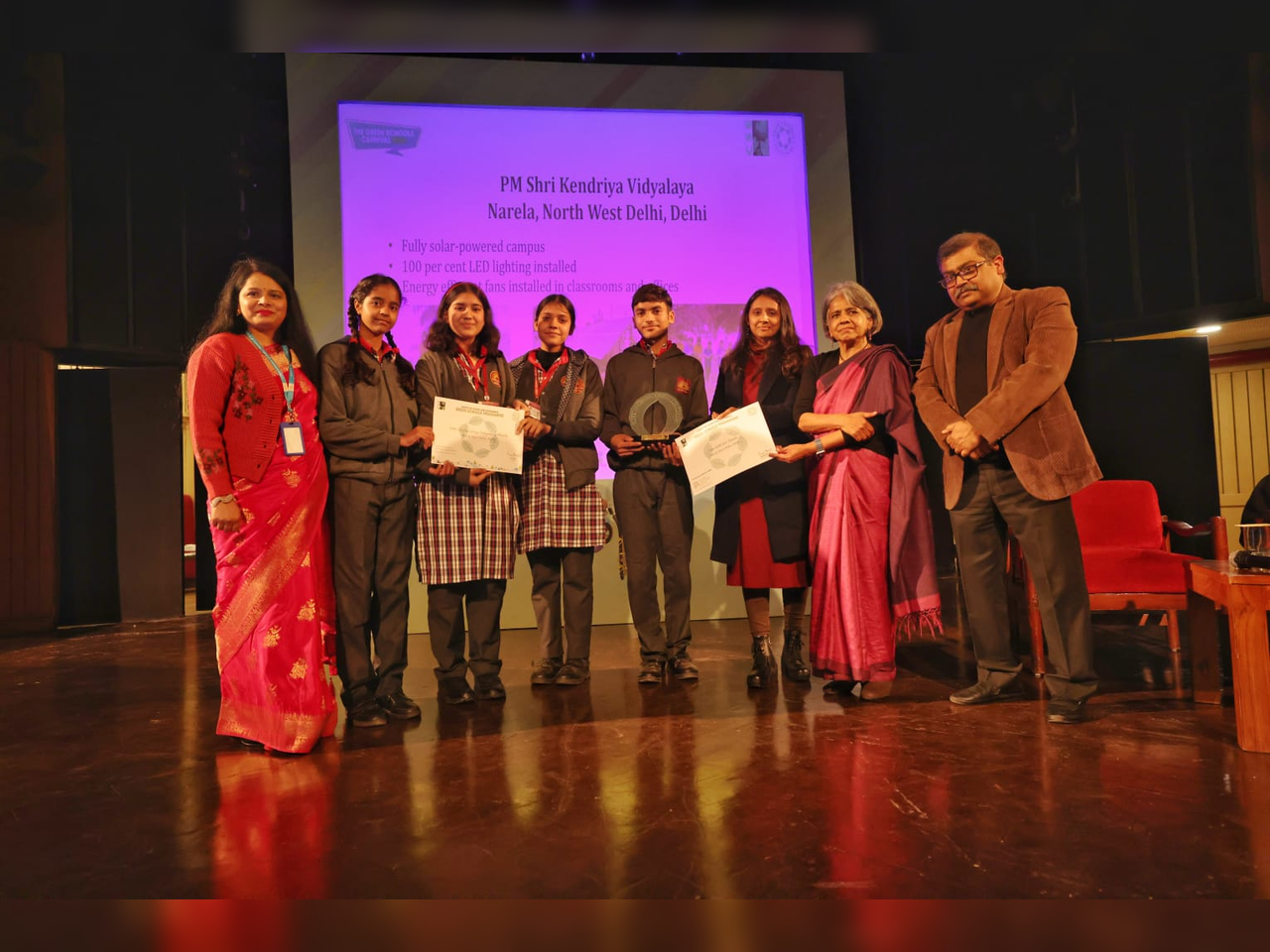
On Friday, the Centre for Science and Environment (CSE), the environmental think tank, has awarded 433 schools for being India’s ‘greenest’ institutions at the Green School Awards 2025–26, recognising their commitment to sustainable campus practices and environmental learning, in a ceremony organised at India habitat Center, Delhi.
The awards are conferred annually under CSE’s Green Schools Programme (GSP), a more than two decade old environmental education initiative, which enables students to conduct a rigorous, on-campus environmental audit of their own schools, as well as measuring the efficacy of resource conservation and green practices in the schools. The schools lead their green journey through self-conducted audits with CSE’s guidance.
“Over the years, many generations of students have gone through the CSE led GSP’s process of learning how to audit their own environmental footprint—to measure it, benchmark it, and then work deliberately to make a difference,” pointed out CSE director general during the award ceremony. “The green school programme allows us to measure the change; which is visible” added Narain.
Several environment and wildlife experts as well as senior government officials were present in the programme.
Pan Indian schools participated, most from rural India
The green school audit during 2025–26 saw participation from 7,407 schools across 28 states and Union territories.
According to CSE, out of the schools that participated, government schools led the way, accounting for 86 per cent of all submissions, followed by private schools at 12 per cent and government-aided schools at 1 per cent. Over 81 per cent of the participating institutions are based in rural areas across India.
“Initiated in 2005, the Green Schools Programme of Centre for Science and Environment has been egging on schools across the country, hand holding them, and inspiring them to look at environment and its conservation through a unique lens — by undertaking a rigorous audit conducted by students and teachers themselves of environmental resources and practices inside each campus. The most interesting thing about this audit is that it allows schools to measure their success rate — how environmentally compliant they are — year on year,” . says Souparno Banerjee, senior director, environment education, CSE
Greenest of them all
Punjab bagged the award for the best state by setting the bar with the highest participation and report submissions with 6,264 schools from the state submitted their audit reports – 237 were rated ‘green’. Hoshiarpur in Punjab bagged the Best District Award with 947 report submissions.
The Changemaker awards went to schools which have improved their sustainability rating to green by monitoring and improving their practices over the year. While Vidya Pratishthan’s New English Medium School, Pune, Maharashtra got the award in the secondary category, the primary category award went to Satya Bharti School, Tungaheri, Ludhiana, Punjab.
Sterling awards went to 5 schools, from Uttar Pradesh, Haryana and Rajasthan, those that have sustained their green rating for 10 consecutive years, i.e., since 2015.
Separate awards were also given to schools for performing well in air, water, land, waste and energy sectors.
Improved performance in transport, energy, ventilation
The green school audit dashboard shows that 56 per cent of the schools use non-polluting modes of transport. Over 34 per cent use energy-efficient lighting, while 73 per cent have well-ventilated classrooms. More than 75 per cent use chemical-free fertilisers, and over 31 per cent practice rainwater harvesting.
“Out of the schools that participated, 6 per cent were rated ‘green’, up from 4 per cent last year, indicating steady improvement in environmental performance,” says CSE report.
The CSE expert pointed out that the green programme helps schools to assess their use of resources and map their consumption and wastage across six key subject areas: air, energy, food, land, water and waste.
“Our analysis finds that sustainability considerations are increasingly being integrated into the everyday operations of these GSP schools.”