
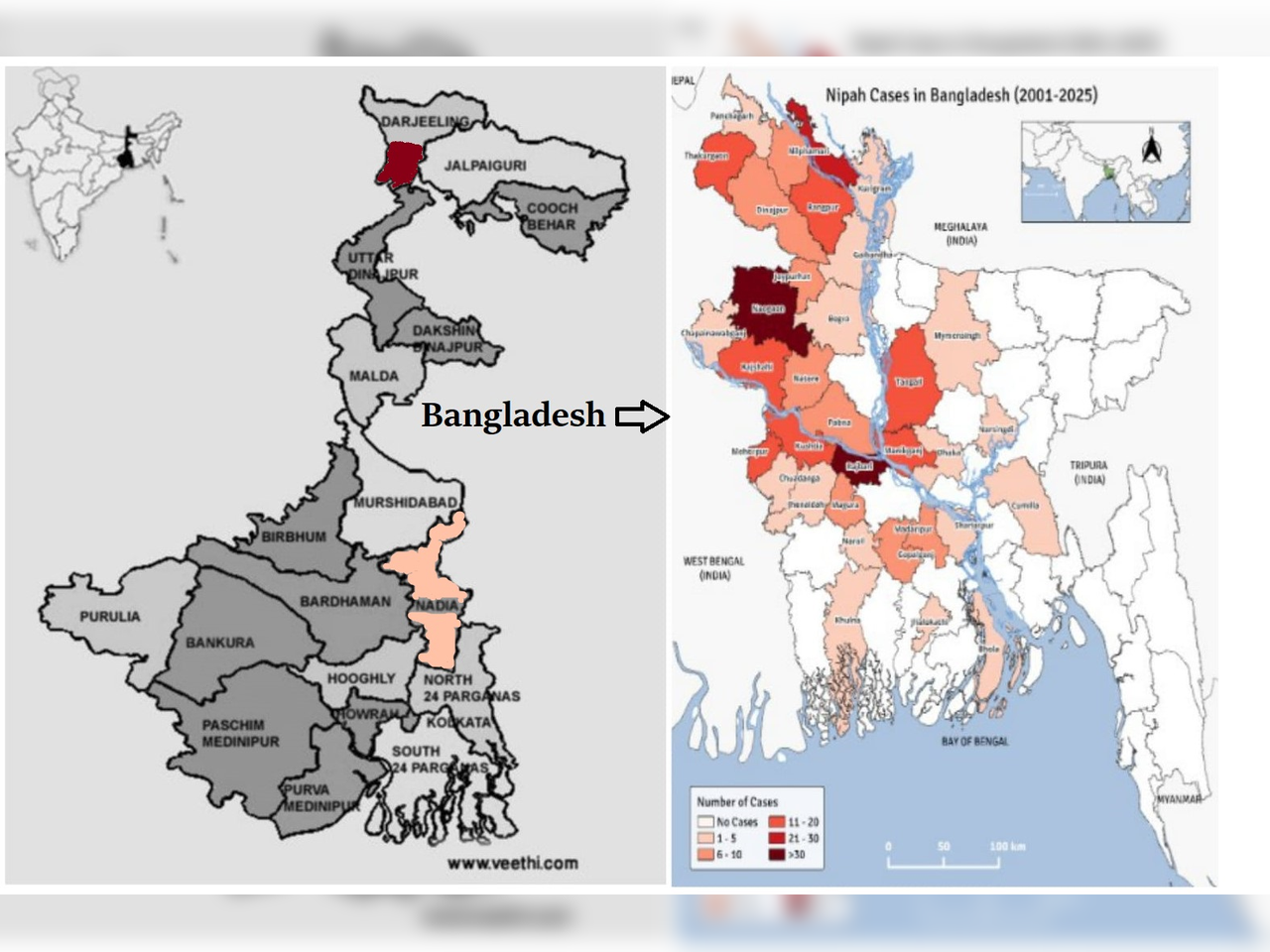

The source of the dreaded Nipah virus, appearing after close to two decades in West Bengal and affecting two nurses so far, is still uncertain with two possible sources emerging after the initial set of investigations.
The first investigation suggested that the infection might have spread from a village in Nadia located within 3km of the Bangladesh border, adjacent to the part of Bangladesh known for low to moderate level of Nipah infections that occurred frequently during the last two decades. One of the two affected nurses had gone to the village to attend a social occasion, and, it is believed, might have contracted the virus through consuming raw date palm sap or some other food during her stay.
However, on Thursday, it also emerged that both the nurses attended to a patient suffering from acute respiratory distress, who later died, and might have been infected from her. No Nipah test, however, was carried out on the patient before her death and hence it is difficult to confirm the possibility.
So far, till Friday afternoon, the infection is limited to two nurses both of whom are in hospital, and according to state health department sources on Thursday, improving marginally, though still not out of risk. The infection has not been found within the contacts of the nurses who have been tested so far for the virus. Overall, close to 150 of their contacts have been traced so far and samples were sent for testing apart. The contacts were home-quarantined.
The samples from the two nurses primarily tested positive for Nipah at AIIMS Kalyani, and were subsequently confirmed at the lab of National Institute of Virology, Pune.
“The state is fully prepared,” said state health secretary N.S. Nigam to The Plurals when asked about combating the Nipah situation in the state. In a rare gesture of unanimity in the face of the political quagmire in the poll-bound state, Union health minister JP Nadda and Bengal chief minister Mamata Banerjee spoke on the development and agreed to act at tandem to combat the virus. So far, the state health department has not circulated any specific advisory about the latest viral spread to the general administration, though guidelines to both government and private hospitals have already been sent on the protocol of handling suspected Nipah patients.
The Nipah virus is considered extremely dangerous for its high fatality rate, which is in the range of 40 to 75 percent. It can lead to severe health conditions, leading to encephalitis or inflammation of the brain. The virus is transmitted from animals, particularly bats, to humans, often through contaminated food or direct contact with infected individuals.
The infection, on either side of Bengal, is frequently spread through bat-contaminated date palm juice, an extremely popular food item in West Bengal and Bangladesh during winter.
Possible sources
According to sources, Ghoghragachi village in Krishnaganj block of Nadia, about 85km north-east to Kolkata, is one of the possible points of origin of the latest infection. A report from AIIMS Kalyani, which first found the samples to be positive, has pointed out the village’s proximity to areas across the border such as Chuadanga and Kushtia in Bangladesh, where Nipah cases are often found.
A Bangladesh report that The Plurals tracked shows that areas close to the India–Bangladesh border adjacent to Ghoghragachi have recorded regular Nipah infections from 2001 to 2025: more than 30 in Rajshahi, 11 to 20 in both Meherpur and Kustia. The Indian village, considered to be the origin of the latest Nipah spread, is hardly 3km away from Bangladesh border and 55 km from Meherpur, 81km from Kustia and 120km from Rajshahi.
“Between January 1, 2025, and August 29, 2025, Bangladesh … notified WHO of four confirmed fatal Nipah virus (NiV) infection cases that occurred at different times from four separate districts across three different divisions (Barisal, Dhaka, and Rajshahi) of Bangladesh,” the World Health Organisation (WHO) website mentions.
Health officials in Kalyani AIIMS have noted that infrared surveillance in these regions has captured fruit bats drinking raw date palm sap, a known risk factor for Nipah transmission. As per the record available, on December 15, one of the nurses from a private hospital in Barasat reportedly attended a family wedding in Ghoghragachi village.
“It is suspected that she might have consumed raw date palm sap during her visit. Experts say fruit bats are particularly attracted to date palm sap during this season and often contaminate it with saliva, urine or faeces while feeding, which can transmit the virus to humans,” said an expert associated with the Kalyani AIIMS study.
However, on Thursday, upon investigation, it was found that both the nurses had attended an elderly woman from Barasat in the northern fringe of Kolkata. The hospital the nurses work at is also located there. The patient was suffering from fever and acute respiratory distress on December 19 -21 and expired on December 22. Enquiry in the deceased woman’s house showed that she was suffering from symptoms like Nipah.
Close monitoring
Chief secretary of West Bengal Nandini Chakraborty on Monday had assured that the cases are being closely monitored. “This virus comes from bats, as you know. So, people must be careful about what bats eat and what humans consume,” she had said, adding that both the affected nurses had also travelled to East Bardhaman, which expanded the scope of contact tracing.
Following the developments, Union health minister Nadda spoke to the Bengal chief minister, requested Centre-state coordination, and assured full support from the Centre. Subsequently an expert team of doctors has flown in from Delhi to assist the state health machinery.
In a video release, Nadda said the Central government firmly stands with the state government and is providing comprehensive technical, logistical and operational support to it for the effective management and prevention of the outbreak. He further added that upon receipt of information, the secretary of health and family welfare held an immediate discussion with the chief secretary and health secretary of the state to review the situation.
On Thursday evening, a senior official of the state health department expressed relief as no new Nipah cases were confirmed since Monday. According to sources, around 150 samples have so far been sent for testing, out of nearly 40 have already been tested with all showing negative results. The list includes 13 who are believed to have come in close contact with the affected nurses. The samples of a nurse and a house staff of Burdwan medical college, who were admitted on Wednesday with Nipah like symptoms, were also found negative.
Not to panic
Experts urged people not to panic, but to remain alert.
“Nipah infection, though having a very high fatality rate, hardly spreads from human to human; and hence normally remains localised. There is no reason to press the panic button,” said Tapan Mukherjee, an advisor to the health department associated with Kolkata Municipal Corporation on Thursday.
“We need to be careful about consuming bat-contaminated food materials, particularly date palm sap, which may trigger the disease,” said Subhrajyoti Bhowmick, a clinical trial specialist and clinical pharmacologist, associated with a private hospital in Kolkata.
“Routine surveillance of Nipah virus in human samples and bat droppings is important to contain the spread,” observed Saumitra Das, a professor at the Department of Microbiology and Cell Biology of the Indian Institute of Science, on Wednesday. Das is also a former director of National Institute of Biomedical Genomics.