
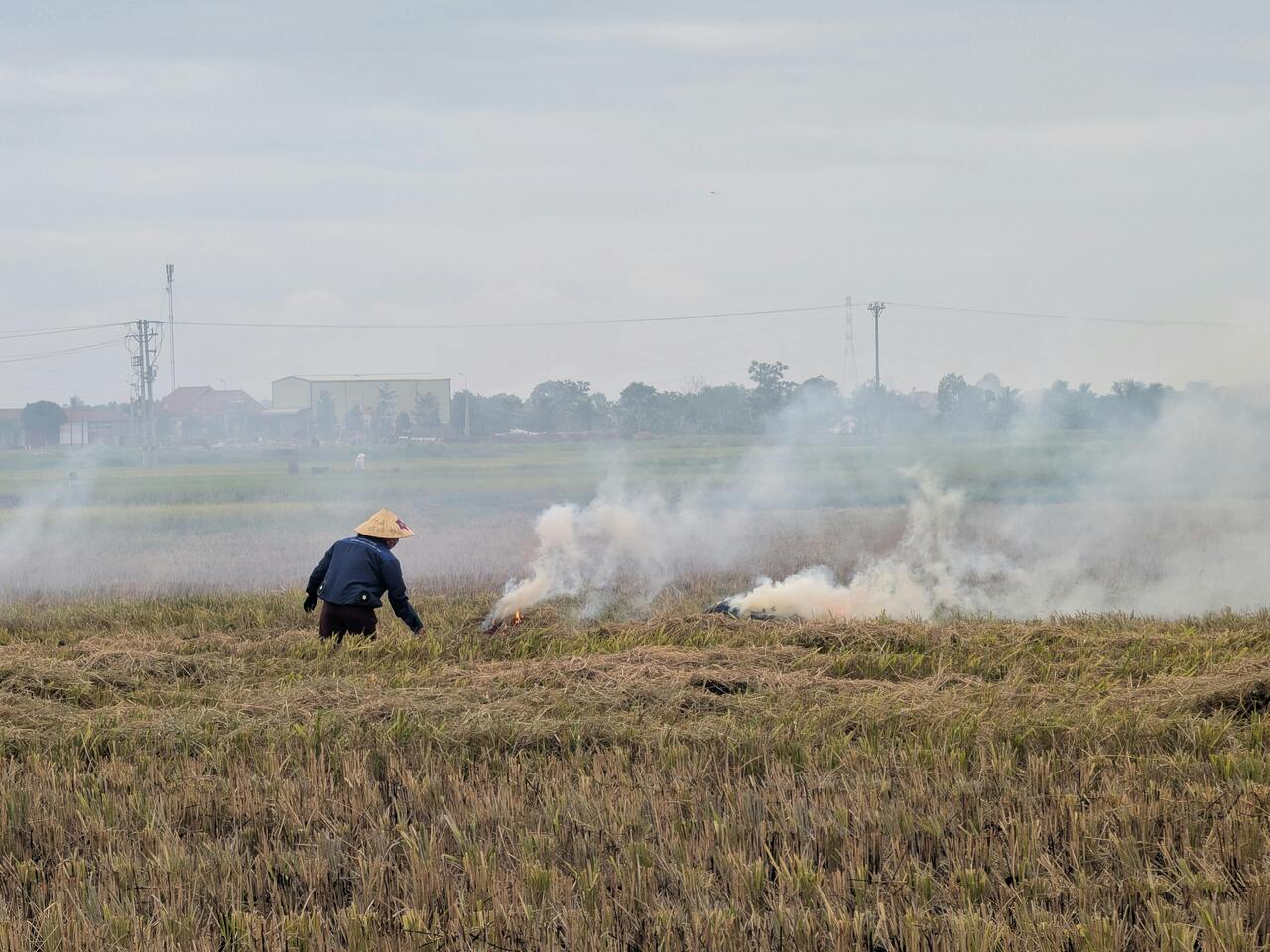
A report released on Monday by an environmental think-tank claims that the sharp reduction claimed recently by the government of India in stubble burning is based on severe undercounting. The finding has put under the scanner the government’s recently flaunted success in controlling crop residue burning around Delhi and adds a new dimension to the ongoing debate about controlling air pollution in Delhi, considered one of the most polluted cities globally.
The ‘Stubble Burning Status Report 2025’, prepared by the International Forum for Environment, Sustainability and Technology (iFOREST), says that while there has been a reduction in stubble burning, the actual decline is much less than the government claimed statistics, which is over 90 per cent in farm fires since 2021.
The lowest number of farm fire counts since 2021 was recorded during the paddy harvesting season this year, says the government statement, released a few days back. “Punjab recorded 5,114 such incidents. This reflects a reduction of 53% over 2024, 86% over 2023, 90% over 2022, and 93% over 2021,” says the union environment ministry statement.
The think-tank analysis finds that the decline the government claimed in Punjab and Haryana, states within the National Capital Region (NCR) can be largely linked to “limitations of the current monitoring system”, which is run by the Consortium for Research on Agroecosystem Monitoring and Modeling from Space (CREAMS) of the Indian Agricultural Research Institute (IARI).
Burning time missed
Released on Monday at a national webinar, the report says that “the CREAMS monitoring protocol — based primarily on polar-orbiting satellites (MODIS/VIIRS) that pass over India between 10:30am and 1:30pm — misses the majority of large farm fires, which now occur later in the afternoon and evening”.
The timing is crucial, as it changes the readings entirely, says the report. It claims to be based on “India’s first-ever multi-satellite, multi-sensor assessment, combining MODIS (Terra and Aqua satellites), VIIRS (Suomi-NPP satellite), Sentinel-2 Multispectral Instrument (MSI) burnt-area mapping, and 15-minute geostationary observations from the Spinning Enhanced Visible and Infrared Imager (SEVIRI) on Meteosat 8 and 9”.
Massive underestimation
“In Punjab, over 90% of large fires in 2024 and 2025 occurred after 3:00pm, compared to just 3% in 2021,” the iFOREST report says. “In Haryana, most large fires have occurred after 3pm since 2019, meaning undercounting has persisted for years,” it added.
Such data gaps weaken the evidence base for air-quality policymaking, the report warns. Stubble burning has been traditionally considered as a major factor in increasing air pollution in the winter in the Delhi-NCR region; the Centre’s claim that it had gone down significantly had raised hopes.
Chandra Bhushan, CEO, iFOREST, said, “Our analysis provides incontrovertible evidence that India’s current stubble-burning monitoring system is structurally misaligned with ground realities. Farmers have shifted burning to the late afternoon, while our monitoring relies on satellites that capture active fires only during a narrow time window—10:30am to 1:30pm.”
Bhushan added: “The result is a massive underestimation of fires, emissions, and their contribution to air pollution in Delhi. We urgently need to overhaul the system.” However, the analysis shows a significant progress in the reduction of stubble burning in Punjab and Haryana.
Burnt area statistics key
Burnt-area satellite mapping shows that in Punjab, burnt area during the Kharif season reduced from 31,447 km² in 2022 to about 20,000 km² in 2025, a 37% reduction. In Haryana, burnt area has come down from 11,633 km² in 2019 to 8,812 km² in 2025 — a 25% reduction,” the release said.
“Burnt area provides a more reliable picture of stubble burning. Our analysis shows that Punjab and Haryana have reduced burnt area by 25–35%, which is good news and indicates that in-situ and ex-situ stubble-management practices are being adopted,” said Bhushan. But this is not the time to become complacent, the expert added. “Even in 2025, close to 30,000 km² of paddy fields were burnt in Punjab and Haryana, making them a major source of air-quality degradation in Delhi-NCR and the wider Indo-Gangetic region.”
“We also need to expand our focus beyond Punjab and Haryana to emerging hotspots in Uttar Pradesh and Madhya Pradesh,” said Ishaan Kochhar, Programme Lead, iFOREST.