
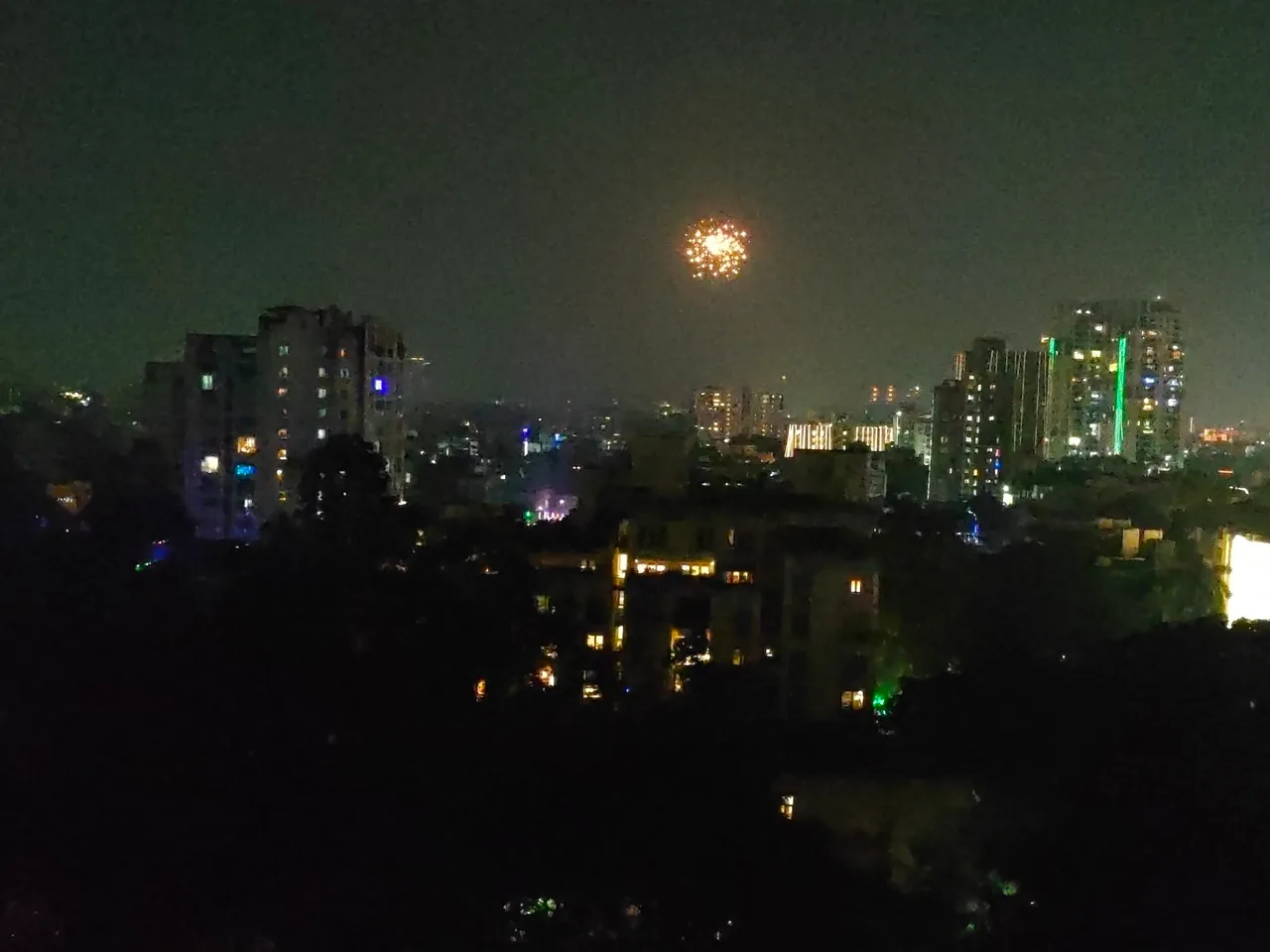

Kolkata, once known as the model city for controlling fireworks menace, witnessed large scale violations even before the Diwali day arrived this year.
Pockets of the city had a blast, especially its southern part, on Sunday evening, more than 24 hours before the Supreme Court fixed deadline sets to roll out from 8 pm on Diwali day for two hours. Incidentally, in context to a hearing, the Kolkata high court had recently also asked state administration to ensure strict compliance of the timeline. State pollution control board admitted that they received few complaints on fireworks on Sunday evening, a testimony of the trend.
“In the state of West Bengal only green crackers can be sold and bursting of such crackers shall be allowed for … two hours during Deepawali festival from 8 pm to 10 pm …” reads the order issued by member secretary of state pollution control board on Oct 18; a copy of which has been forwarded to both city’s police commissioner as well as state’s director general of police.
“Such order was issued just as a response to the court order, but on ground, the police and rest of the administration are hardly active to implement the court directive” alleged Naba Dutta, secretary of state environmental platform Sabuj Mancha.
“Almost all the so-called firework units approved by National Environmental Engineering Research Institute (NEERI), as per its list, got license from district magistrates under political influence in West Bengal and hardly being monitored; which opens up the possibility of violation” claimed a green activist.
Nothing ‘green’ about fireworks
This correspondent has travelled throughout the length and breadth of the city since Saturday, including at government supported Bazi bazars (firework markets) and found a range of violations in the quality of fireworks.
“As per government norms, enjoy fireworks in between 6 am and 10 pm” was found to be printed on a box of fireworks claimed to have been cleared by NEERI, the nodal agency selected by apex court to approve green firework formulation, in complete contrast to apex court and government directive.
“All the fireworks sold here are within the 1403 approved fireworks list shared by NEERI in its website” claimed the organisers of Burrabazar and Talla Park bazi bazars to this correspondent; the two major government supported firework markets in the city having close to 150 stalls together.
Sudipta Bhattacharya, an environmental technocrat who accompanied this correspondent, listed the major violations found in the bazi bazars.
“Hardly 10 percent of fireworks were found to have valid NEERI certificates. While many do not have any QR codes, in many cases either the QR codes are not opening up or showing expired certificates. In some fireworks, the QR codes are directed to either YouTube or any other website”, said Bhattacharya.
The environment expert further pointed out that most fireworks do not have chemical composition written over the packets; and nothing has also been written about the noise level of the fireworks. Incidentally, as per union government norms, no fireworks should cross the 125-decibel noise level while measured 4 meter from the source of blasting.
“Our area has lot of socio economically poor people and they can not afford the costly fireworks of Sivakashi, and generally opted for local varieties which are not cleared by NEERI” admitted a representative of Kalikapur Bazi Bazar when it was pointed out that several of the fireworks being displayed, do not have any company’s name printed on those.
No centre – state coordination
West Bengal Pollution Control Board, who earlier monitored the firework markets alongside NEERI and PESO, complained that the union government agencies have not cooperated this year.
“We tried to undertake joint visits also this year but NEERI and PESO ( Petroleum and Explosives Safety Organisation, an union government body) hardly responded” stated a senior official of WBPCB. NEERI and PESO sources, without wanting to be quoted, cited both lack of personnel and mandate to undertake such monitoring. “We earlier undertook such joint monitoring under court order, and can not repeat unless we receive a specific judicial directive or being asked by our head office,” said the source.
State pollution board also reminded that NEERI has not taken the initiative to test the green fireworks in Bengal despite a state of the earth facility having been created by the state board under mutual agreement that NEERI would start testing here once PCB sets up such infrastructure.
“Both state and union government agencies are responsible for the firework violations in West Bengal. While the illegal fireworks from Sivakashi are flooding the market with union government agencies looking in other direction, state government is also responsible for not enforcing the norms and allowing district magistrates to provide production licenses without virtually any monitoring under political pressure” opined Biswajit Mukherjee, former chief law officer of state PCB.
According to the NEERI list, as accessed, almost 99 percent of around 230 production licenses were provided by district magistrates while only three had been given by PESO, the union government agencies. As per law, district magistrates can provide licenses to units manufacturing not more than 15 kilograms of fireworks at a time.
“It’s a faulty list. According to our estimates around 30 to 40 units, across the state, have received district magistrate licenses” pointed out an environment department .
“The licenses from the state may be shown close to 230 but most fireworks sold in the bazi bazars are from Sivakashi” agreed Subhankar Manna from Talla bazi bazar.