
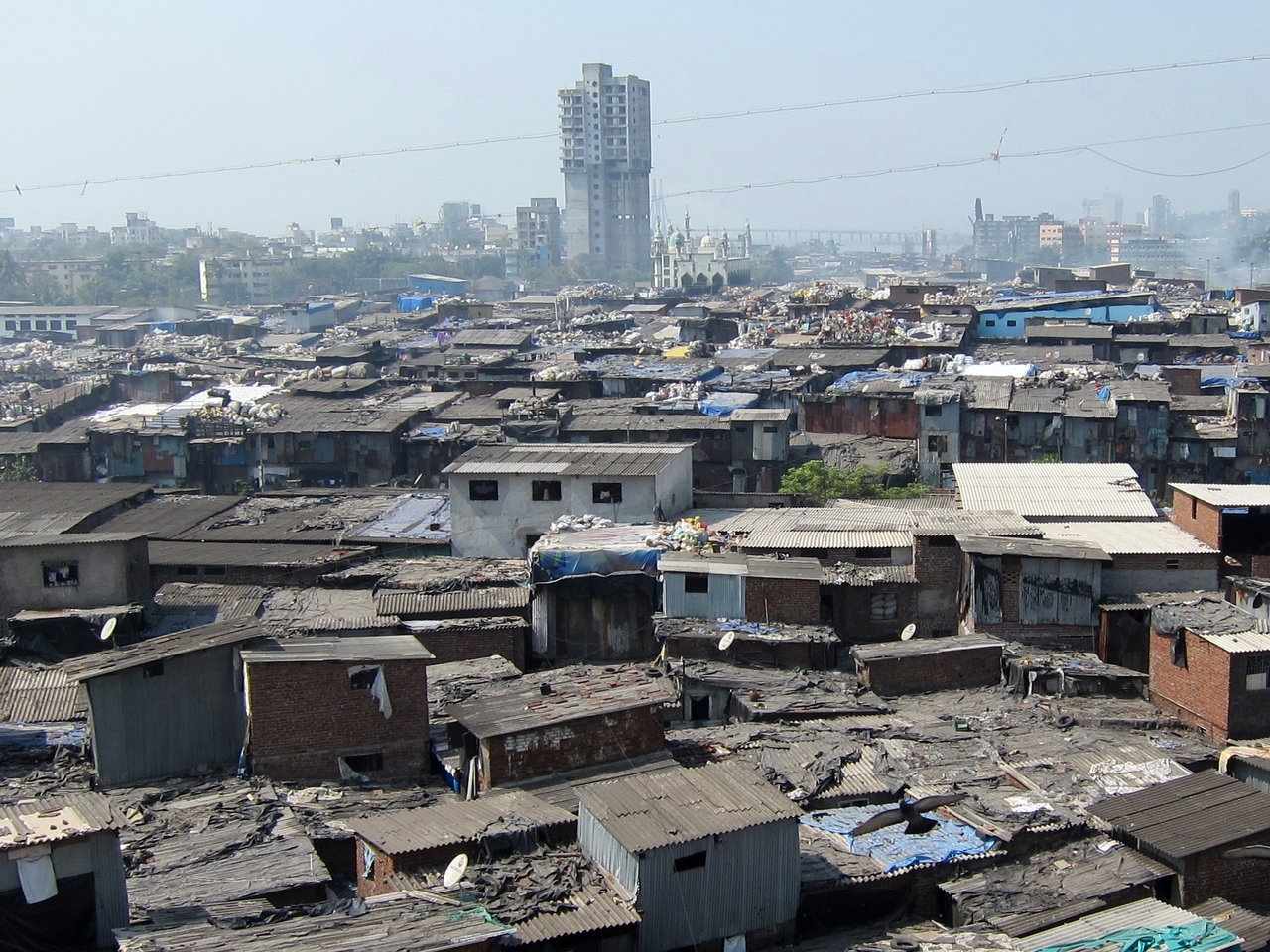
At the time of independence, only 17% of the total population lived in urban areas. The total population in the rural areas was huge and so also the absolute number of people under poverty line. The planners and policy-makers were more concerned with the upliftment of the rural mass. In the urban areas, their main concern was basic infrastructure like water supply and the slums. The latter was considered as an eyesore to the new nation and so removal of slums in the big cities was given priority in the Second Five Year Plan (1956). This slum-centric approach to address the urban poverty has done more damage to the urban poor in India. Such approach did not understand the nature of the urban poverty and also vulnerability of urban poor compared to their rural counterparts.
Poverty versus progress
Persistent poverty anywhere is an antithesis of progress, and more so in urban areas. Urban economy is a monetized economy everywhere even in the developing countries like India. Survival needs a steady flow of income from a stable employment, which is almost impossible in an informality-dominated economy where employment is irregular and uncertain; and the rate of payment is also negotiable varying across many parameters including gender. That forces the urban poor to reside in poor quality housing with unsafe tenure, and very little access basic infrastructure like water supply, sanitation, and drainage.
This makes the inhabitants susceptible not only to diseases and accidents but also to environmental hazards (both natural and manmade). Social fragmentation increases with the incidence of poverty and the poor people are more exposed to crime and violence.
Measuring urban poverty
It will be incorrect to say that the dimension of urban poverty in India has not changed over the years. It is difficult to get estimates of urban poverty and its nature during the last decade. But there was intensive discussion on urban poverty in the 2008-2014 period.
India started to measure poverty with the calorific measure in the late sixties. There were separate indicators not only for rural and urban populace but also for manual and white-collared workers and across gender and age. Later it became essential to differentiate between absolute and relative poverty. Consumption poverty, in terms of food intake only, became an inadequate measure of poverty.
The poverty eradication calls in the seventies (Garibi Hatao as proclaimed by Indira Gandhi in 70s) rightly called for the provision of food, shelter and clothing (Roti, Kaapda aur Makaan). Later the access to social sector like health and education was added to these basic needs and the concept of multidimensional poverty measures grew in importance along with various indices of deprivation.
Urban poverty deeper than rural
In 2010, six key facets of urban poverty were identified as follows: Firstly, urban poverty in India is large and widespread, India’s urban poor constitutes almost one-fifth of total global urban poor. Then, though the head-count ratio of urban poor has fallen over the decade, its rate of decline was lower that its rural counterpart.
It was found that though the poverty gap has fallen to 5.9 ( as compared to 11.9 in 1983) but it continues to be deeper than that of the rural one.The poverty gap is a measure of the depth or intensity of poverty, calculated as the average shortfall of the incomes or consumption of the poor from the poverty line, expressed as a percentage of the poverty line. A higher poverty gap indicates a greater level of deprivation and a greater need for income transfers to lift people out of poverty.
Fourthly, non-wage, informal employment was found to be the dominant characteristic of the urban poor. Fifthly, the decline in urban poverty is uneven across the country. More than 40 percent of the urban poor are concentrated in the BIMARU states (Bihar, Madhya Pradesh, Rajasthan, and Uttar Pradesh) and Odisha. Finally, slum settlements are most visible manifestation of urban poverty in India.
Most city poor are not migrants
The first large survey for estimating poverty was by Dandekar and Rath in late sixties. They declared that urban poverty is a spillover of rural poverty. But after five decades, we are certain that migration contributes only 20% to urban population and recent studies confirm that the ‘poorest of the poor’ do not migrate s they do not have the necessary survival skills in the neo-liberal cities.
The poor people in the urban area are increasing because of lesser opportunities in the formal sector. The dismantling of factories in major cities and the beautification drives are pushing the urban poor to the peripheries and more ecologically vulnerable parts of urban areas; also affecting the environment in the process.
City masterplans ignored poor
Most of the Indian cities from the sixties of the last century depended on Master Plans with functional segregation only. It did not consider the residential and other needs of the economically weaker section. So in most of the cities and even small towns, the poor people have to concentrate inn places with lesser urban amenities or so stay in makeshift jhopries and the multidimensional deprivation index (MDI) gets higher value over the time. Asizeable proportion of the urban population do not have access to safe and adequate drinking water, sanitation and drainage, not to talk of the regular management of their solid waste.
Myopic visions did not help
Since 1956, the government tried to remove slums (and slumdwellers) from the urban areas without understanding the reason behind their growth. When CMDA (the then Calcutta Metropolitan Development Authority) started in-situ development of existing slums in Kolkata, that led to a paradigm change and the Government of India adopted a programme called EIUS (Environmental Improvement of Urban Slums) in 1973. The success of such programmes was short-lived as the slum-dwellers did not have enough fund for the repair and maintenance of the facilities. The concept of livelihood planning and economic upliftment came much later and the recent National Urban Livelihood Mission (NULM) is a step towards that. The Rajiv Awas Yojana of the previous government could not succeed because of its emphasis on land title. Slums on the private land were removed overnight and the landowners were not interested in perpetuation of slum with government help.
Poverty reduced, really?
According to recent NITI Ayog report, India has experienced a significant reduction in multidimensional poverty from 29.17 percent in 2013-14 to 11.28 percent in 2022-23, marking a decrease of 17.89 percent points. Approximately 24.82 crore people have escaped multidimensional poverty in the last nine years (2013-14 to 2022-23). Earlier NITI Aayog (2023) , based on Multidimensional Poverty Index (MPI) estimates, claimed that 13.5 crore people in India moved out of poverty between 2015-16 and 2019-21.
The experts point out that in addition to the indicators used by the United Nations Development Programme (UNDP, 2023) in constructing the Global MPI, the NITI Aayog “Indianised” its MPI by adding two more indicators on bank accounts and maternal health. It is also seen that while the MPI has its advantages, it is designed in such a way that the choice of indicators, their weights, and the cut-off for defining multidimensional poverty are all left to subjective judgement; raising questions on its interpretations. One has to keep in mind that the index is more about deprivation rather than access.
Mahalaya Chatterjee, a professor in Calcutta University, specialises in urban economics, urban planning and gender issues