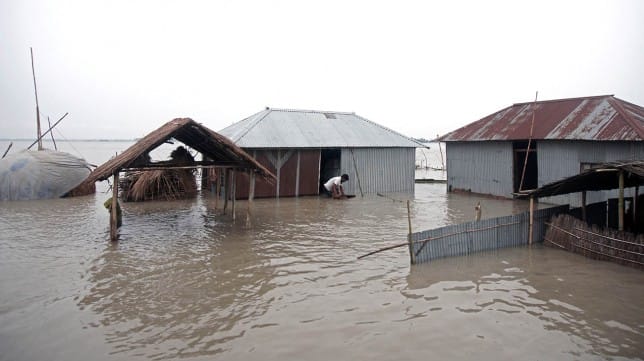
The recently published IPCC assessment report has predicted sharp rise in mercury and high deluge within short duration for most urban locales in Bangladesh.
Analysis of the interactive map provided in the report points out that Bangladesh capital city Dhaka is likely to experience 4.7-degreeCelsius rise by end of century compared to pre-industrial period under worst possible carbon emission scenario.
The analysis also found that the maximum temperature of Dhaka may reach 47.7 degree centigrade by end of the century & the temperature will remain above 35 degree centigrade for 150 days in a year; almost one in every two days.
According to the report more than 90% of the mean temperature rise is expected to happen during the ongoing century vindicating the sharply rising carbon emission impact on global atmosphere.
Other major cities in Bangladesh like Khulna, Sylhet, Jessoreand Chittagong are expected to have the mean temperature rise in the range of 4.4 to 4.8 degree centigrade in between 2080 – 2100 under worst emission scenario, compared to pre-industrial period.
Along with temperature rise, rainfall is also likely to rise significantly, during the current century, particularly rainfall within short duration of time like one day.
Dhaka, which already has inadequate drainage infrastructure to combat heavy downpour within short duration, is expected to have about 51 % higher maximum one day rainfall; with rainfall in a day may cross 110 mm.
Under RCP 4.5, which is the most likely scenario, the mean temperature rise is expected to be in the range of around 2.5 degree celcius, significantly higher than the global benchmark.
CLIMATE CHANGE
NEWS
IPCC Report: sharp heat & rising rainfall to impact Bangladesh cities
The recently published IPCC assessment report has predicted sharp rise in mercury and high deluge within short duration for most urban locales in Bangladesh. Analysis of the interactive map provided in the report points out that Bangladesh capital city Dhaka is likely to experience 4.7-degreeCelsius rise by end of century compared to pre-industrial period under […]