The recently published IPCC assessment report has predicted sharp rise in mercury & high deluge within short duration for most urban locales in Bangladesh.
Analysis of the interactive map provided in the report points out that, Bangladesh capital city Dhaka is likely to experience 4.7-degree Celsius rise by end of the century compared to pre-industrial period under worst possible carbon emission scenario.
The analysis also found that the maximum temperature of Dhaka may reach 47.7 degree Celsius by end of the century & the temperature will remain above 35 degree Centigrade for 150 days; almost one in every two days.
According to the report, more than 90 percent of the temperature rise is expected to happen during the ongoing century vindicating the impact of sharply rising carbon emission in atmosphere.
Other major cities in Bangladesh like Khulna, Sylhet, Jessore&Chattagram are expected to have mean temperature rises in the range of 4.4 to 4.8 degree Centigrade under worst emission scenario in between 2080 – 2100 compared to pre-industrial period.
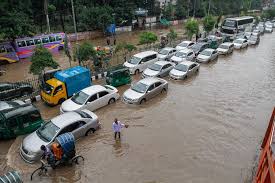
Along with temperature rise, rainfall is also supposed to rise sharply, during the current century, particularly rainfall within short duration of time like one day.
Dhaka, which already has inadequate drainage infrastructure to combat heavy downpour within short duration, is expected to have about 51 percent higher maximum one day rainfall, with rainfall in a day may cross 110 mm.
Under RCP 4.5, which is the most likely scenario, the mean temperature rise is expected to be in the range of around 2.5 degree Celsius, well over than the global benchmark.
“Cities in the South Asia region including Bangladesh are to experience more intense rainfall, and in absence of adequate infrastructure, may face severe water logging in coming years,” said SaleemulHuq, director, International Centre for Climate Change and Development (ICCCAD) in Bangladesh and a lead author of an earlier IPCC report.
Huq added that the frequency of major floods in Ganga basin has now increased at least four times compared to earlier decades.
An analysis by the United States National Aeronautics and Space Administration predicted that several Asian cities located either on or near the coastline would have to withstand significant sea level rise in 2100.
“Low-lying areas near sea level are increasingly at risk and suffering due to the increased flooding, and it will only get worse,” said NASA Administrator Bill Nelson.
According to experts, two-thirds of Bangladesh is less than five meters above sea level; and it’s projected that the country may lose approximately 11 percent of its land, affecting an estimated 15 million people by 2050, with a projected 50 cm rise in sea level.
CLIMATE CHANGE
NEWS
IPCC Report: Dhaka, Khulna, Jessore, Chattagram to face climate emergency
The recently published IPCC assessment report has predicted sharp rise in mercury & high deluge within short duration for most urban locales in Bangladesh. Analysis of the interactive map provided in the report points out that, Bangladesh capital city Dhaka is likely to experience 4.7-degree Celsius rise by end of the century compared to pre-industrial […]