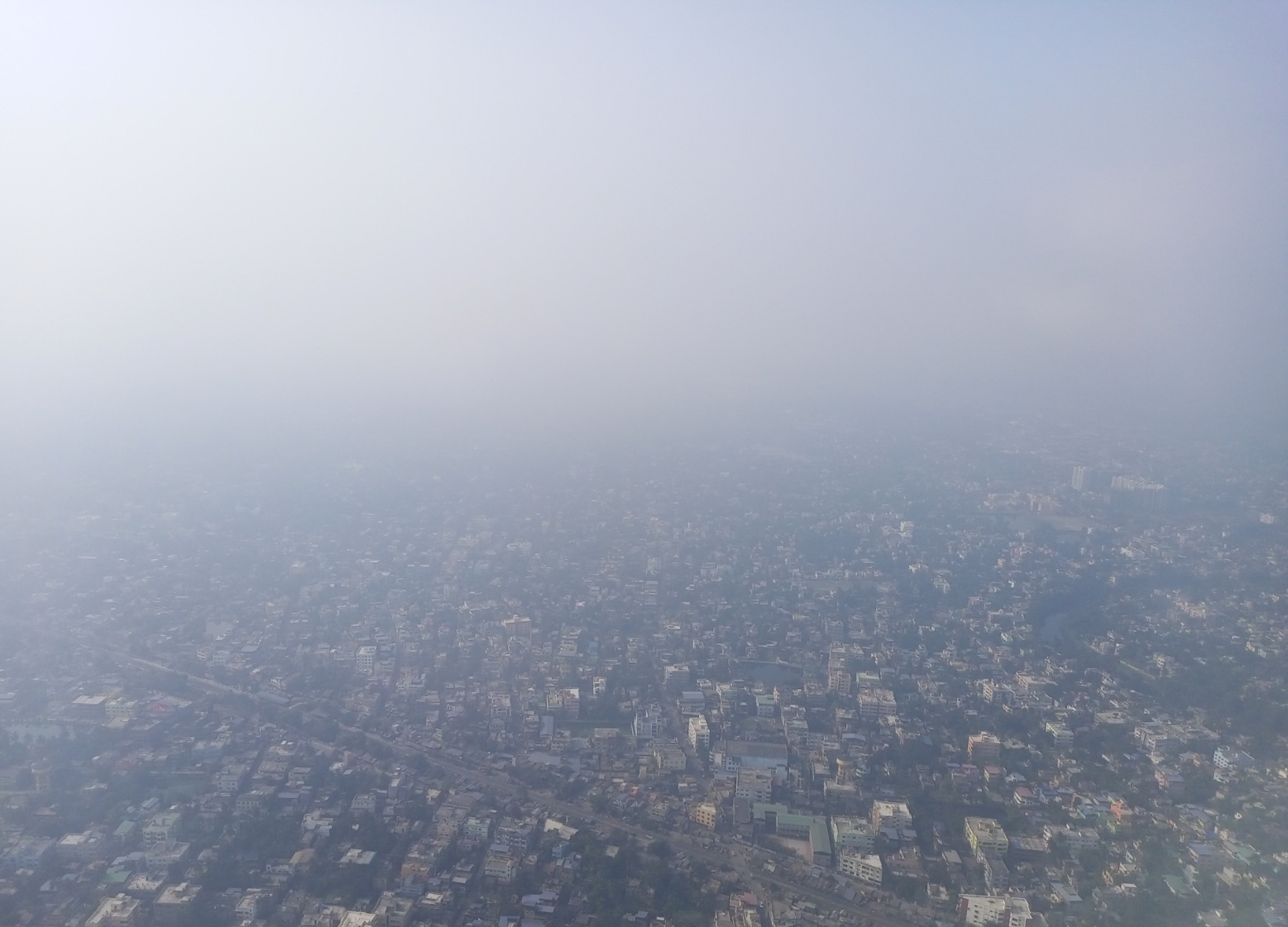
Kolkata has welcomed the New Year with almost unbreathable air.
At 12 am on Saturday night, when hundreds of thousands were ringing in 2023 either on roads or at various open-air destinations, 5 out of 7 automatic air pollution measuring stations in the city recorded ‘very poor’ while one recorded ‘poor’ air quality.
The situation hardly improved over the next day, January 1, with most stations within Kolkata and surrounding, at 6 pm, showing ‘red’ – very poor air quality – followed by few ‘brown’ circles, meaning ‘poor’ quality air. Experts pointed out the coupling of meteorological with anthropogenic factors was responsible for the trend.
According to the union government notification, while ‘very poor’ AQI – the index value ranging from 301 to 400 – can trigger “respiratory illness on prolonged exposure”, ‘poor’ AQI – index value 201 to 300 – is likely to cause “breathing discomfort to most people on prolonged exposure”.
According to central pollution control board data, accessed by The Plurals, at 12 midnight the automatic air pollution measuring station at Rabindra Bharati recorded the poorest air quality in city – 346 – followed by Victoria, Bidhannagar and Ballygunge with air quality index values being 330, 326 and 310 respectively.
The data from air pollution measuring points of the West Bengal pollution control board attested the trend. Red circles, points with ‘very poor’ air quality, were found to dominate city’s pollution picture both at its southern and northern parts at Sunday evening; as measuring points ranging from Paribesh Bhaban, the headquarters of state pollution control board, Administrative Training Institute and Karunamoyee crossing at Salt Lake; Victoria Memorial; Rabindra Bharati; Ballygunge Science College; Lady Brabourne College at Park Circus; Presidency University at College Street were found to have ‘very poor’ air quality.
“We find that the surge of the ultrafine PM 2.5, the most toxic pollutant, is the main trigger of such high AQI but even PM 10 pollutant level was quite high. Interestingly the PM 2.5 and PM 10 pollution levels were around three to 5 times higher than the permissible limits even at the head office of state pollution control board” stated an environment expert.
“The day time temperature has decreased by around 1.5 degree on January 1 compared to December 31, there was cloud cover as well. Moreover, in absence of north westerly wind, the wind movement was slow”, explained G K Das, head of Alipore IMD. All these factors contribute to maximising pollution levels.
“This surge of pollution is due to a combination of both metrological and anthropogenic factors. Due to an increase in chill, the inversion phenomenon has become pronounced and the pollution has come closer to the ground. Moreover, due to festivities surrounding the New Year celebration, there have been huge footfalls and leapfrog in the number of vehicles on road which are hardly having a smooth run leading to release of more pollutants in the air” explained Abhijit Chatterjee, an air pollution scientist from Bose Institute.
Chatterjee, an advisor of the national clean air programme (NCAP), informed that the boundary layer of pollutants was very low, around 600 meters, from December 31 night till close to noon on January 1 leading to the accumulation of the pollutants close to the surface.
ENVIRONMENT
NEWS
Kolkata rings in New Year with toxic air
Kolkata has welcomed the New Year with almost unbreathable air. At 12 am on Saturday night, when hundreds of thousands were ringing in 2023 either on roads or at various open-air destinations, 5 out of 7 automatic air pollution measuring stations in the city recorded ‘very poor’ while one recorded ‘poor’ air quality. The situation […]