
The 22nd of September 2025 was meant to be a day of celebration. It was my husband Sanjit’s birthday, and his school friend, Jayanta and his wife Sujata, had invited us to what every Kolkatan dreams of during Durga Puja — an all-night sneak peak at some of the city’s finest pandals. We left home around 8.30pm, beginning our adventure at Tala Park before weaving through the brilliantly-lit streets of a city immersed in festivity.
The crowds were cheerful, the lights dazzling, and the air carried the unmistakable magic of Puja. But somewhere in the distance, dark clouds had begun to gather. As we moved from one pandal to another, we sensed that rain was imminent. None of us, however, imagined that within a few hours Kolkata would be brought to its knees.
After visiting a few more pandals, the downpour notwithstanding, we decided to stop at Jayanta’s apartment around 2.30am for the ultimate rejuvenation…some late night tea. They live on the 10th floor of a high-rise. Barely had we settled down when the heavens opened with fuller might. What followed was not an ordinary shower but a relentless cloudburst that seemed determined to overwhelm the city.
Power-less night
Soon the lights went out. The meter room and generator area had been flooded, we were told, leaving the building without power or backup. The lifts stopped functioning. Fans fell silent. Mobile phones slowly ran out of charge. Sleep became impossible as we listened to the pounding rain and wondered what dawn would reveal. As the rain eased slightly Jayanta’s wife Sujata moved tirelessly around the darkened apartment, offering water, snacks and reassurance, her warmth and hospitality providing a small but meaningful comfort amid the uncertainty. In the morning, we decided to venture downstairs. Ten flights of stairs later, reality struck with full force.
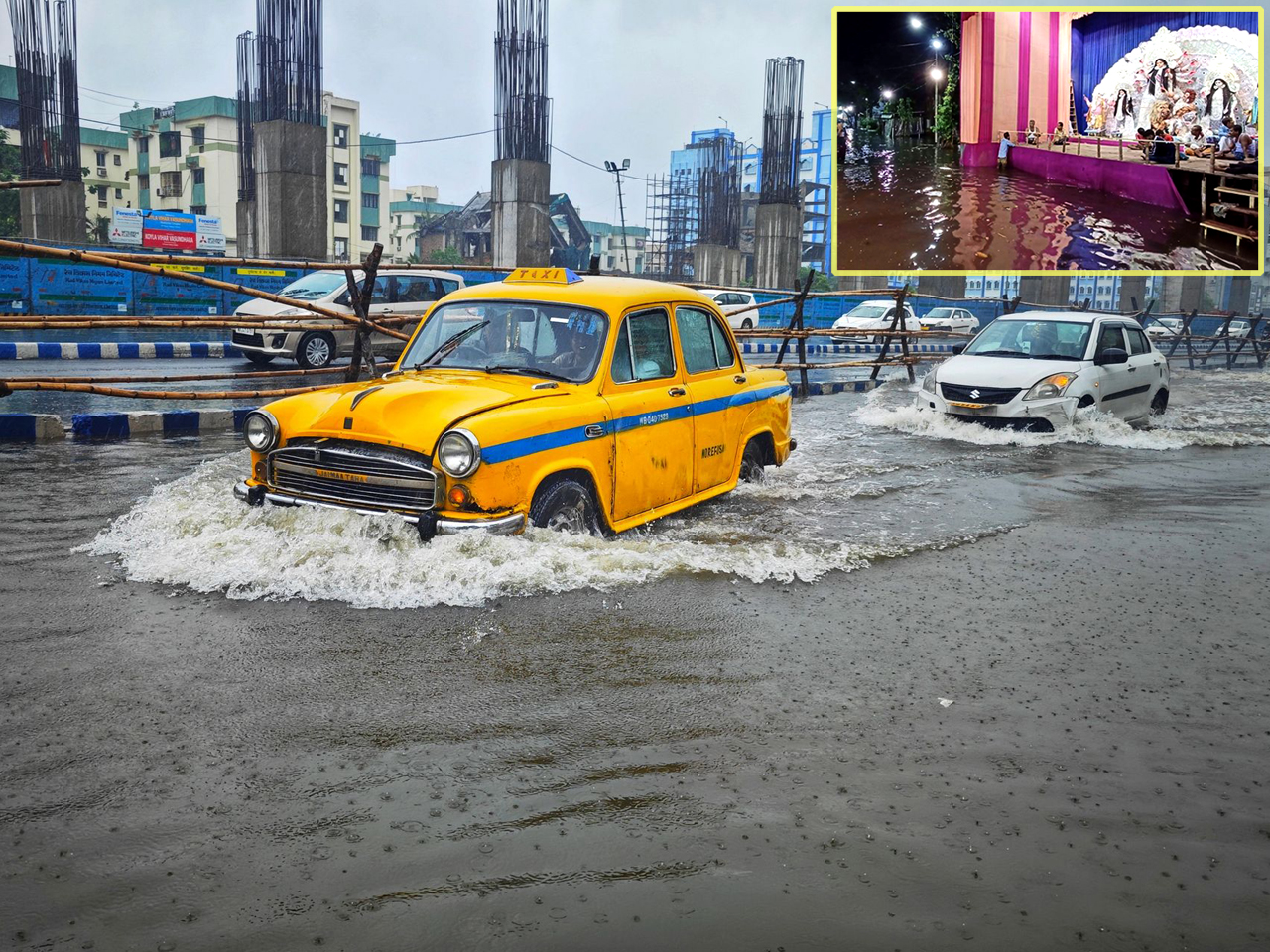
Our car was partially submerged. Ballygunge Circular Road had disappeared beneath a vast sheet of water that resembled a lake rather than one of Kolkata’s busiest thoroughfares. Expensive vehicles — including a Rolls-Royce and an MG — stood marooned alongside modest cars, all equally helpless before nature’s fury. In those moments, wealth, status and luxury meant very little.
Roads turned rivers
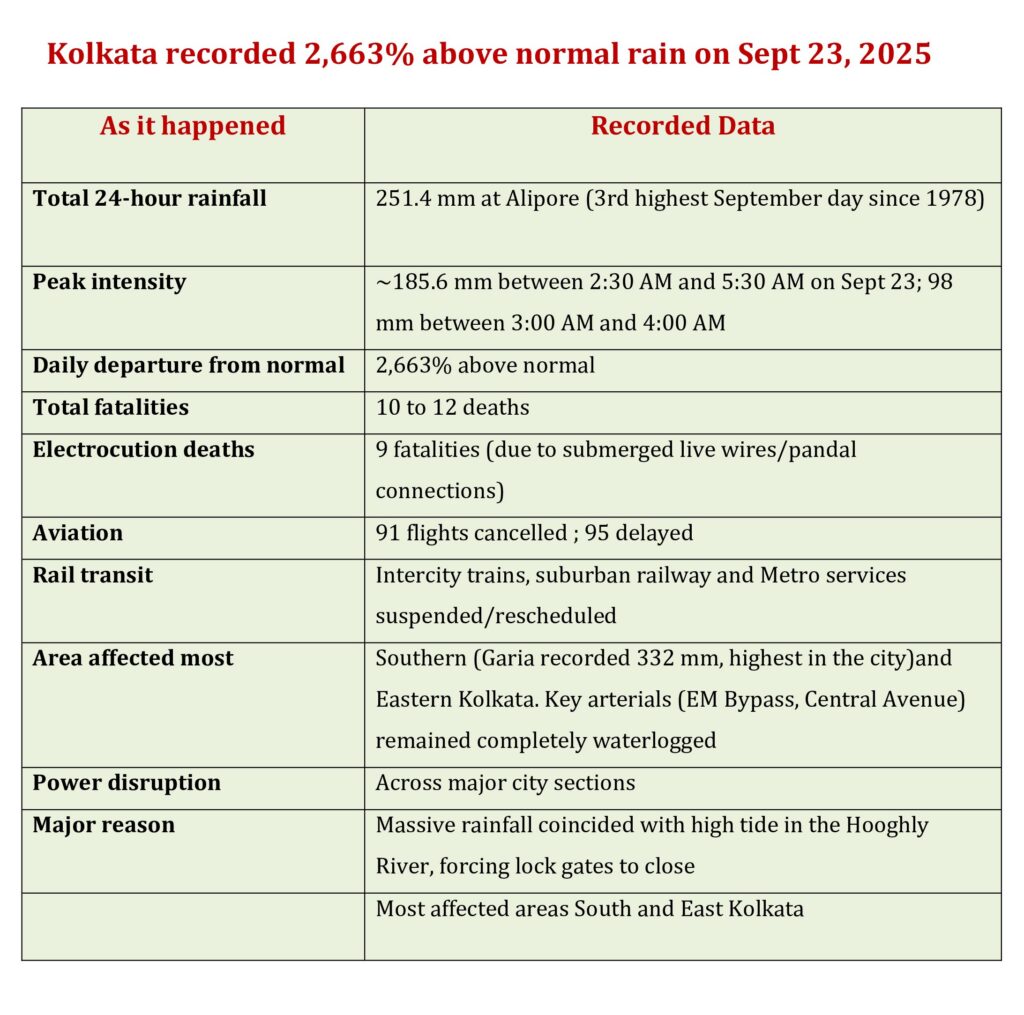
Walking was too dangerous. Reports of electrocution had already begun circulating, making every flooded street a potential death trap, Incidentally India Meteorological Department (IMD) reported that the city had 98 mm rainfall between 3 to 4 am on 23 September,2025; barely missing the ‘cloudburst’ category as it needs 100 mm rainfall in an hour to qualify for the tag; but no less devastating in terms of impact, i guess. We tried to leave Saptaparni from all directions, hoping to find a way out, but every route had vanished under water. Left with no alternative, we climbed all 10 flights back to the apartment!
The next 24 hours became an exercise in patience and endurance. No electricity. No lifts. No certainty of when we could return home. It was only the following morning, after the waters had receded enough, that we were able to retrieve our car from higher ground near Saptaparni and finally begin our journey back to our Behala home — we heard that the water had also receded there — after over 30 hours being kept captive by flooding in one of the most affluent areas of the city.
The drive home was haunting. Roads had become rivers. Fallen trees lay scattered across neighbourhoods. Stranded vehicles stood abandoned like silent witnesses to the night’s devastation. It was difficult to believe that this was the same vibrant city that had celebrated Durga Puja with such splendour only some 40 hours earlier. Headlines had informed that at least nine persons had died, mostly due to electrocution.
Disaster is an equaliser
The experience revealed how differently — but with equal severity — natural disasters affect people. For the common citizen, flooded homes, disrupted transport, contaminated water, loss of livelihood and the constant fear of electrocution become immediate realities. For those living in high-rises, dependence on electricity creates another kind of vulnerability. Without power, lifts stop, water pumps fail, generators become unusable if basements are flooded, communication becomes difficult, and the elderly, children and those with medical needs can find themselves effectively stranded.
However, residents of high-rises are spared from water invading their homes. People living close to the ground, including in slums, do not have that respite. For the record, every one out of three people among the nearly 5 million residents of the city, live in slums.
As climate change makes extreme weather events more frequent and intense, such experiences can no longer be dismissed as aberrations. They are warnings; just a trailer.
Climate should be a priority in city plans
Urban administration must now prepare for a future where cloudbursts and flash floods are increasingly likely. Stormwater drainage systems need urgent modernisation. Critical electrical infrastructure — including transformer rooms and generator facilities — must be protected from flooding. Residential complexes should have well-rehearsed emergency plans, while civic authorities need robust early warning systems, rapid dewatering equipment, reliable communication networks and coordinated disaster response mechanisms. Infrastructure planning can no longer rely on yesterday’s weather patterns; it must anticipate tomorrow’s extremes and include the worst-possible scenario of most vulnerable as the benchmark of future planning.
That birthday will forever remain etched in our memories — not for the pandals we visited, but for the lesson the city taught us. Amid darkness, uncertainty and rising waters, we witnessed both the overwhelming force of nature and the remarkable resilience of ordinary people. Kolkata endured that night, as it always does. But resilience alone cannot be our future strategy, as sooner or later the risk will overwhelm the resilience. The city deserves preparedness, foresight and infrastructure strong enough to withstand the challenges that a changing climate is already bringing to our doorstep.
It may invade our entire homes tomorrow.